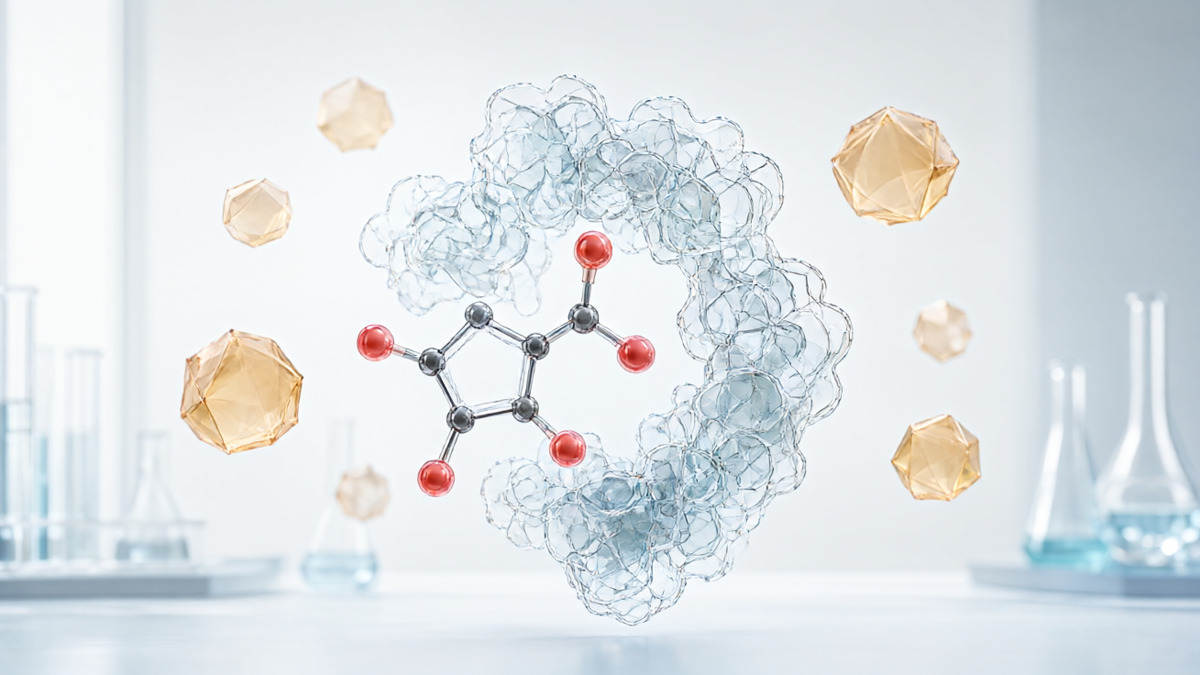
Decoupling Tyrosinase Kinetics via L-Ascorbate Redox Cycling
The biochemical efficacy of L-ascorbic acid (VitC) in melanogenesis relies on its ability to reverse the oxidation of tyrosinase-bound dopaquinone, converting it back to tyrosine. This redox cycling effectively halts melanin synthesis at the enzyme level. However, this benefit is kinetically fragile; ascorbate must be present in high enough concentrations to outcompete the natural auto-oxidation of the enzyme intermediate. If the concentration drops below critical thresholds, the dopaquinone re-oxidizes, leading to pigment formation despite the active ingredient’s presence.
Unlike newer precursors such as Ascorbyl Glucoside, which rely on enzymatic hydrolysis to release the active moiety, L-ascorbic acid acts directly. This direct action requires immediate dissolution and penetration. Formulators must recognize that while Ascorbyl Glucoside offers superior shelf stability, L-ascorbic acid provides superior immediate clinical impact, provided the formulation matrix can protect the molecule from premature environmental degradation before it reaches the melanocyte.
Optimal pH Windows for Receptor Complementarity & Penetration
To maximize transdermal flux of L-ascorbic acid, the formulation pH must be maintained below 3.5. This acidic environment ensures the molecule remains in its un-ionized state, facilitating passive diffusion across the stratum corneum. However, this pH requirement creates a tension with skin compatibility, as prolonged exposure to highly acidic pH can disrupt the epidermal barrier. The following matrix outlines the synergistic requirements for stabilizing this potent antioxidant:
| Active Ingredient | Biochemical Target | Clinical Concentration (%) | Optimal Formulation pH | Synergistic Advantage |
|---|---|---|---|---|
| L-Ascorbic Acid | Tyrosinase | 10-20 | 2.5 – 3.5 | Direct melanin inhibition |
| Vitamin E (Tocopherol) | Free Radicals | 1-5 | 5.0 – 6.0 | Regenerates Ascorbate |
| Phytic Acid | Oxidative Stress | 0.5-1 | 3.0 – 5.0 | Chelates Metals |
The synergy between Vitamin C and Vitamin E is critical. Ascorbate sacrifices electrons to neutralize free radicals, becoming a radical itself. Tocopherol then donates electrons to regenerate Ascorbate, creating a protective cycle. Without this regeneration, Ascorbate depletes rapidly, losing its protective efficacy. Formulators must balance the concentration of these two actives to ensure long-term protection without compromising the pH required for penetration.
Additionally, the presence of Phytic Acid is essential to chelate trace metals like iron and copper, which otherwise catalyze the degradation of Ascorbate via Fenton-like reactions. This multi-layered defense strategy ensures that the active ingredient remains bioavailable until it reaches the target melanocytes.
Preventing Photolytic Degradation & Colloidal Phase Integrity
Photolytic degradation is the primary enemy of L-ascorbic acid formulations. When exposed to UV light, Ascorbate undergoes rapid oxidation, leading to browning and loss of potency. To mitigate this, formulators must employ opaque packaging or incorporate UV filters that absorb the specific wavelengths responsible for Ascorate degradation. Furthermore, the addition of antioxidants like Ethylhexyl Methoxycarbinate can provide an additional layer of protection against light-induced oxidation.
Maintaining colloidal phase integrity is equally challenging. L-Ascorbic acid is highly water-soluble, meaning it requires a low-pH aqueous vehicle. This can lead to instability if the formulation lacks proper emulsifiers or stabilizers. The use of small-molecule surfactants can help maintain the dispersion of the active ingredient, preventing precipitation and ensuring uniform application. Formulators must monitor viscosity and pH changes over time to detect early signs of phase separation.
Bench-Scale Compounding Sequence & Clinical Tolerance Protocols
The compounding sequence is critical to prevent premature oxidation. First, prepare the water phase at 40°C and dissolve the L-ascorbic acid. Second, prepare the oil phase with Tocopherol. Third, combine the phases under low shear mixing to avoid introducing air bubbles, which accelerate oxidation. Finally, add Phytic Acid at the end of the process to chelate any remaining metals. The entire process should be conducted under nitrogen or argon to minimize oxygen exposure.
For clinical tolerance, patch testing is recommended. Apply a small amount of the formulation to the inner forearm for 24 hours. Monitor for signs of irritation, such as redness or itching. If irritation occurs, reduce the concentration of L-ascorbic acid or increase the pH slightly to improve skin compatibility. Patients should be advised to apply the product in the morning, followed by a broad-spectrum sunscreen, to maximize protection and minimize degradation.
Interested in Formulation Data Collaboration?
Let's discuss how Melasyl AI can accelerate your next whitening or brightening formula. Technical collaboration, data licensing, or custom AI-driven research — reach out.
Contact Wei