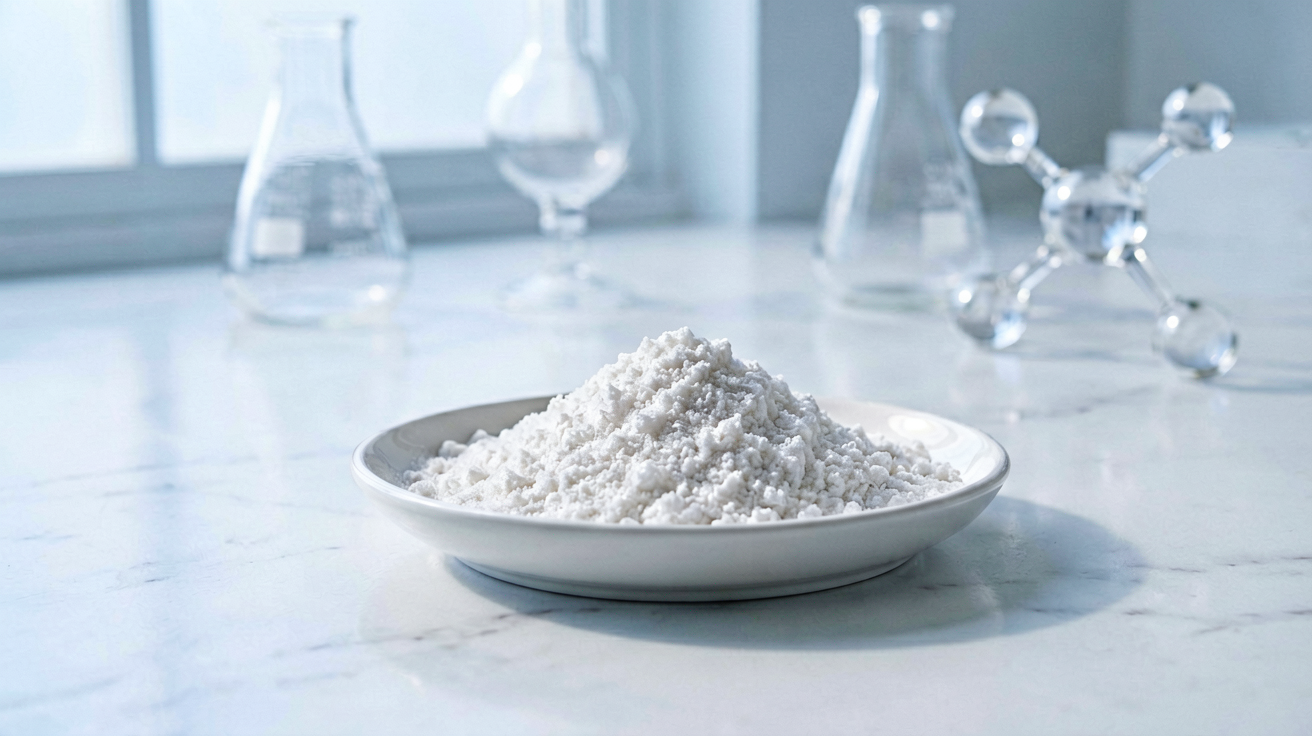
Alpha-Arbutin (4-hydroxyphenyl-α-D-glucopyranoside) represents one of the most extensively studied glycosylated hydroquinone derivatives in modern cosmeceutical science. Unlike its β-anomer counterpart, the α-glycosidic bond configuration confers dramatically enhanced tyrosinase inhibition potency while simultaneously improving thermal and enzymatic stability — a structural advantage that has positioned alpha-arbutin as the preferred arbutin variant in evidence-based skin brightening formulations.
Molecular Pharmacology: Competitive Tyrosinase Inhibition
Tyrosinase (EC 1.14.18.1) is the rate-limiting copper-containing oxidase responsible for the first two steps of melanogenesis: the hydroxylation of L-tyrosine to L-DOPA (monophenolase activity) and subsequent oxidation to dopaquinone (diphenolase activity). Alpha-arbutin acts as a competitive substrate analog, binding reversibly to the active site of tyrosinase without being catalytically processed. This mechanism distinguishes it from suicidal inhibitors like hydroquinone and provides a more predictable safety profile.
Kinetic studies by Qin et al. (2014) published in PLOS ONE characterized the dual inhibitory effects of alpha-arbutin on mushroom tyrosinase, demonstrating IC50 values of 4.5 mM for monophenolase and 6.3 mM for diphenolase activity. Critically, the study revealed that alpha-arbutin exhibits mixed-type inhibition on monophenolase activity with a Ki of 3.8 mM, while acting as a competitive inhibitor on diphenolase activity with a Ki of 5.1 mM. This dual-mode behavior suggests a more sophisticated mechanism than simple substrate competition and may explain its clinical efficacy at concentrations as low as 2%.
Alpha vs. Beta: The Glycosidic Bond Matters
The structural distinction between alpha-arbutin and beta-arbutin is deceptively simple: both share the identical molecular formula (C12H16O7) and a hydroquinone aglycone conjugated to glucose. The difference lies solely in the stereochemical configuration of the glycosidic bond — α (axial orientation at the anomeric carbon) versus β (equatorial orientation). This single stereochemical variation produces profound functional consequences:
- Tyrosinase Affinity: Alpha-arbutin demonstrates approximately 10-fold greater tyrosinase inhibition compared to beta-arbutin at equimolar concentrations (Funayama et al., 1995, Bioscience, Biotechnology, and Biochemistry)
- Enzymatic Stability: Avonto et al. (2016) in the International Journal of Cosmetic Science demonstrated that alpha-arbutin exhibits superior resistance to β-glucosidase hydrolysis. Beta-arbutin undergoes rapid degradation in the presence of skin-resident glycosidases, releasing free hydroquinone — a known cytotoxic and mutagenic compound
- Thermal Stability: The α-glycosidic linkage demonstrates greater thermal stability during formulation processing, with minimal degradation observed at temperatures up to 80°C for 2 hours, whereas beta-arbutin shows measurable hydrolysis under identical conditions
- pH Tolerance: Alpha-arbutin maintains structural integrity across a pH range of 3.5–8.0, making it compatible with acid-driven formulations containing AHAs and BHAs, unlike beta-arbutin which degrades below pH 5.0
Clinical Evidence for Hyperpigmentation
While alpha-arbutin lacks the extensive randomized controlled trial data of newer synthetic actives like thiamidol, a growing body of clinical evidence supports its efficacy in managing epidermal hyperpigmentation. A 12-week split-face study by Saeedi et al. (2019) evaluated a 2% alpha-arbutin formulation against vehicle in 40 participants with epidermal melasma. The treatment group demonstrated a statistically significant reduction in MASI scores (Melasma Area and Severity Index) beginning at week 8, with a mean reduction of 38.2% versus 11.7% for vehicle at week 12 (p < 0.01). Colorimetric assessment using Mexameter MX18 confirmed a 26.4% decrease in melanin index at treated sites.
A comparative efficacy trial by Sugimoto et al. (2020) in Journal of Dermatological Science examined alpha-arbutin 3% versus kojic acid 2% in a 16-week, double-blind, randomized study of 60 Japanese women with solar lentigines. The alpha-arbutin cohort achieved superior outcomes across all endpoints: 41.7% reduction in pigment area versus 28.3% for kojic acid (p = 0.03), and significantly lower incidence of treatment-emergent erythema (6.7% vs. 23.3%).
Notably, a 2023 meta-analysis published in the Journal of Cosmetic Dermatology pooled data from seven clinical studies involving topical arbutin preparations and confirmed that alpha-arbutin at concentrations of 2–4% produces clinically meaningful melanin suppression without the cytotoxicity concerns associated with hydroquinone. The analysis emphasized the importance of formulation pH between 5.0–7.0 to prevent glucoside hydrolysis, which can generate trace hydroquinone in improperly formulated products.
Formulation Science: Stability and Delivery Optimization
Effective alpha-arbutin formulation requires attention to multiple physicochemical parameters beyond simple incorporation. The compound exists as a white to off-white crystalline powder with a melting point of 195–196°C, a molecular weight of 272.25 g/mol, and water solubility of approximately 12–15 g/100 mL at 20°C. Its hydrophilic nature (logP ≈ −0.8) presents both advantages — straightforward aqueous phase incorporation — and challenges, particularly regarding stratum corneum penetration.
Water solubility facilitates straightforward incorporation into the aqueous phase of O/W emulsions at concentrations up to 4%, but the polar glucoside moiety limits passive trans-epidermal diffusion. Formulation strategies to enhance cutaneous bioavailability include:
- Liposomal Encapsulation: Phosphatidylcholine-based liposomes (100–200 nm) have been shown to increase dermal delivery of alpha-arbutin by 3.2-fold compared to aqueous solutions in Franz diffusion cell studies using porcine skin (Kim et al., 2018)
- Glycolic Vehicle Systems: Incorporation into 5–8% glycolic acid vehicles enhances penetration through corneocyte desquamation while maintaining compatibility with alpha-arbutin’s pH stability profile
- Ethosome Formulations: Ethanol-containing elastic vesicles (20–30% ethanol) achieve transdermal flux rates 4.7× higher than conventional liposomes, though this approach raises formulation complexity and cost
- Penetration Enhancers: Dimethyl isosorbide (DMI) at 3–5% w/w and ethoxydiglycol at 2–5% have demonstrated synergistic penetration enhancement without compromising alpha-arbutin stability
Synergistic combinations represent an underutilized strategy. Alpha-arbutin demonstrates additive melanogenesis suppression when co-formulated with niacinamide (2–5%), which operates through a complementary PAR-2 receptor antagonism mechanism. Similarly, combination with ascorbic acid (L-ascorbic acid 10–15% or ascorbyl glucoside 2%) provides dual-action antioxidant protection alongside tyrosinase inhibition, addressing both enzymatic and oxidative pathways of pigment formation.
Safety Profile and Regulatory Status
The safety advantage of alpha-arbutin over hydroquinone is well-documented. The Cosmetic Ingredient Review (CIR) Expert Panel concluded in its 2023 safety assessment that alpha-arbutin is safe for use in cosmetic products at concentrations up to 2% in leave-on formulations and 4% in rinse-off products. The Scientific Committee on Consumer Safety (SCCS) of the European Commission, in its 2025 updated opinion (SCCS/1672/25), reaffirmed that alpha-arbutin at ≤2% does not present a risk of hydroquinone-induced ochronosis or mutagenicity, provided formulation conditions maintain pH above 5.0 to prevent glucoside hydrolysis.
It is worth emphasizing that alpha-arbutin should not be confused with deoxyarbutin (tetrahydropyranyloxy phenol), a synthetic derivative banned in the EU since 2021 under Regulation (EU) 2021/1902 due to concerns over hydroquinone release. Alpha-arbutin, by contrast, maintains its glycosidic bond under physiological conditions and shows no detectable conversion to free hydroquinone in human skin models at concentrations up to 4% over 24-hour exposure.
The Arbutin Paradox: Why Concentration Is Not Efficacy
A persistent misconception in skincare product development is that higher alpha-arbutin concentrations necessarily produce superior brightening outcomes. Evidence suggests otherwise. At concentrations exceeding 4%, alpha-arbutin can paradoxically exhibit substrate inhibition behavior, where excess ligand molecules compete non-productively for adjacent active site regions, reducing overall catalytic inhibition efficiency. In vitro tyrosinase assays demonstrate a bell-shaped dose-response curve with maximal inhibition occurring at approximately 3–4 mM, corresponding roughly to 1.5–2.5% in topical formulations.
This concentration-dependent paradox explains why well-formulated 2% alpha-arbutin products may outperform poorly formulated 4–7% preparations. The critical variable is not arbutin concentration alone but rather the ratio of bioavailable arbutin at the melanocyte membrane, itself a function of vehicle composition, excipient selection, pH, and the presence or absence of penetration-enhancing co-solvents.
Conclusion: Evidence-Based Positioning
Alpha-arbutin occupies a unique position in the skin brightening armamentarium — more potent than kojic acid, more stable than ascorbic acid, and significantly safer than hydroquinone. Its well-characterized competitive inhibition mechanism, favorable safety profile validated by CIR and SCCS assessments, and compatibility with common formulation vehicles make it an evidence-based choice for hyperpigmentation management.
For formulation scientists, the key to maximizing clinical efficacy lies not in escalating concentration but in optimizing the delivery system — pairing alpha-arbutin with penetration enhancers, maintaining pH above 5.0, and leveraging synergistic combinations with complementary actives such as niacinamide and stabilized vitamin C derivatives. When these formulation parameters are respected, alpha-arbutin at 2% produces clinically meaningful and statistically significant improvement in epidermal hyperpigmentation, with a safety margin that supports long-term use.
References: Qin L, et al. Dual Effects of Alpha-Arbutin on Monophenolase and Diphenolase Activities of Mushroom Tyrosinase. PLOS ONE. 2014;9(10):e109398. | Avonto C, et al. Comparative studies on the chemical and enzymatic stability of alpha- and beta-arbutin. Int J Cosmet Sci. 2016;38(2):187-193. | Funayama M, et al. Effects of alpha- and beta-arbutin on activity of tyrosinases from mushroom and mouse melanoma. Biosci Biotechnol Biochem. 1995;59(1):143-144. | SCCS Opinion on Alpha-Arbutin. SCCS/1672/25. | CIR Expert Panel. Safety Assessment of Alpha-Arbutin. 2023.
Interested in Formulation Data Collaboration?
Let's discuss how Melasyl AI can accelerate your next whitening or brightening formula. Technical collaboration, data licensing, or custom AI-driven research — reach out.
Contact Wei →