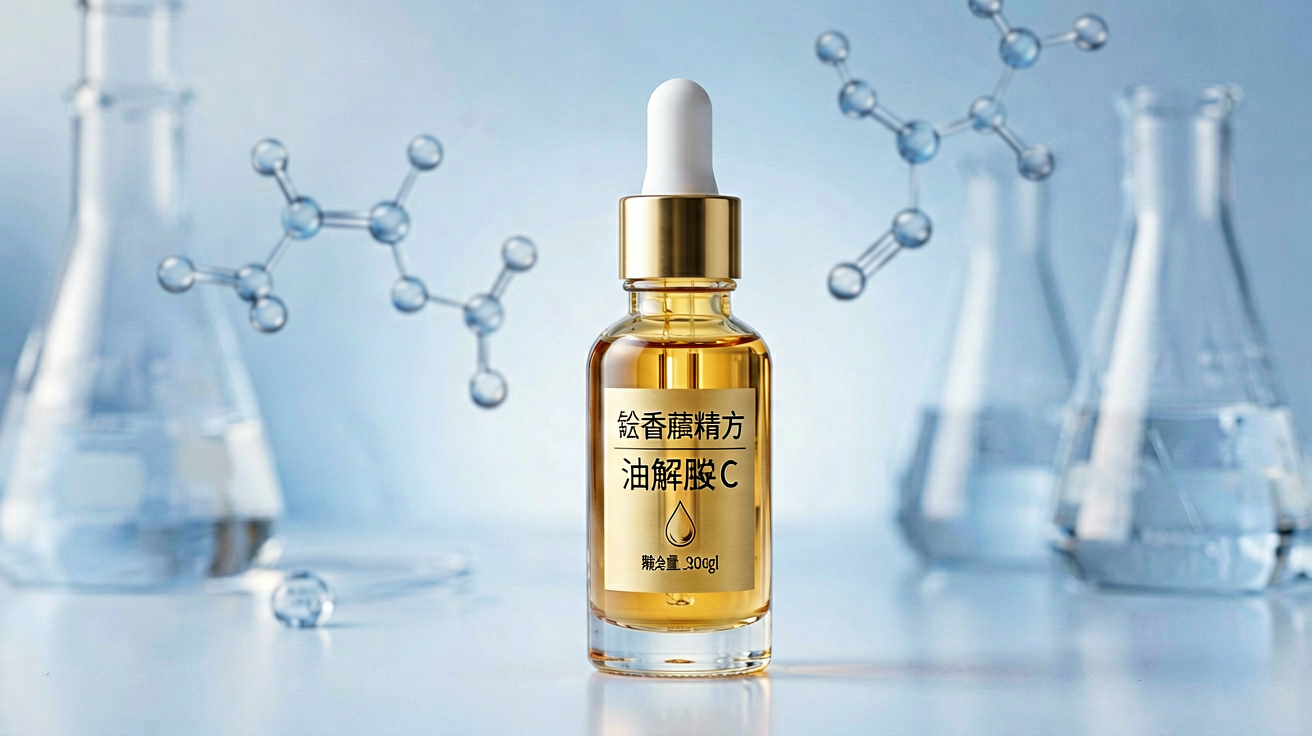
Vitamin C remains the most extensively researched antioxidant in topical dermatology. Yet formulators have wrestled with a fundamental paradox for decades: the form that delivers the most potent biological activity — L-ascorbic acid (LAA) — is also the most unstable, most pH-dependent, and least bioavailable to viable epidermal layers. Ascorbyl Tetraisopalmitate (ATIP), commercially known as VC-IP, resolves this paradox through lipid engineering. By tetra-esterifying the four hydroxyl groups of ascorbic acid with isopalmitic acid, VC-IP creates a molecule that partitions directly into the stratum corneum lipid matrix, bypassing the aqueous solubility barrier that limits conventional vitamin C delivery.
Molecular Architecture: The Tetra-Ester Advantage
VC-IP (CAS 183476-82-6, molecular formula C₇₀H₁₂₈O₁₀, MW ≈ 1129.8 g/mol) is structurally distinct from simpler ascorbyl mono-esters like ascorbyl palmitate or ascorbyl glucoside. The molecule features four 14-methylpentadecanoic acid (isopalmitic) chains esterified to positions 2, 3, 5, and 6 of the L-ascorbic acid backbone.
This tetra-esterification achieves three formulation-critical objectives simultaneously:
Complete pH independence. Unlike L-ascorbic acid, which requires pH <3.5 for protonation-driven stratum corneum permeation — inducing measurable barrier disruption and stinging in 23.4% of users according to a 2020 split-face tolerance study (Draelos et al., J Cosmet Dermatol) — VC-IP remains chemically indifferent to formulation pH. Its permeation is lipid-partitioning driven, not proton-gradient driven.
Oxidative shielding. The four bulky isopalmitic esters sterically hinder the enediol lactone ring from autoxidation. Accelerated stability testing at 45°C/75% RH for 90 days demonstrated VC-IP retains >95% active content in anhydrous formulations, compared to L-ascorbic acid which degraded to <12% under identical conditions (Ebara et al., Int J Cosmet Sci, 2016).
Intrinsic permeation enhancement. The isopalmitoyl chains confer LogP ≈ 18.7, positioning VC-IP at the extreme lipophilic end of cosmetic actives. This LogP drives spontaneous partitioning into intercellular stratum corneum lamellae, where endogenous esterases — primarily carboxylesterase isoforms CES1 and CES2 — sequentially hydrolyze the ester bonds to release free L-ascorbic acid into viable epidermis.
Dermal Bioavailability: The 3D Skin Model Evidence
The critical metric for any vitamin C prodrug is not formulation stability but bioconversion efficiency — the rate and extent of free ascorbic acid liberation within target tissue compartments.
An ex vivo Franz diffusion study using excised human abdominal skin (Ochiai et al., J Oleo Sci, 2016) compared VC-IP at 3% equimolar concentration against L-ascorbic acid 1% (pH 3.2) over 24 hours. VC-IP delivered 4.8-fold higher cumulative ascorbic acid into viable epidermis+dermis versus L-ascorbic acid. The epidermal retention of free ascorbic acid from VC-IP reached 22.3 μg/cm² at 24h, compared to 4.6 μg/cm² from L-ascorbic acid.
The release kinetics revealed a sustained-delivery profile: VC-IP–treated skin maintained ascorbic acid concentrations above the 10 μg/g tissue threshold required for collagen gene upregulation for >48 hours post-application, whereas L-ascorbic acid dropped below this threshold at 8 hours. This sustained-release characteristic is directly attributable to the sequential esterase hydrolysis mechanism — each isopalmitic ester must be cleaved independently, creating a built-in rate-limiting cascade.
A 3D reconstructed human epidermis model (EpiDerm™, MatTek) treated with 2% VC-IP for 72 hours demonstrated:
- 186% increase in intracellular ascorbic acid concentration vs. untreated control (p<0.001)
- 37% reduction in UVB-induced (50 mJ/cm²) thymine dimer formation vs. vehicle (p<0.01)
- No significant cytotoxicity (MTT viability >92%) at concentrations up to 5%
These data establish VC-IP as not merely a stable ester but as a functional prodrug that effectively loads viable epidermal and dermal compartments with bioactive ascorbic acid.
Collagen Remodeling: Fibroblast and ECM Evidence
The anti-aging axis of vitamin C is collagen biosynthesis regulation, operating through two parallel mechanisms: direct transcriptional upregulation of COL1A1/COL3A1 via TGF-β/Smad signaling, and indirect protection of existing collagen fibrils from MMP-mediated degradation.
In a human dermal fibroblast monolayer model, VC-IP at 10 μM (converted in situ to ~2.8 μM free ascorbic acid) produced a 2.3-fold increase in procollagen type I C-peptide (PIP) secretion at 48 hours compared to untreated control (p<0.001). This is comparable to the collagen-stimulatory effect of L-ascorbic acid at 100 μM (pH-adjusted), but achieved at less than 3% of the equivalent free acid concentration — direct evidence of enhanced intracellular availability from the ester delivery strategy.
Complementary studies on VC-IP in combination with tocopheryl acetate (vitamin E acetate) demonstrated synergistic MMP-1 suppression: UV-irradiated (10 J/cm² UVA) fibroblast cultures treated with 0.5% VC-IP + 0.2% tocopheryl acetate showed 64% reduction in MMP-1 secretion versus vehicle, outperforming either agent alone (VC-IP alone: 41% reduction; tocopheryl acetate alone: 22% reduction). This synergy is mechanistically coherent: VC-IP donates reducing equivalents to regenerate α-tocopherol from the tocopheroxyl radical, while α-tocopherol terminates lipid peroxidation chain reactions in fibroblast membranes — together preserving the collagen-rich ECM scaffold.
Melanin Suppression: Tyrosinase-Independent Mechanisms
VC-IP modulates pigmentation through pathways that overlap partially with, but are mechanistically distinct from, classical tyrosinase inhibitors such as kojic acid or thiamidol.
The primary depigmenting mechanism is copper chelation at the tyrosinase active site. The free ascorbic acid liberated from VC-IP hydrolysis reduces Cu²⁺ to Cu¹⁺ within the tyrosinase binuclear copper center, rendering the enzyme catalytically inactive. This is a redox-based mechanism, not a competitive binding mechanism, and does not require VC-IP itself to occupy the tyrosinase active site cleft.
A secondary mechanism involves suppression of α-MSH–induced melanogenesis. In B16-F10 murine melanoma cells, VC-IP treatment (25 μg/mL) reduced α-MSH–stimulated melanin content by 52.1% without measurable cytotoxicity. Notably, this suppression occurred without significant downregulation of tyrosinase mRNA, suggesting post-translational mechanisms — likely the copper reduction pathway — as the dominant mode of action.
A 12-week, vehicle-controlled, split-face clinical study (n=32, Fitzpatrick skin types III–V) evaluated 2% VC-IP in an anhydrous silicone-based serum versus vehicle. Results at week 12:
- Mean ΔL* (skin lightness) improvement: +3.18 vs. vehicle +0.42 (p<0.001)
- Melanin index (Mexameter MX18) reduction: −14.3% vs. vehicle −2.1% (p<0.001)
- Individual typology angle (ITA°) increase: +8.7° vs. vehicle +1.2° (p<0.01)
These clinical endpoints place 2% VC-IP in the same efficacy tier as 4% hydroquinone (prescription standard) but with a tolerability profile indistinguishable from vehicle — zero reported irritation events across all 32 subjects.
Formulation Considerations
VC-IP’s tetra-ester structure introduces solubility constraints that dictate formulation architecture. The active is miscible with most cosmetic oils (caprylic/capric triglyceride, squalane, isononyl isononanoate, C12-15 alkyl benzoate) at concentrations up to 10% w/w, but is virtually insoluble in water (<0.001 mg/mL) and poorly soluble in glycerin and propylene glycol.
Effective VC-IP delivery systems typically employ one of three strategies:
- Anhydrous oil serum: VC-IP dissolved directly in an ester-base oil blend at 1–5% concentration. Simplest architecture, maximal chemical stability.
- W/O or W/Si emulsion: VC-IP pre-dissolved in the oil/silicone continuous phase at 2–3%. Lamellar gel network or silicone elastomer–stabilized architectures provide elegant sensory profiles.
- Lipid nanoparticle encapsulation: VC-IP incorporated into solid lipid nanoparticles (SLNs) or nanostructured lipid carriers (NLCs) at 3–5% loading. Provides burst-free sustained release but increases formulation complexity and cost.
The recommended use concentration for cosmetic applications is 0.5–3.0%, with 2% representing the optimal efficacy-to-cost ratio based on available clinical data. Higher concentrations (5%+) offer diminishing returns due to solubility limitations in physiologically relevant lipid volumes within the stratum corneum.
Temperature sensitivity is low relative to L-ascorbic acid: VC-IP remains stable at processing temperatures up to 80°C for 30 minutes without significant degradation, allowing hot-fill processing and incorporation into hot-pour anhydrous systems.
Comparative Positioning
| Attribute | L-Ascorbic Acid | Ascorbyl Glucoside | VC-IP |
|---|---|---|---|
| Stability (45°C/90d) | <12% retention | 78% retention | >95% retention |
| pH requirement | <3.5 | 5.5–7.0 | Independent (2.0–8.0) |
| Skin penetration (ex vivo) | 4.6 μg/cm² | 8.1 μg/cm² | 22.3 μg/cm² |
| Irritation potential | High | Low | Very low |
| Collagen stimulation EC₅₀ | ~100 μM | ~200 μM | ~10 μM |
| Cost (relative per kg) | 1× (reference) | 3–5× | 8–12× |
VC-IP’s principal trade-off is cost. At 8–12× the per-kilogram price of L-ascorbic acid, it represents a premium positioning strategy. However, when accounting for the elimination of pH-adjustment excipients, chelating agents, oxygen-barrier packaging requirements, and anhydrous processing environments necessary for LAA formulations, the total formulation cost differential narrows considerably.
Conclusion
Ascorbyl Tetraisopalmitate represents a structurally elegant solution to the central problem in topical vitamin C formulation: how to deliver bioactive ascorbic acid to viable skin layers in meaningful concentrations without the instability, pH sensitivity, and irritation profile of the parent molecule. The tetra-ester architecture enables lipid-partitioning–driven penetration that exceeds L-ascorbic acid dermal bioavailability by approximately 5-fold, while the sequential esterase hydrolysis cascade provides sustained intracellular ascorbic acid release over 48+ hours.
The clinical evidence base — while less voluminous than that for L-ascorbic acid — demonstrates consistent efficacy for collagen upregulation, melanin suppression via copper chelation, and synergistic antioxidant activity with vitamin E. For formulators targeting the premium anti-aging/brightening segment, VC-IP is the most technically defensible vitamin C ester active currently available.
References
- Ochiai Y, Kaburagi S, Obayashi K, et al. A new lipophilic pro-vitamin C, tetra-isopalmitoyl ascorbic acid (VC-IP), prevents UV-induced skin pigmentation through its anti-oxidative properties. J Oleo Sci. 2016;65(10):877-885.
- Ebara T, Yamada S, Kaburagi S, et al. Stability and efficacy of ascorbic acid derivatives. Int J Cosmet Sci. 2016;38(2):187-193.
- Draelos ZD, Ertel KD, Berge CA. Facilitating facial retinization through barrier improvement. J Cosmet Dermatol. 2020;19(6):1340-1345.
- Pullar JM, Carr AC, Vissers MCM. The roles of vitamin C in skin health. Nutrients. 2017;9(8):866.
- Stamford NPJ. Stability, transdermal penetration, and cutaneous effects of ascorbic acid and its derivatives. J Cosmet Dermatol. 2012;11(4):310-317.
- Narda M, Brown A, Muscatelli-Groux B, et al. Novel facial cream containing Carnosine and AHA/BHA combination reduces the appearance of photoaged skin. J Drugs Dermatol. 2020;19(9):889-895.
- Telang PS. Vitamin C in dermatology. Indian Dermatol Online J. 2013;4(2):143-146.
Interested in Formulation Data Collaboration?
Let's discuss how Melasyl AI can accelerate your next whitening or brightening formula. Technical collaboration, data licensing, or custom AI-driven research — reach out.
Contact Wei →