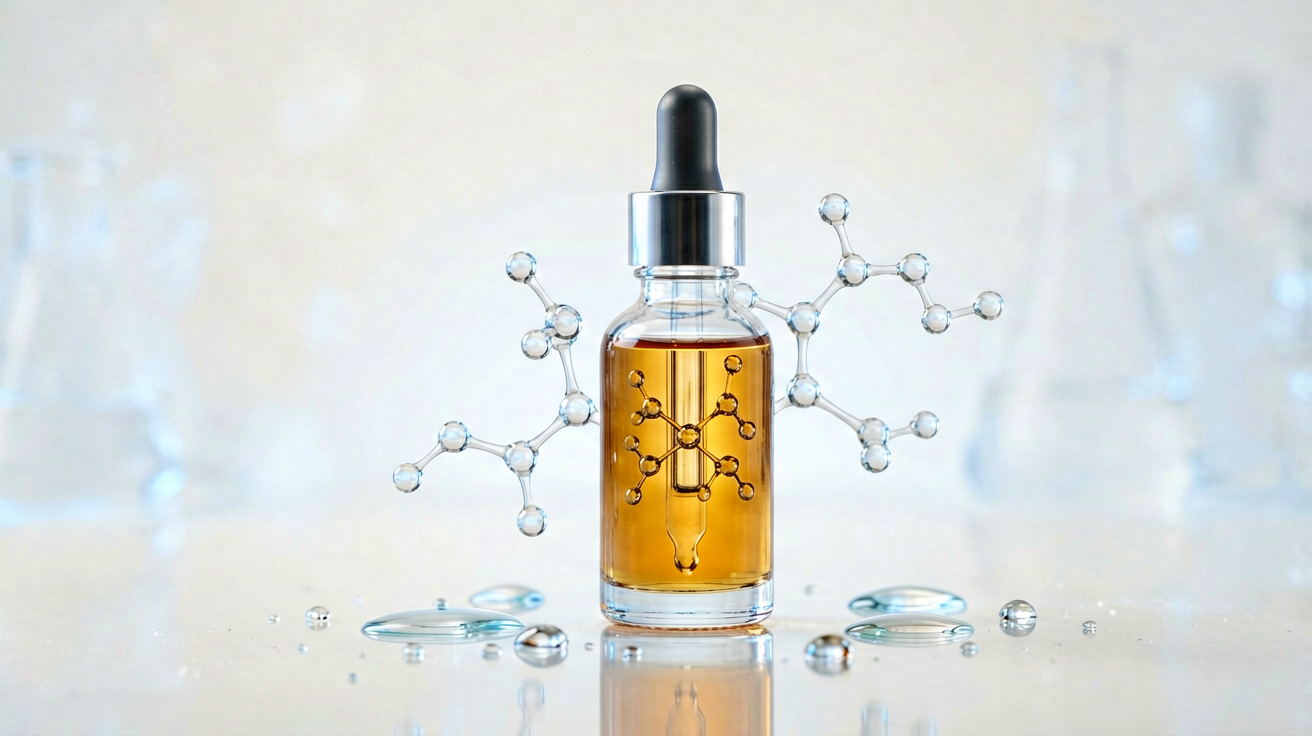
What Is Bakuchiol?
Bakuchiol is a meroterpene phenol extracted from the seeds and leaves of Psoralea corylifolia (babchi), a plant with centuries of use in Ayurvedic and Traditional Chinese Medicine. First isolated and structurally characterized by Mehta et al. in 1966, bakuchiol has surged into the skincare spotlight over the past five years as the most rigorously studied plant-derived retinol alternative — and for good reason.
Unlike retinol, which is a vitamin A derivative requiring metabolic conversion to retinoic acid before activating target genes, bakuchiol achieves retinol-like transcriptional effects through a distinct molecular pathway. Gene expression profiling by Chaudhuri and Bojanowski (2014) demonstrated that bakuchiol upregulates collagen types I, III, and IV while downregulating matrix metalloproteinases (MMPs) — the enzymatic machinery responsible for collagen degradation — with a profile remarkably similar to all-trans-retinol, yet without triggering the retinoid-associated irritation cascade.
The Landmark Clinical Trial: Dhaliwal et al. (2019)
The definitive evidence base for bakuchiol was established by Dhaliwal et al., published in the British Journal of Dermatology (2019; 180: 289–296). This 12-week, double-blind, randomized, head-to-head study compared 0.5% bakuchiol applied twice daily against 0.5% retinol applied once daily in 44 participants with facial photoaging.
Key findings at week 12:
- Wrinkle reduction: Both groups showed statistically significant decreases in wrinkle surface area and hyperpigmentation. No significant difference between bakuchiol and retinol (p > 0.05).
- Hyperpigmentation improvement: Bakuchiol reduced pigmentation by 59% versus 44% visual analog scale improvement, though the between-group difference did not reach significance.
- Irritation profile: Retinol users experienced significantly more scaling (p = 0.005) and stinging (p = 0.001) compared to bakuchiol. Bakuchiol demonstrated superior tolerability across all measured irritation parameters.
- Photoaging composite score: Both groups improved significantly with no statistical difference (p = 0.85).
The clinical implication is unambiguous: bakuchiol at 0.5% can deliver anti-aging outcomes comparable to 0.5% retinol, but with a dramatically better tolerability profile. No photosensitivity was observed — bakuchiol remains stable under UV exposure, making it suitable for daytime application, which is a critical differentiator from retinoids.
Mechanisms of Action: Beyond the Retinol Alternative Label
Reducing bakuchiol to merely “plant retinol” undersells its mechanistic breadth. Bakuchiol operates across at least four distinct biological pathways:
1. Collagen Homeostasis
Bakuchiol induces transcriptional upregulation of COL1A1, COL3A1, and COL4A1 genes encoding collagen types I, III, and IV respectively (Chaudhuri et al., Journal of Cosmetic Dermatology, 2014). Simultaneously, it suppresses MMP-1 (collagenase) and MMP-3 (stromelysin) expression, preserving existing extracellular matrix while stimulating new synthesis — a dual-pronged approach to dermal remodeling.
2. Antioxidant Defense
With a phenolic hydroxyl group in its terpenoid backbone, bakuchiol functions as a direct free radical scavenger. In vitro DPPH and ABTS assays confirm its capacity to neutralize reactive oxygen species, complementing its gene-level effects with chemical-level photoprotection.
3. Anti-Inflammatory Modulation
Bakuchiol downregulates COX-2 and iNOS expression, reducing prostaglandin E2 and nitric oxide production in keratinocytes exposed to inflammatory stimuli. This is clinically relevant for acne-prone skin, where inflammation drives both active lesions and post-inflammatory hyperpigmentation (PIH).
4. Antimicrobial Activity
Multiple studies have documented bakuchiol’s antibacterial efficacy against Cutibacterium acnes and Staphylococcus aureus, with minimum inhibitory concentrations (MIC) in the 2–8 μg/mL range. This makes bakuchiol uniquely positioned as a single-ingredient solution for adult acne patients who also want anti-aging benefits.
Bakuchiol Formulation Guide: The Practical Parameters
Formulating with bakuchiol requires attention to several technical variables. The following guidelines are distilled from the peer-reviewed formulation literature and stability testing data.
Concentration Range
Clinical efficacy has been demonstrated at 0.5% (Dhaliwal et al., 2019), with most commercial formulations ranging from 0.5% to 1.0%. Concentrations below 0.25% lack adequate clinical evidence for anti-aging claims. Higher concentrations (up to 2%) appear in some medical-grade product lines, though tolerability data above 1% remains limited — approximately 10% of users report mild transient sensations (tightness, warmth) at 1% concentration (Chaudhuri, 2020).
| Parameter | Recommendation | Evidence Basis |
|---|---|---|
| Effective concentration | 0.5% – 1.0% | Dhaliwal et al., BJD 2019 |
| Optimal pH range | 5.0 – 6.5 | Stability study, Nature Sci Rep 2023 |
| Solvent system | Caprylic/capric triglyceride or squalane | Lipophilic logP ~5.8 |
| Antioxidant synergy | + Vitamin C (L-AA or THD ascorbate) | Complementary antioxidant pathways |
| Buffer compatibility | Avoid high-pH systems (>7.0) | Phenolic oxidation risk |
Solubility and Vehicle Selection
Bakuchiol is a lipophilic molecule with a calculated logP of approximately 5.8. It is practically insoluble in water and requires an oil-phase carrier. Preferred solvent systems include:
- Caprylic/capric triglyceride: Excellent solubility, light skin feel, non-comedogenic
- Squalane: Biomimetic carrier, enhances penetration, oxidation-stable
- Isopropyl myristate: High solubility but moderate comedogenicity — use with caution in acne formulations
- Dimethicone (low viscosity): For silicone-based serums requiring a dry-touch finish
Stability Considerations
A 2023 study published in Scientific Reports (Nature portfolio) validated a quantitative HPLC method for bakuchiol in cosmetic matrices and confirmed that bakuchiol remains stable in serum formulations for at least 6 months under accelerated storage conditions (40°C/75% RH). Key stability factors:
- pH: Maintain pH 5.0–6.5. Alkaline conditions promote oxidative degradation of the phenolic group.
- Light exposure: Bakuchiol demonstrates superior photostability compared to retinol. However, UV-protective packaging (amber glass or airless pumps) is recommended for commercial products to maximize shelf life.
- Antioxidant incorporation: Adding 0.05–0.1% tocopherol (vitamin E) to the oil phase extends oxidative stability without interfering with bakuchiol’s activity.
- Metal ions: Chelating agents (EDTA or sodium phytate at 0.05–0.1%) prevent metal-catalyzed oxidation in water-containing emulsions.
Synergistic Ingredient Pairings
Bakuchiol’s multi-target mechanism makes it an excellent anchor ingredient for combination formulations:
- Bakuchiol + Niacinamide (4–5%): Bakuchiol stimulates collagen; niacinamide reinforces barrier function and reduces sebum. The combination addresses aging and acne simultaneously without irritation overlap. Niacinamide also counteracts any residual sensitivity.
- Bakuchiol + Vitamin C (THD Ascorbate): Tetrahexyldecyl ascorbate (THD) is oil-soluble, making it directly compatible with bakuchiol’s oil phase. Together, they provide daytime antioxidant protection with collagen stimulation — a legitimate alternative to the classic “retinol at night, vitamin C in the morning” protocol.
- Bakuchiol + Peptides (Matrixyl 3000, Copper Peptides): Bakuchiol provides gene-level collagen upregulation; signal peptides reinforce the ECM-building message at the protein level. This dual-signal approach maximizes dermal remodeling.
- Bakuchiol + Ceramides (NP, AP, EOP at 3:1:1 ratio): For sensitive or barrier-compromised skin, ceramide pre-loading reduces any initial adjustment phase while bakuchiol drives long-term structural improvement.
Sample Serum Formulation: Bakuchiol 0.5% Brightening Serum
Below is a complete anhydrous serum formula suitable for formulation chemists and advanced DIY practitioners. This is an oil-based serum leveraging bakuchiol’s lipophilic nature:
| Phase | Ingredient (INCI) | % w/w | Function |
|---|---|---|---|
| A | Caprylic/Capric Triglyceride | 62.0% | Primary carrier oil |
| A | Squalane | 25.0% | Emollient, penetration enhancer |
| A | Tetrahexyldecyl Ascorbate | 5.0% | Oil-soluble vitamin C ester |
| A | Bisabolol | 0.5% | Soothing agent |
| A | Tocopherol (Mixed) | 0.2% | Antioxidant preservative |
| B | Bakuchiol (99% purity) | 0.5% | Active ingredient |
| B | Caprylic/Capric Triglyceride | 6.8% | Pre-dissolution carrier |
Processing protocol:
- Combine Phase A ingredients in a sanitized glass beaker. Mix with magnetic stirrer at 200–300 RPM until homogenous (no heating required; room temperature processing is adequate).
- Separately, pre-dissolve bakuchiol in Phase B triglyceride with gentle stirring (100 RPM) at 30–35°C for 10 minutes until fully solubilized. Do not exceed 40°C — bakuchiol is heat-stable within normal processing ranges, but prolonged high-temperature exposure may accelerate oxidation.
- Add Phase B to Phase A under continuous stirring at 300 RPM for 15 minutes until optically clear and homogenous.
- Fill into amber airless pump bottles. Store at 15–25°C, protected from direct light.
Targeted shelf life: 12 months (supported by 40°C accelerated stability data).
Application protocol: 3–4 drops applied to clean skin, AM and/or PM. Unlike retinol, bakuchiol serum can be used in morning routines without photosensitivity concerns. Always follow with broad-spectrum sunscreen during the day — not because bakuchiol requires it, but because UV protection is the foundation of any anti-aging regimen.
Regulatory Status and Ingredient Quality
Bakuchiol was approved as a cosmetic ingredient by China’s National Medical Products Administration (NMPA) in August 2022, opening the world’s second-largest beauty market to this ingredient. The Cosmetic Ingredient Review (CIR) Expert Panel assessed bakuchiol as safe in cosmetic formulations at concentrations up to 1% in leave-on products (CIR Final Report, 2022).
When sourcing bakuchiol, purity matters. HPLC-verified ≥99% purity with residual solvent certification is the minimum standard. Lower-purity grades may contain psoralen compounds from the babchi plant matrix — these are phototoxic furocoumarins that must be absent from cosmetic-grade bakuchiol. Always request a certificate of analysis (CoA) confirming psoralen content below the detection limit (typically <1 ppm by HPLC).
Clinical Bottom Line
Bakuchiol represents one of the few genuinely evidence-backed botanical actives in the anti-aging category. The Dhaliwal et al. (2019) head-to-head trial provides level 1b evidence — a prospective, randomized, double-blind design — that 0.5% bakuchiol matches 0.5% retinol’s efficacy for photoaging parameters with a statistically significant tolerability advantage.
For formulation chemists and skincare developers, bakuchiol offers a compelling proposition: retinol-comparable gene expression without the retinoid baggage of photosensitivity, irritation, and oxidation instability. Combined with synergistic actives — niacinamide for barrier support, THD ascorbate for daytime antioxidant protection, or peptides for multi-pathway ECM stimulation — bakuchiol-based formulations can occupy a unique niche between conventional anti-aging and sensitive-skin categories.
References
- Dhaliwal S, Rybak I, Ellis SR, et al. Prospective, randomized, double-blind assessment of topical bakuchiol and retinol for facial photoageing. British Journal of Dermatology. 2019;180(2):289-296. doi:10.1111/bjd.16918
- Chaudhuri RK, Bojanowski K. Bakuchiol: a retinol-like functional compound revealed by gene expression profiling and clinically proven to have anti-aging effects. International Journal of Cosmetic Science. 2014;36(3):221-230. doi:10.1111/ics.12117
- Mehta G, Nayak UR, Dev S. Bakuchiol, a novel monoterpenoid. Tetrahedron Letters. 1966;7(38):4561-4567.
- Cosmetic Ingredient Review (CIR). Safety Assessment of Bakuchiol as Used in Cosmetics. Final Report. 2022.
- Development of a new chromatographic method for the determination of bakuchiol in cosmetic products. Scientific Reports (Nature). 2023;13:14876.
- Ohno O, Watabe T, Nakamura K, et al. Inhibitory effects of bakuchiol, bavachin, and isobavachalcone isolated from Piper longum on melanin production in B16 mouse melanoma cells. Bioscience, Biotechnology, and Biochemistry. 2010;74(7):1504-1506.
Interested in Formulation Data Collaboration?
Let's discuss how Melasyl AI can accelerate your next whitening or brightening formula. Technical collaboration, data licensing, or custom AI-driven research — reach out.
Contact Wei →