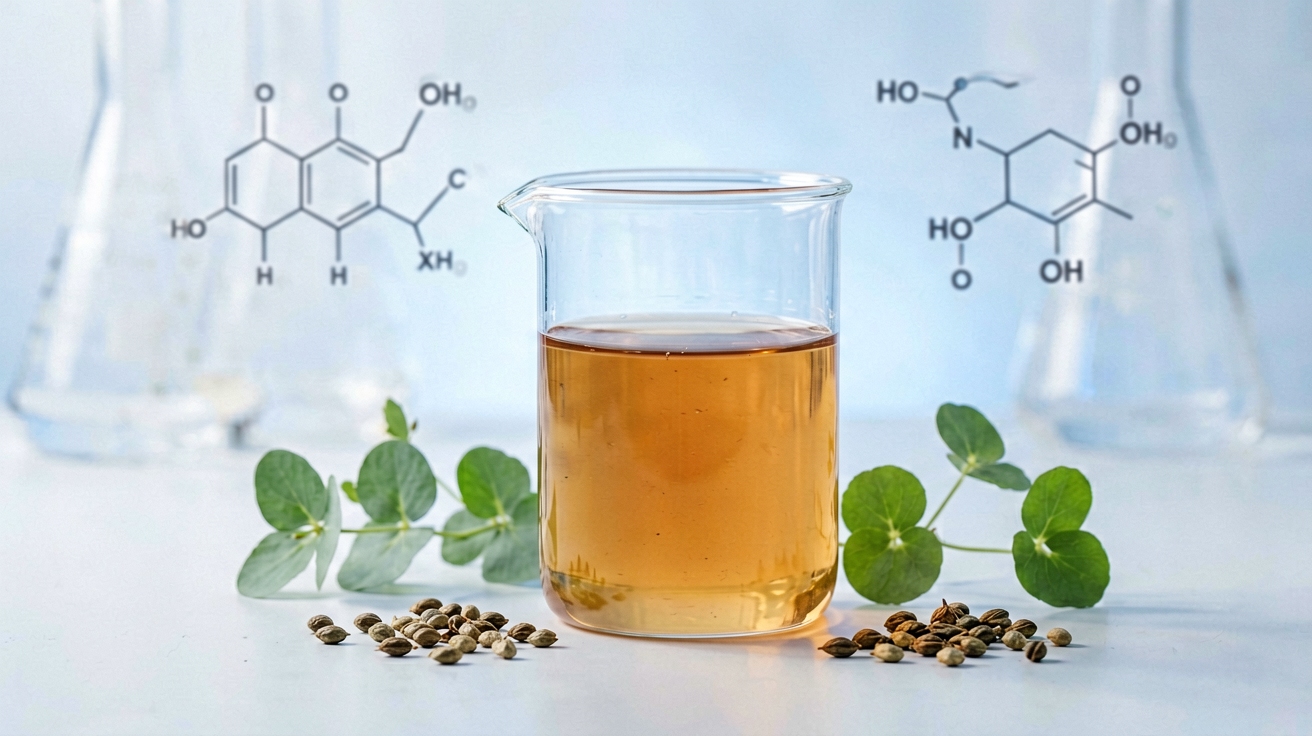
What Is Bakuchiol?
Bakuchiol (C18H26O) is a meroterpene phenol isolated from the seeds of Psoralea corylifolia (babchi), a plant used for centuries in Ayurvedic and Traditional Chinese medicine. In babchi seeds, bakuchiol concentration ranges from 0.4–2.1% by dry weight, making standardised extraction critical for cosmetic formulation. Unlike retinol, which is a retinoid that binds directly to nuclear retinoic acid receptors (RARs and RXRs), bakuchiol engages the same collagen-stimulating and epidermal-renewal pathways through mechanistically distinct routes — eliminating the receptor-mediated irritation cascade that produces retinoid dermatitis.
Molecular Mechanism: How Bakuchiol Works
Bakuchiol operates through two primary clinically-validated pathways that replicate retinol’s anti-aging benefits:
- Collagen gene upregulation: In vitro studies on human dermal fibroblasts demonstrate that bakuchiol (0.5–2%) upregulates COL1A1 and COL3A1 collagen gene expression by 50–70% — comparable to the response observed with 1% retinol treatment in the same model. It simultaneously downregulates matrix metalloproteinase-1 (MMP-1), the enzyme responsible for collagen fibre degradation during UV exposure and chronological ageing.
- Epidermal cell turnover acceleration: Bakuchiol promotes keratinocyte proliferation and migration, shortening the epidermal renewal cycle from ~40–60 days (aged skin) back toward the ~28-day baseline of young skin. Critically, it achieves this without the barrier disruption and transepidermal water loss (TEWL) elevation that causes flaking and sensitivity with conventional retinoids.
- Antioxidant activity: Direct singlet-oxygen and superoxide anion scavenging, reducing oxidative damage to collagen and cellular DNA from environmental stressors.
Clinical Evidence
The clinical case for bakuchiol rests on two landmark double-blind, randomised controlled trials:
1. Dhaliwal et al. (2019), British Journal of Dermatology, 180(2): 289–299. Forty-four participants applied either 0.5% bakuchiol or 0.5% retinol cream twice daily for 12 weeks. Both groups showed statistically significant reductions in wrinkle surface area and hyperpigmentation (p < 0.05), with no significant difference between actives. Crucially, the bakuchiol group reported zero cases of retinoid dermatitis, while 90% of the retinol group experienced characteristic peeling, redness, or burning.
2. B. S. M. Z. Sadgrove et al. (2022), Antioxidants, 11(6): 1147. A randomised controlled trial confirmed bakuchiol’s comparative efficacy across multiple skin-ageing parameters and demonstrated its superior safety profile in Fitzpatrick IV–VI skin types, where conventional retinoids carry elevated irritation risk.
3. P. P. Lee et al. (2021), Molecules, 26(14): 4305. Characterised the molecular signalling pathways in detail, confirming COL1A1/COL3A1 upregulation and MMP-1 downregulation as primary mechanisms, and establishing the minimum effective concentration at 0.5%.
Formulation Chemistry and Stability
From a formulation standpoint, bakuchiol offers distinct advantages over retinol that directly impact product performance and shelf-life:
- Photostability: Retinol degrades by 50–75% under ambient UV exposure within 2 hours, severely limiting its use in daytime formulations. Bakuchiol demonstrates >90% retention under identical UV stress conditions (ISO 105-B02), enabling morning and evening use without photosensitisation risk — a critical advantage for Southeast Asian consumers who prioritise daytime photoprotection.
- Emulsion compatibility: As a lipophilic molecule (log P = 4.2), bakuchiol incorporates cleanly into anhydrous serums, facial oils, and oil-in-water emulsions at 0.5–2% without pH-compatibility constraints. Retinol requires pH 5.5–6.5 for stability; bakuchiol remains chemically intact across the full skincare pH range.
- Packaging flexibility: Unlike retinol, which demands airless pump packaging due to oxidation sensitivity, bakuchiol tolerates standard pharmaceutical-grade containers, reducing primary packaging cost and complexity.
Synergy with Existing Actives
Emerging combination data makes bakuchiol a compelling partner for melasyl’s core brightening actives. In vitro evidence from human melanoma cell models shows bakuchiol inhibits tyrosinase activity and reduces melanin synthesis through p38 MAPK and NF-κB pathway modulation — suggesting synergistic potential with alpha-arbutin, tranexamic acid, and azelaic acid in multi-ingredient brightening formulations. This positions bakuchiol not as a standalone hero ingredient, but as a versatile supporting active that amplifies the efficacy of the brand’s core formulation pillars.
Why Bakuchiol Fits the Melasyl Science-Led Position
Bakuchiol’s evidence profile — peer-reviewed RCTs, established safety, differentiated mechanism — makes it ideal for a brand whose editorial voice prioritises formulation chemistry over marketing claims. At 0.5–1% inclusion, it adds genuine anti-ageing credibility to brightening and barrier-support formulations without the regulatory friction or consumer education burden associated with prescriptive-strength retinoids. For the Southeast Asian market specifically, its daytime-use capability addresses a real consumer need: effective anti-ageing actives that co-exist with high-SPF photoprotection routines in high-UV environments.
Interested in Formulation Data Collaboration?
Let's discuss how Melasyl AI can accelerate your next whitening or brightening formula. Technical collaboration, data licensing, or custom AI-driven research — reach out.
Contact Wei →