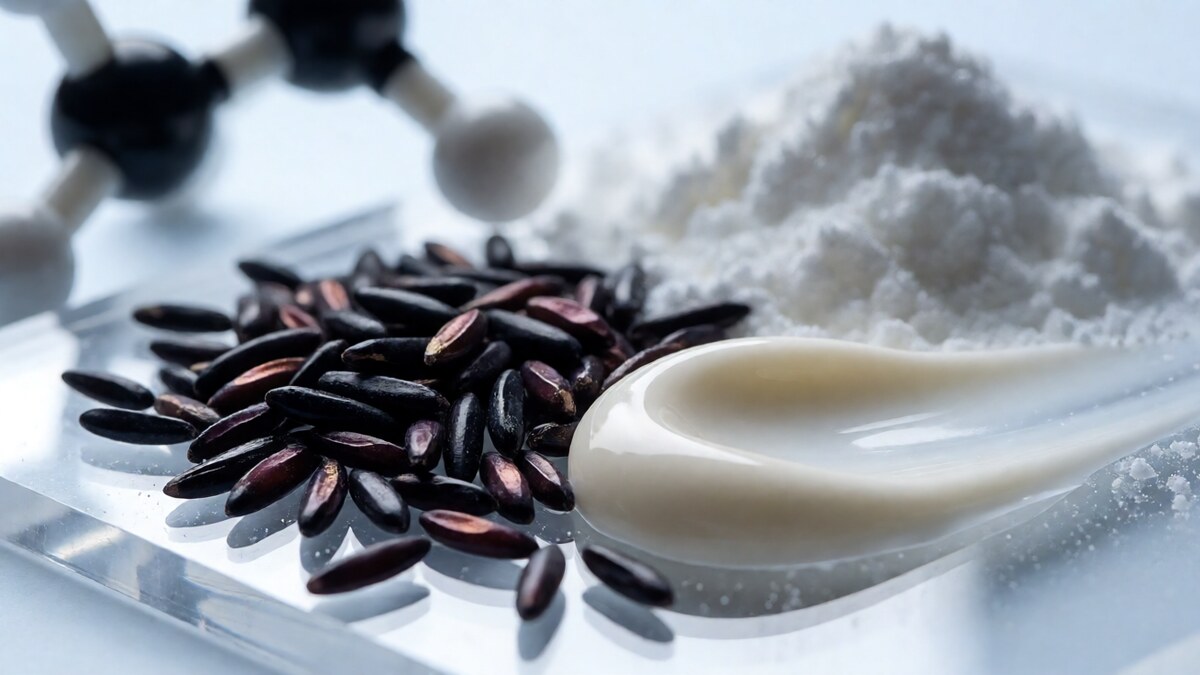
Black rice — the deep purple “forbidden rice” of K-beauty toners, essences and sleeping masks — has become one of the most requested natural brightening actives of 2026. Unlike plain rice water or white rice extract, black rice carries a concentrated anthocyanin and ferulic-acid fraction in its bran, and that chemistry is the reason it keeps appearing in pigment-focused formulas. Here is what the evidence actually supports for black rice extract for hyperpigmentation, and where its limits lie.
What Black Rice Extract Is
Black rice (Oryza sativa L. indica), also called purple rice, owes its colour to anthocyanins concentrated in the bran layer. The dominant anthocyanin is cyanidin-3-O-glucoside (C3G), with peonidin-3-O-glucoside as the main secondary. The bran also carries gamma-oryzanol — a ferulic acid ester present at roughly 118.6 mg/g in one authenticated Indonesian sample — plus free ferulic acid, which accounts for 56–77% of the bran’s total phenolic acids. That two-fraction profile, anthocyanins plus ferulic acid esters, is what separates black rice from a plain rice-water rinse.
Mechanism: Tyrosinase, MITF and the Oxidative Trigger
1. Direct competitive tyrosinase inhibition. The catechol-like B-ring of C3G acts as a substrate mimic for the tyrosinase copper pocket. Molecular docking places C3G at residues TYR140, PRO366, TRP386 and HIS390 through hydrogen and ionic bonding, with a binding energy of −16.9 kcal/mol versus arbutin’s −11.82 kcal/mol — a substantially more stable complex. Enzyme kinetics confirm reversible competitive inhibition: black-brown rice anthocyanins returned a tyrosinase IC50 of 94.2 µg/mL, beating arbutin (126.95 µg/mL) in the same assay.
2. MITF downregulation via MAPK/Akt. Upstream of the enzyme, polyphenol- and flavonoid-enriched rice extracts suppressed p38 MAPK phosphorylation, raised p-ERK1/2 and Akt, and downregulated MITF, cutting tyrosinase, TRP-1 and TRP-2 in melan-a cells at 100 µg/mL without cytotoxicity. Because MITF is the master switch for the whole melanogenic cassette, hitting it avoids the enzyme-compensation problem that limits pure tyrosinase blockers.
3. Antioxidant and anti-inflammatory buffering. Gamma-oryzanol’s antioxidant capacity exceeds alpha-tocopherol in several assays, and the ORAC value of Korean black rice bran reaches roughly 1101 µmol TE/g. Anthocyanins also suppress TNF-α, IL-6 and NO in activated macrophages, and a UVB mouse study showed black rice cream lowered IL-1β and MITF dose-dependently. Since UV and visible light drive pigment partly through ROS-activated MAPK and inflammatory signalling, this layer interrupts the trigger rather than the output.
Clinical Evidence
The key human data come from Jufri et al. (Jundishapur J Nat Pharm Prod, 2021), a split-forearm trial in 34 women. A 10% black rice bran extract oil-in-water lotion reduced the melanin index from 240.21 to 214.38 in 14 days (p < 0.0001) and the erythema index from 196.09 to 173.91 (p < 0.0001). The placebo lotion produced no significant melanin change (232.77 → 229.74, p = 0.3311). The paired decrease in erythema is read as tolerability rather than irritation — a meaningful point for melanin-rich skin.
Supporting human data sit on the oral and fermented side: rice bran glucosylceramides (1.2 mg/day) plus elasticamide (56 µg/day) suppressed UVB-induced pigmentation after eight weeks of ingestion, and a fermented rice bran niosome cream reduced skin melanin 33.2-fold versus untreated after 28 days. The caveat is consistency: most trials use whole bran extract, not isolated C3G, so the observed effect size reflects the full phenolic matrix, and no published RCT isolates C3G topically.
In Vitro and Fermentation Evidence
Miyazawa et al. (J Agric Food Chem, 2003) isolated the tyrosinase inhibitor from black rice bran and reported that 0.4 mg/mL extract inhibited tyrosinase by 80.5%, with a dry-extract IC50 of 74.8 µg/mL. Fermentation appears to amplify the activity: fermented unpolished black rice reduced cellular melanin and intracellular tyrosinase in B16F10 cells and lowered MITF, TRP-1 and TRP-2 at both mRNA and protein level, while co-fermentation of rice bran with Lactobacillus rhamnosus and Saccharomyces cerevisiae inhibited α-MSH-induced melanin synthesis. A 2026 study further showed rice bran extract activates Akt and Erk in B16F10 cells, consistent with the MITF route.
Formulation: The Stability Problem
Anthocyanins are the fragile part of the equation. C3G is a flavylium cation that is stable only at acidic pH; as pH rises toward neutral it shifts to colourless and then chalcone forms, and it degrades with heat, oxygen and light. Practical controls:
- Hold finished pH at 3.5–4.5. Above pH 5 both the colour and the measured activity fall away.
- Protect from light and oxygen. Use opaque or airless packaging, consider nitrogen blanketing, and add a chelator — anthocyanins can turn pro-oxidant in the presence of free metals.
- Keep thermal processing short and below roughly 60 °C.
- Use a vesicular or emulsion carrier. Polyphenols penetrate poorly in plain solution; liposomes, niosomes (as in the fermented-rice work) and O/W emulsions raise skin deposition.
- Typical use level: 1–5% for a standardised bran extract, or 0.1–0.5% when standardised to C3G.
Pairing logic matters too. Black rice extract complements a niacinamide or tranexamic acid platform because it works the tyrosinase-competitive and antioxidant arms while those address melanosome transfer and plasmin pathways. The ferulic acid already present in the bran can also stabilise vitamin C in a CE-ferulic-style system.
The Takeaway
Black rice extract earns its K-beauty shelf space with a genuinely unusual combination: a competitive tyrosinase inhibitor (C3G) that out-docks and out-inhibits arbutin in vitro, plus a gamma-oryzanol and ferulic acid antioxidant fraction that blunts the inflammatory and oxidative triggers upstream of MITF — backed by a real, if small, human trial showing a significant melanin and erythema drop in 14 days. Its weakness is stability: the same anthocyanin chemistry that makes it active makes it pH-, heat- and light-sensitive, so it only performs in an acidic, protected, well-carried formula. Formulated properly, it is a rational multi-pathway brightening active and a strong natural-positioning alternative to arbutin.
References
- Jufri M, Vardhani A, Purwaningsih E. Evaluating the efficacy of lotion containing black rice bran (Oryza sativa L. indica) extract as skin brightening agent: a clinical trial. Jundishapur J Nat Pharm Prod. 2021;16(4):e114152.
- Miyazawa M, et al. Tyrosinase inhibitor from black rice bran. J Agric Food Chem. 2003;51(24):6953–6956.
- Monmai C, et al. Inhibitory effects of polyphenol- and flavonoid-enriched rice seed extract on melanogenesis in melan-a cells via MAPK signaling-mediated MITF downregulation. Int J Mol Sci. 2023;24(14):11841.
- Chang D, et al. Study on antioxidant and inhibition of tyrosinase activity of anthocyanins in black brown rice. Food and Fermentation Industries. 2026;52(9):126–134.
- Black rice extract attenuates UVB-induced hyperpigmentation by inhibiting IL-1β and MITF gene expression. Trop J Nat Prod Res. 2026.
- Anti-melanogenic activity of rice bran extracts for development of cosmeceutical ingredients. AIMS Bioengineering. 2026.
- Biologically active components and skincare benefits of rice fermentation products: a review. Cosmetics (MDPI). 2025;12(1):29.
- Manosroi A, et al. Fermented rice bran-encapsulated niosomes and skin pigmentation reduction (as reviewed in ref. 7).
Interested in Formulation Data Collaboration?
Let's discuss how Melasyl AI can accelerate your next whitening or brightening formula. Technical collaboration, data licensing, or custom AI-driven research — reach out.
Contact Wei →