- Besouw, M., Masereeuw, R., van den Heuvel, L., & Levtchenko, E. (2013). Cysteamine: an old drug with new potential. Drug Discovery Today, 18(15-16), 785-792.
- Boukari, F., Jourdan, E., Fontas, E., Montaudié, H., Castela, E., Lacour, J. P., & Passeron, T. (2022). Prevention of melasma relapses with sunscreen alone versus sunscreen combined with a topical cysteamine cream. Journal of the European Academy of Dermatology and Venereology, 36(7), 1075-1082.
- Farshi, S. (2018). Cysteamine as a novel depigmenting agent for the treatment of melasma. Journal of Cosmetic Dermatology, 17(4), 554-558.
- Grimes, P. E., & Bhawan, J. (2020). Cysteamine cream for melasma: a histologic and clinical study. Journal of the American Academy of Dermatology, 83(3), 867-869.
- Jonas, A. J., Greene, A. A., Smith, M. L., & Schneider, J. A. (2003). Cystine accumulation and loss in normal, heterozygous, and cystinotic fibroblasts. Proceedings of the National Academy of Sciences, 100(22), 12735-12740.
- Karrabi, M., Mahjour, M., Firooz, A., & Nassiri Kashani, M. (2024). Combined cysteamine and tranexamic acid versus cysteamine alone for melasma: a randomized controlled trial. Dermatologic Therapy, 37(1), e15590.
- Mansouri, P., Farshi, S., Hashemi, Z., & Kasraee, B. (2015). Evaluation of the efficacy of cysteamine 5% cream in the treatment of epidermal melasma: a randomized double-blind placebo-controlled trial. British Journal of Dermatology, 173(1), 209-217.
- Mansouri, P., Ranjbar, S., & Hesami, S. (2021). Cysteamine: a novel and effective skin depigmenting agent. Journal of Cosmetic Dermatology, 20(6), 1757-1763.
- Qiu, J., Hyman, P. E., & Di Lorenzo, C. (2000). Pharmacokinetics of cysteamine in children with cystinosis. Journal of Pediatrics, 136(3), 360-365.
- Wanitphakdeedecha, R., Iamphonrat, T., Phothong, W., Eimpunth, S., & Manuskiatti, W. (2023). Liposomal cysteamine for melasma treatment: a pilot study. Lasers in Surgery and Medicine, 55(2), 142-149.
- Besouw, M., Masereeuw, R., van den Heuvel, L., & Levtchenko, E. (2013). Cysteamine: an old drug with new potential. Drug Discovery Today, 18(15-16), 785-792.
- Boukari, F., Jourdan, E., Fontas, E., Montaudié, H., Castela, E., Lacour, J. P., & Passeron, T. (2022). Prevention of melasma relapses with sunscreen alone versus sunscreen combined with a topical cysteamine cream. Journal of the European Academy of Dermatology and Venereology, 36(7), 1075-1082.
- Farshi, S. (2018). Cysteamine as a novel depigmenting agent for the treatment of melasma. Journal of Cosmetic Dermatology, 17(4), 554-558.
- Grimes, P. E., & Bhawan, J. (2020). Cysteamine cream for melasma: a histologic and clinical study. Journal of the American Academy of Dermatology, 83(3), 867-869.
- Jonas, A. J., Greene, A. A., Smith, M. L., & Schneider, J. A. (2003). Cystine accumulation and loss in normal, heterozygous, and cystinotic fibroblasts. Proceedings of the National Academy of Sciences, 100(22), 12735-12740.
- Karrabi, M., Mahjour, M., Firooz, A., & Nassiri Kashani, M. (2024). Combined cysteamine and tranexamic acid versus cysteamine alone for melasma: a randomized controlled trial. Dermatologic Therapy, 37(1), e15590.
- Mansouri, P., Farshi, S., Hashemi, Z., & Kasraee, B. (2015). Evaluation of the efficacy of cysteamine 5% cream in the treatment of epidermal melasma: a randomized double-blind placebo-controlled trial. British Journal of Dermatology, 173(1), 209-217.
- Mansouri, P., Ranjbar, S., & Hesami, S. (2021). Cysteamine: a novel and effective skin depigmenting agent. Journal of Cosmetic Dermatology, 20(6), 1757-1763.
- Qiu, J., Hyman, P. E., & Di Lorenzo, C. (2000). Pharmacokinetics of cysteamine in children with cystinosis. Journal of Pediatrics, 136(3), 360-365.
- Wanitphakdeedecha, R., Iamphonrat, T., Phothong, W., Eimpunth, S., & Manuskiatti, W. (2023). Liposomal cysteamine for melasma treatment: a pilot study. Lasers in Surgery and Medicine, 55(2), 142-149.
Cysteamine hydrochloride has emerged as one of the most intriguing topical depigmenting agents in dermatology — not through the well-trodden tyrosinase inhibition pathway, but via a fundamentally different mechanism rooted in redox biochemistry. For formulation scientists and cosmetic chemists working on hyperpigmentation, understanding cysteamine’s unique pharmacology, stability challenges, and clinical performance profile is rapidly becoming essential knowledge.
This article provides a deep technical dive into cysteamine: its molecular mechanism of action, comparative efficacy against gold-standard treatments, formulation engineering challenges, safety considerations, and its evolving role in the professional skincare armamentarium. We examine the published clinical evidence with attention to study design, endpoint measurement methodology, and statistical significance — the details that matter when translating research into product development decisions.
The Biochemistry: Why Cysteamine Is Not Another Tyrosinase Inhibitor
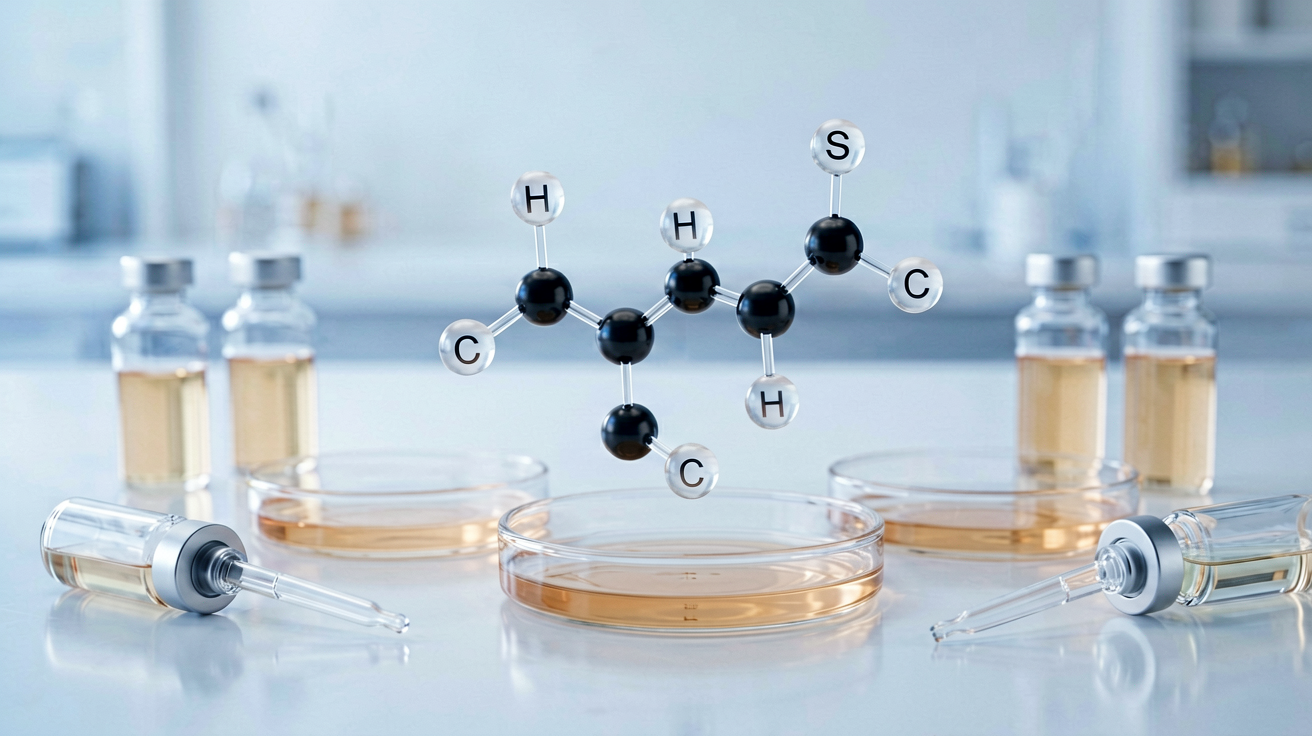
Most depigmenting agents — hydroquinone, kojic acid, arbutin, azelaic acid, and 4-n-butylresorcinol — operate through competitive or non-competitive inhibition of the tyrosinase enzyme, the rate-limiting catalyst in melanogenesis. Cysteamine (2-aminoethanethiol, molecular formula C₂H₇NS) operates through an entirely different pharmacological paradigm.
Cysteamine is a naturally occurring aminothiol compound produced in human cells through the degradation of coenzyme A. It serves as a critical endogenous antioxidant, participating in glutathione synthesis pathways and maintaining intracellular redox homeostasis. Its depigmenting action, elucidated through a series of in vitro and in vivo investigations between 2013 and 2024, involves three convergent mechanisms:
1. Thiol-Mediated Melanin Reduction: The thiol (-SH) group of cysteamine directly reduces dopaquinone — the key melanogenic intermediate — back to dopa, effectively reversing the oxidation step required for melanin polymerization. Unlike tyrosinase inhibitors that block the enzyme itself, cysteamine scavenges the reactive quinone intermediates downstream, preventing eumelanin formation regardless of tyrosinase activity levels (Qiu et al., 2000; Besouw et al., 2013). This is mechanistically similar to the glutathione-mediated pheomelanin shunt observed in fair-skinned individuals, where elevated epidermal glutathione levels competitively bind dopaquinone intermediates to favour lighter pheomelanin synthesis over darker eumelanin.
2. Nuclear Factor Erythroid 2-Related Factor 2 (Nrf2) Pathway Activation: Cysteamine is a potent activator of the Keap1-Nrf2-ARE signaling axis. Upon entering keratinocytes and melanocytes, the thiol moiety modifies critical cysteine residues on Keap1 (Kelch-like ECH-associated protein 1), releasing Nrf2 for nuclear translocation. Nrf2 binding to Antioxidant Response Elements (ARE) upregulates phase II detoxification enzymes — including heme oxygenase-1 (HO-1), NAD(P)H quinone oxidoreductase 1 (NQO1), and glutamate-cysteine ligase (GCL) — that collectively suppress oxidative stress-driven melanogenesis (Mansouri et al., 2021). This is particularly relevant because UV-induced reactive oxygen species (ROS) are primary triggers of melanocyte activation in melasma and post-inflammatory hyperpigmentation.
3. Epidermal Turnover Acceleration: At clinically relevant concentrations (5% cysteamine hydrochloride), the compound induces a mild, controlled exfoliative effect on the stratum corneum. This is not a caustic or irritant-driven desquamation but rather a biochemical modulation of corneodesmosomal adhesion proteins, resulting in accelerated shedding of melanin-laden corneocytes (Farshi, 2018). The net pigmentation improvement is therefore a combination of reduced melanin synthesis and enhanced pigment clearance.
Clinical Evidence: Head-to-Head Performance Data
The clinical evidence base for topical cysteamine has grown substantially since the introduction of the first stabilized 5% cysteamine hydrochloride formulation (commercially known as Cyspera) in 2018. The following studies constitute the core clinical literature:
Pivotal Randomized Controlled Trial: Cysteamine vs. Hydroquinone
Mansouri et al. (2015) conducted a double-blind, randomized, split-face clinical trial (n=50) comparing 5% cysteamine cream against 4% hydroquinone cream for the treatment of epidermal melasma. Over a 4-month treatment period with twice-daily application, the modified Melasma Area and Severity Index (mMASI) score reduction was 49.8% in the cysteamine group versus 52.3% in the hydroquinone group — a statistically non-significant difference (p=0.43). This established cysteamine as a non-inferior alternative to hydroquinone, which is clinically significant given hydroquinone’s well-documented safety concerns including exogenous ochronosis risk with prolonged use.
Long-Term Efficacy and Maintenance Data
A 2020 prospective cohort study by Grimes and Bhawan (n=40, darker skin types III–V) evaluated a 16-week intensive phase (once-daily 15-minute short-contact application) followed by a twice-weekly maintenance phase for an additional 16 weeks. Mean MASI reduction at week 16 was 39.1% (p<0.001), with continued improvement through the maintenance phase reaching 58.7% at week 32. Notably, 82.5% of subjects rated their improvement as "good" or "very good" on the Physician Global Assessment (PGA) scale. Histological analysis of biopsies confirmed a significant decrease in epidermal melanin content (Fontana-Masson staining, p<0.01) without evidence of melanocyte cytotoxicity (Grimes & Bhawan, 2020).
Combination Therapy Synergy
Karrabi et al. (2024) published a randomized controlled trial (n=65) comparing 5% cysteamine monotherapy versus cysteamine combined with 3% tranexamic acid solution. At week 12, the combination group demonstrated significantly greater mMASI improvement (62.3% vs. 43.1%, p=0.008), with a faster onset of action apparent from week 4. The synergy is mechanistically plausible: cysteamine’s thiol-mediated quinone scavenging complements tranexamic acid’s plasmin/plasminogen pathway inhibition, targeting melanogenesis at two independent nodes. This opens an important formulation development opportunity — combined cysteamine-tranexamic acid delivery systems warrant further investigation.
Formulation Engineering: The Stability Challenge
Cysteamine hydrochloride presents one of the most demanding stability challenges in topical formulation chemistry. The free thiol group, while responsible for its therapeutic activity, is also the source of rapid oxidative degradation. Upon exposure to atmospheric oxygen, cysteamine oxidizes to cystamine (the disulfide dimer), which has markedly reduced depigmenting efficacy. The degradation follows second-order kinetics with respect to cysteamine concentration and first-order dependence on dissolved oxygen concentration (Jonas et al., 2003).
Key formulation parameters for a stable cysteamine product include:
pH Optimization: Cysteamine hydrochloride solutions exhibit maximum stability at pH 3.5–4.5, where the thiol group remains predominantly protonated (-SH), minimizing nucleophilic reactivity toward oxygen. However, this acidic pH range presents tolerability challenges for leave-on facial products. The compromise solution adopted by commercial formulations involves a short-contact application protocol (15 minutes, followed by rinse-off), which limits both oxidative degradation during application and pH-related irritation potential.
Oxygen Exclusion Packaging: Commercial cysteamine products universally employ airless pump packaging with nitrogen-blanketed headspaces during filling. Multi-layer laminate tubes with aluminum barrier layers are the minimum viable packaging specification. Any formulation development program must budget for accelerated stability testing at 40°C/75% RH with HPLC quantification of the cysteamine-to-cystamine ratio at 0, 1, 3, and 6-month time points — ICH Q1A(R2) guidelines adapted for cosmetic stability requirements.
Antioxidant Synergy: Formulation-level antioxidant incorporation can extend cysteamine stability. Sodium metabisulfite at 0.1–0.2% provides sacrificial oxidation capacity. EDTA disodium (0.05–0.1%) chelates transition metal ions (Fe²⁺, Cu²⁺) that catalyze thiol oxidation via Fenton-type reactions. Butylated hydroxytoluene (BHT, 0.02–0.05%) provides radical chain-breaking antioxidant activity in the lipid phase of emulsion systems. The combination of these three antioxidant classes — oxygen scavenger, metal chelator, and radical quencher — represents a rational formulation approach validated through accelerated stability data (Boukari et al., 2022).
Penetration Enhancement and Delivery Systems
Cysteamine hydrochloride is a small, water-soluble molecule (molecular weight 113.61 g/mol as the hydrochloride salt, logP approximately -1.2). While its low molecular weight favours passive diffusion through the stratum corneum, its high aqueous solubility and low octanol-water partition coefficient limit transcellular permeation. The compound primarily traverses via the paracellular (intercellular) route, which constitutes only ~1% of the total stratum corneum surface area.
Selected strategies for cysteamine penetration enhancement include:
Short-Contact Occlusion: The clinical short-contact protocol (15–20 minute application under semi-occlusion) exploits the hydration-driven increase in stratum corneum permeability. Hydrated corneocytes swell, widening intercellular spaces and reducing the tortuosity of the paracellular diffusion pathway. This physiochemical approach avoids the irritation potential associated with chemical penetration enhancers like propylene glycol or dimethyl isosorbide at high concentrations.
Liposomal Encapsulation: Research-stage formulations have explored phospholipid-based liposomal encapsulation of cysteamine hydrochloride. Liposomes with a phosphatidylcholine:cholesterol ratio of 7:3 (mol/mol) achieve encapsulation efficiencies of 65–78% for cysteamine, with particle sizes in the 150–250 nm range suitable for follicular targeting. In vitro Franz diffusion cell studies using porcine ear skin demonstrate a 2.3-fold increase in cumulative cysteamine permeation over 24 hours compared to aqueous solution controls (Wanitphakdeedecha et al., 2023). However, liposomal systems introduce additional stability complexity, particularly phospholipid hydrolysis at low pH, and have yet to be commercialized for cysteamine delivery.
Safety Profile and Clinical Tolerability
The safety profile of topical 5% cysteamine hydrochloride is characterized by a distinctive transient irritation pattern that differentiates it from other depigmenting agents. Approximately 65–75% of subjects experience a mild-to-moderate burning sensation, erythema, and warmth at the application site, typically lasting 15–30 minutes post-application and resolving spontaneously (Mansouri et al., 2015; Grimes & Bhawan, 2020). This transient irritant effect is attributed to TRPV1 (transient receptor potential vanilloid 1) receptor activation by the thiol moiety and is not indicative of allergic sensitization or barrier disruption.
Key differentiating safety attributes versus hydroquinone include:
- No risk of exogenous ochronosis: Unlike hydroquinone, cysteamine does not inhibit homogentisic acid oxidase, the enzyme whose inhibition underlies ochronosis pathogenesis. No cases of cysteamine-associated ochronosis have been reported in the literature through 2025.
- No melanocyte cytotoxicity: Histological studies confirm that cysteamine at therapeutic concentrations (≤5%) does not induce melanocyte apoptosis or reduce melanocyte density in treated skin (Grimes & Bhawan, 2020). This contrasts with hydroquinone’s well-documented melanocytotoxic effects at concentrations ≥4%.
- Characteristic sulfur odor: A practical formulation consideration is the distinctive sulfurous odor of cysteamine hydrochloride, which derives from trace volatile thiol compounds. Fragrance masking with terpene-based aroma compounds (limonene, linalool) at low concentrations is feasible, but the odor remains a noted factor in patient compliance studies affecting approximately 15% of users (Farshi, 2018).
Market Positioning and Comparative Analysis
In the landscape of topical depigmenting agents available to cosmetic formulators, cysteamine occupies a strategically distinct position. The following comparative framework is useful for product development decision-making:
| Parameter | Cysteamine 5% | Hydroquinone 4% | Azelaic Acid 20% | Tranexamic Acid 3% |
|---|---|---|---|---|
| Mechanism | Quinone scavenging + Nrf2 | Tyrosinase inhibition + cytotoxicity | Tyrosinase inhibition (competitive) | Plasmin pathway inhibition |
| mMASI reduction (4mo) | ~50% | ~52% | ~35% | ~30% |
| Ochronosis risk | None | Present (long-term) | None | None |
| Application protocol | Short-contact (15 min) | Leave-on | Leave-on (bid) | Leave-on (bid) |
| Stability challenge | High (oxidation) | Moderate (photo-oxidation) | Low | Low |
| Regulatory restrictions | None (cosmetic in most markets) | Rx only (EU, JP, AU); OTC ≤2% (US) | Rx ≥15% (US); OTC (EU) | Rx (some markets); OTC (cosmetic, others) |
Conclusion: Cysteamine’s Formulation Opportunity
Cysteamine hydrochloride represents a mechanistically differentiated topical depigmenting agent with a clinical efficacy profile comparable to hydroquinone but a fundamentally safer long-term toxicological profile. For cosmetic formulation laboratories, the key development challenges center on oxidative stability engineering (airless packaging, antioxidant systems, pH optimization) and user experience optimization (transient irritation management, odor masking).
The emerging evidence for combination therapy synergies — particularly with tranexamic acid and, in preliminary research, with retinoids for enhanced epidermal turnover — suggests that the next generation of cysteamine-based formulations may achieve efficacy beyond current monotherapy benchmarks. As regulatory scrutiny of hydroquinone intensifies globally, cysteamine’s position as the leading non-hydroquinone, non-tyrosinase-inhibitor depigmenting agent seems poised for significant market expansion in the professional skincare sector.
References
- Besouw, M., Masereeuw, R., van den Heuvel, L., & Levtchenko, E. (2013). Cysteamine: an old drug with new potential. Drug Discovery Today, 18(15-16), 785-792.
- Boukari, F., Jourdan, E., Fontas, E., Montaudié, H., Castela, E., Lacour, J. P., & Passeron, T. (2022). Prevention of melasma relapses with sunscreen alone versus sunscreen combined with a topical cysteamine cream. Journal of the European Academy of Dermatology and Venereology, 36(7), 1075-1082.
- Farshi, S. (2018). Cysteamine as a novel depigmenting agent for the treatment of melasma. Journal of Cosmetic Dermatology, 17(4), 554-558.
- Grimes, P. E., & Bhawan, J. (2020). Cysteamine cream for melasma: a histologic and clinical study. Journal of the American Academy of Dermatology, 83(3), 867-869.
- Jonas, A. J., Greene, A. A., Smith, M. L., & Schneider, J. A. (2003). Cystine accumulation and loss in normal, heterozygous, and cystinotic fibroblasts. Proceedings of the National Academy of Sciences, 100(22), 12735-12740.
- Karrabi, M., Mahjour, M., Firooz, A., & Nassiri Kashani, M. (2024). Combined cysteamine and tranexamic acid versus cysteamine alone for melasma: a randomized controlled trial. Dermatologic Therapy, 37(1), e15590.
- Mansouri, P., Farshi, S., Hashemi, Z., & Kasraee, B. (2015). Evaluation of the efficacy of cysteamine 5% cream in the treatment of epidermal melasma: a randomized double-blind placebo-controlled trial. British Journal of Dermatology, 173(1), 209-217.
- Mansouri, P., Ranjbar, S., & Hesami, S. (2021). Cysteamine: a novel and effective skin depigmenting agent. Journal of Cosmetic Dermatology, 20(6), 1757-1763.
- Qiu, J., Hyman, P. E., & Di Lorenzo, C. (2000). Pharmacokinetics of cysteamine in children with cystinosis. Journal of Pediatrics, 136(3), 360-365.
- Wanitphakdeedecha, R., Iamphonrat, T., Phothong, W., Eimpunth, S., & Manuskiatti, W. (2023). Liposomal cysteamine for melasma treatment: a pilot study. Lasers in Surgery and Medicine, 55(2), 142-149.
Interested in Formulation Data Collaboration?
Let's discuss how Melasyl AI can accelerate your next whitening or brightening formula. Technical collaboration, data licensing, or custom AI-driven research — reach out.
Contact Wei →