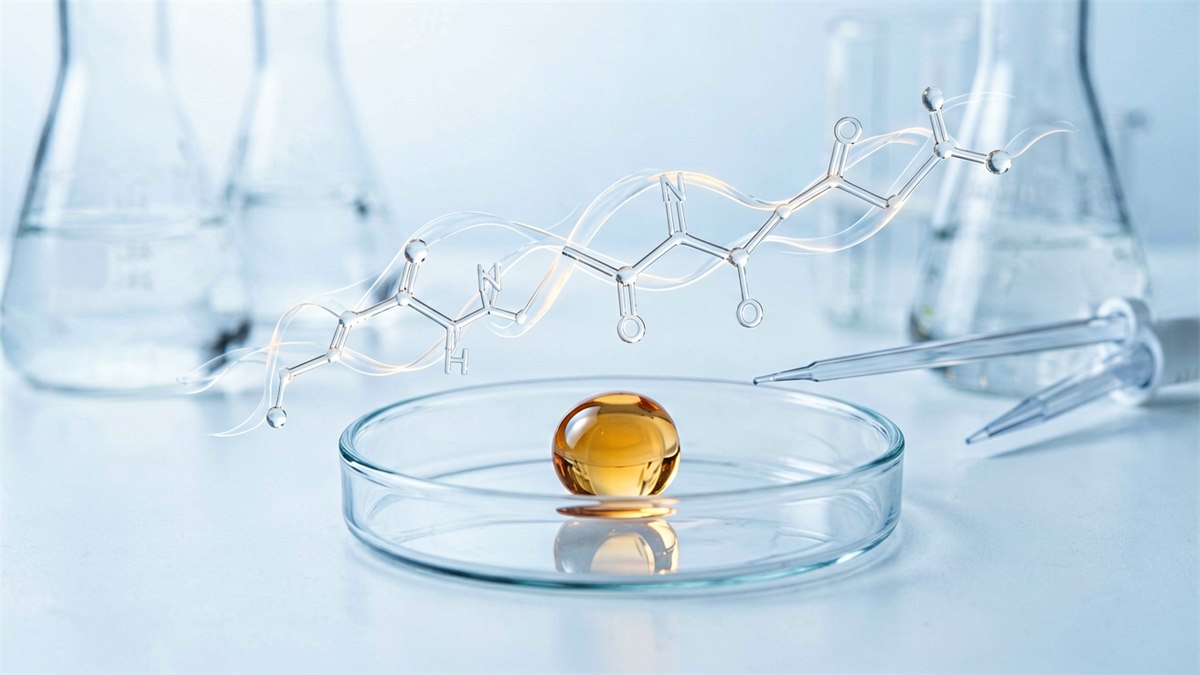
Dioic acid for hyperpigmentation occupies an unusual position in brightening science: it is one of the very few topical actives that measurably lowers melanin output without ever touching the tyrosinase active site. Instead of competing with L-DOPA for a copper-coordinated binding pocket, it works upstream — at the level of gene transcription, through a nuclear receptor. For formulators who have spent a decade stacking catalytic inhibitors and watching efficacy plateau, that distinction matters far more than any percentage printed on a label.
What Dioic Acid Actually Is
Dioic acid is the cosmetic shorthand for octadecenedioic acid, a C18 mono-unsaturated dicarboxylic acid. Structurally, it is oleic acid whose terminal methyl group has been oxidised into a second carboxyl — an omega-oxidation product typically obtained by biotransformation of oleic acid with yeast, rather than by petrochemical routes. The result is a symmetrical, amphiphilic molecule: two ionisable acid heads separated by an eighteen-carbon lipophilic chain containing a single cis double bond.
That architecture explains nearly all of its behaviour. The chain is lipid-like enough to partition into stratum corneum lipids, while the twin carboxyls make the molecule dispersible once neutralised. Crucially, it is not a phenol — a single structural fact that resolves the oxidative stability problem undermining most of the brightening category.
The Mechanism: PPARγ, Not the Enzyme
The mechanistic work behind dioic acid is unusually clean for a cosmetic active. Wiechers and colleagues started from an anomaly: octadecenedioic acid reduced pigmentation, yet did not directly inhibit tyrosinase in enzyme assays. Because the molecule also showed anti-inflammatory and anti-ageing behaviour, the team hypothesised involvement of the peroxisome proliferator-activated receptor (PPAR) family — lipid-sensing nuclear receptors that mediate exactly that combination of effects.[1]
Using reporter gene assays, they demonstrated binding to all three PPAR subtypes, with the strongest interaction at PPARγ (EC50 approximately 1 × 10⁻⁶ M). Activating PPARγ — either with octadecenedioic acid or with rosiglitazone, a pharmaceutical PPARγ agonist used as a positive control — reduced melanogenesis. Downstream analysis showed why: tyrosinase mRNA fell (real-time PCR) and tyrosinase protein fell with it (Western blot).[1]
The causal chain is therefore: receptor binding → reduced tyrosinase transcription → less tyrosinase enzyme synthesised → less melanin. This is regulation of enzyme supply, not enzyme speed. Every arbutin, kojic acid, resorcinol derivative and thiazolyl resorcinol on the market attacks the second variable. Dioic acid attacks the first.
Clinical Evidence in Melasma
Mechanism without clinical endpoints is marketing. Dioic acid has been tested head-to-head against the reference standard.
Tirado-Sánchez, Santamaría-Román and Ponce-Olivera enrolled 96 Mexican women with melasma in a 12-week comparative study. Participants applied either 1% dioic acid cream or 2% hydroquinone cream, twice daily.[2]
- Dioic acid 1%: MASI fell from 14.52 at baseline to 6.05 ± 1.2 at week 12 (P = 0.001)
- Hydroquinone 2%: MASI fell from 15.22 ± 2.4 to 6.34 ± 1.3 (P = 0.001)
- Between-group difference at week 12: not significant (P = 0.287)
- Tolerability: side effects were broadly comparable, but pruritus was more frequent in the hydroquinone arm
A roughly 58% MASI reduction, statistically indistinguishable from 2% hydroquinone, at half the concentration and with less itch. The authors were appropriately cautious — the study was open-label and single-centre, and they explicitly called for controlled, blinded, multicentre confirmation.[2] That caveat still stands, and it is the honest weak point of the dossier.
Why Transcriptional Control Behaves Differently in a Formula
Three practical consequences follow from targeting transcription rather than catalysis.
Kinetics are slower but flatter. Catalytic inhibitors act the moment they reach the melanosome and stop acting the moment they are cleared. Suppressing tyrosinase transcription changes the steady-state pool of enzyme, which takes days to turn over. Expect visible change on a melanocyte-turnover timescale — weeks, not days — but with less rebound between applications.
The oxidation trap disappears. Hydroquinone, kojic acid, ascorbic acid and most resorcinols are electron-rich phenols. They brighten partly because they are readily oxidised — and they discolour in the pack for the same reason. An aliphatic diacid has no such liability: dioic acid does not brown, does not need heavy chelation to survive trace iron and copper, and does not force system pH down into an aggressive range purely to protect the active.
Combination logic changes. Because dioic acid and a classical tyrosinase inhibitor act on different variables of the same output, they are additive by design rather than by hope. Recent reviews of clinically validated hyperpigmentation actives consistently conclude that multi-target, combined approaches outperform single-mechanism regimens.[3] Dioic acid is one of the few ways to add a genuinely orthogonal mechanism instead of a fourth resorcinol.
Four Formulation Constraints
1. Solubility and neutralisation. A long-chain diacid is poorly soluble in cold water and only moderately soluble in most cosmetic esters. In practice it is incorporated hot, then partially neutralised so the carboxyls ionise and disperse. Under-neutralise and you risk recrystallisation on storage — grittiness or a hazy film after freeze-thaw. Run full thermal cycling with polarised light microscopy, not just a 45 °C oven.
2. The pH window is narrower than it looks. Efficacy depends on the molecule crossing the stratum corneum, which favours the un-ionised form, while physical stability favours the ionised form. Push pH too high and you have an elegant, permanently stable, poorly penetrating salt. A mildly acidic finished pH keeps a workable fraction un-ionised while retaining barrier compatibility.
3. It is surface-active — treat it as part of the emulsifier system. An ionised C18 diacid is effectively a soap. At 1% it interacts with your primary emulsifier, shifts the effective HLB, and can thin a carbomer-thickened system through electrolyte effects. Rebuild the emulsifier ratio around it rather than dropping it into an existing base.
4. Watch the polyvalent cations. Dicarboxylates form insoluble salts with calcium, magnesium and zinc. Zinc oxide sunscreen bases, zinc PCA and hard process water are all realistic failure routes. Use deionised water and reconsider any zinc-containing companion active.
Where It Fits in a 2026 Brightening System
The current model of hyperpigmentation extends well beyond melanocyte enzymology to the melanocyte microenvironment, melanosome transport and transfer, epidermal homeostasis and dermal fibroblast signalling.[3][4] A defensible modern system covers several nodes at once: broad-spectrum photoprotection including visible light; an antioxidant layer; a catalytic tyrosinase inhibitor; a transfer or turnover modulator; and — the layer almost everyone omits — transcriptional suppression of tyrosinase itself. Dioic acid is the best-evidenced cosmetic option for that last slot. Its PPARγ agonism plausibly adds anti-inflammatory benefit relevant to post-inflammatory pigmentation, though that endpoint has not been isolated clinically.
The Honest Assessment
The mechanistic data are strong and specific. The clinical dataset is a single 96-patient open-label comparison from 2009 — encouraging and non-inferior to 2% hydroquinone, but not replicated at the scale tranexamic acid or thiamidol now enjoy. Anyone claiming dioic acid is “proven equivalent to hydroquinone” is over-reading one study.
What is defensible: dioic acid delivers a mechanism nothing else in the cosmetic toolkit provides, at roughly 1% use level, with excellent oxidative stability and less pruritus than hydroquinone. In a category where most launches recombine the same six phenols, an orthogonal, non-oxidising, receptor-mediated active is a genuine asset — provided the solubility, pH and cation constraints are respected at the first bench trial rather than discovered during stability testing.
References
- Wiechers JW, Rawlings AV, Garcia C, Chesné C, Balaguer P, Nicolas JC, Corre S, Galibert MD. A new mechanism of action for skin whitening agents: binding to the peroxisome proliferator-activated receptor. International Journal of Cosmetic Science. 2005;27(2):123–132. doi:10.1111/j.1467-2494.2004.00256.x
- Tirado-Sánchez A, Santamaría-Román A, Ponce-Olivera RM. Efficacy of dioic acid compared with hydroquinone in the treatment of melasma. International Journal of Dermatology. 2009;48(8):893–895. doi:10.1111/j.1365-4632.2009.04105.x
- Decoding Hyperpigmentation from Biological Mechanisms to Actives with Clinically Proven Topical Efficacy: A Narrative Review. Dermatology and Therapy (Heidelberg). 2026. doi:10.1007/s13555-026-01807-w
- Melanosome Transport and Processing in Skin Pigmentation: Mechanisms and Targets for Pigmentation Modulation. International Journal of Molecular Sciences. 2025;26(17):8630. doi:10.3390/ijms26178630
This article is provided for formulation science education. It is not medical advice, and it does not constitute a claim of therapeutic efficacy for any finished cosmetic product.
Interested in Formulation Data Collaboration?
Let's discuss how Melasyl AI can accelerate your next whitening or brightening formula. Technical collaboration, data licensing, or custom AI-driven research — reach out.
Contact Wei →