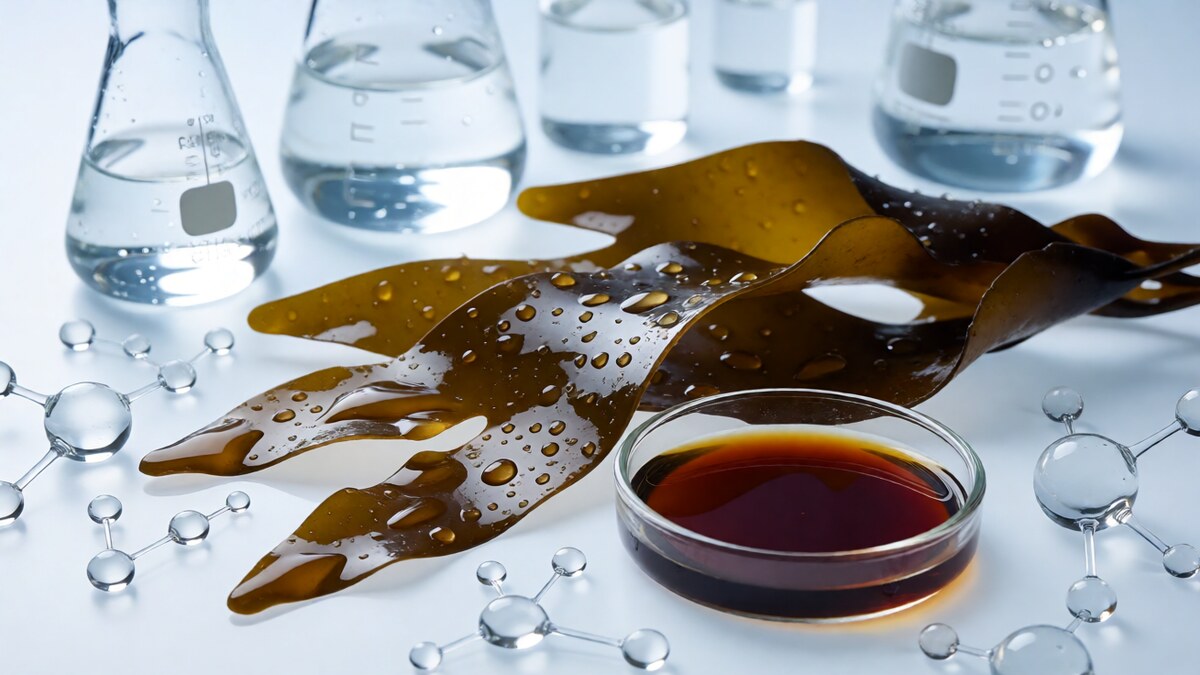
For years, Ecklonia cava lived quietly near the bottom of the ingredient list as a soothing marine antioxidant. In 2026 it is being re-examined for a different job: pigment control. The reason is not marketing drift but hard enzymology. Phlorotannins isolated from this brown alga inhibit tyrosinase through a slow-binding, competitive mechanism, and dieckol — its largest phloroglucinol polymer — has outperformed kojic acid in head-to-head tyrosinase assays. This article breaks down the mechanism, the clinical evidence (and its limits), and how to formulate with it.
What Is Ecklonia cava?
Ecklonia cava is a perennial brown macroalga (family Laminariaceae) that grows along the coasts of Jeju Island, Korea and neighbouring East Asian waters. It is edible, and in Korea it is also an approved health-functional ingredient. Its signature chemistry is the phlorotannins — polyphenols built from phloroglucinol units that occur only in brown algae. The fraction includes:
- Dieckol — a phloroglucinol hexamer, generally the most potent anti-tyrosinase component;
- Eckol — a trimer;
- Phlorofucofuroeckol A, 2-phloroeckol and the bieckols — minor but highly active congeners.
In cosmetics these appear as Ecklonia Cava Extract or standardized Ecklonia Cava Phlorotannins.
Mechanism of Action: Three Layers of Pigment Control
1. Direct, slow-binding tyrosinase inhibition
Tyrosinase is the copper-dependent, rate-limiting enzyme that converts tyrosine into DOPA and onward into melanin. Heo et al. (Toxicology in Vitro, 2009) isolated phloroglucinol, eckol and dieckol from E. cava and tested them against tyrosinase activity and melanin synthesis. Dieckol produced the strongest inhibition in both assays and, in the tyrosinase assay, was more potent than kojic acid. Activity scaled with polymer size: dieckol (hexamer) > eckol (trimer) > phloroglucinol (monomer).
Later enzyme-kinetics work resolved how these molecules bind. Two minor E. cava phlorotannins returned IC50 values of 7.0 ± 0.2 and 8.8 ± 0.1 µM against tyrosinase, acting as competitive, slow-binding inhibitors — a pharmacologically desirable mode associated with prolonged enzyme suppression. Molecular docking placed both compounds at the catalytic site, hydrogen-bonding to His85 and Asn260 (PMC6627058, 2019).
2. Upstream control of the oxidative-inflammatory axis (TXNIP/NLRP3/IL-18 → MITF)
Tyrosinase inhibition alone rarely controls melasma or post-inflammatory hyperpigmentation, because UV and inflammation drive melanogenesis from upstream. Byun et al. (Antioxidants, 2024) tested phlorotannins combined with extracellular vesicles from E. cava on UV-exposed keratinocytes and animal skin. The combination reduced UV-induced oxidative stress (measured as 8-OHdG), blocked the binding of TXNIP to NLRP3, lowered IL-18 secretion, and downstream reduced PKA/p38 signalling, MITF, tyrosinase, TRP-1 and TRP-2 — with a measurable fall in melanin content and restoration of basement-membrane components. In other words, E. cava phlorotannins hit the inflammasome-to-MITF pipeline that keeps pigment recurring.
3. UV-B photoprotection and antioxidant reserve
In the same 2009 study, phlorotannins reduced UV-B-induced intracellular ROS, improved fibroblast viability in a dose-dependent manner, and cut UV-B-induced DNA damage in a comet assay. Their many phenolic hydroxyl groups make them among the stronger marine-derived antioxidants — useful when the formulation goal is to interrupt the oxidative trigger of pigmentation rather than only bleach existing melanin.
The Evidence: Strong Preclinical, Thin Human Skin Data
It is worth being precise. The mechanistic and animal evidence for E. cava phlorotannins in pigmentation is strong and consistent. Human topical clinical trials remain limited, and there is no head-to-head trial of a topical E. cava product against hydroquinone, tranexamic acid or thiamidol. What human data exist are oral, and they establish the class as safe and bioavailable rather than proving a skin-lightening endpoint:
- A 12-week randomized, double-blind, placebo-controlled trial in hypercholesterolemia (n=80) found E. cava extract lowered LDL-cholesterol by roughly 11% with no causal adverse reactions (Choi et al., Int J Pharmacol, 2015).
- A randomized trial of phlorotannins at 500 mg/day improved subjective sleep quality, underpinning Korea’s approved functional claim for sleep.
- Glycemic randomized trials (including 600 mg single-dose and 12-week dieckol arms) show consistent postprandial glucose effects and good tolerability.
Practical reading: treat E. cava as a mechanistically credible, well-tolerated emerging active and a strong supporting player — not a replacement for established first-line brighteners.
2026 Market Context
The marine “blue beauty” wave and Korea’s ingredient-first consumer culture have made E. cava a familiar name, but mostly for soothing and antioxidant positioning. The pigment mechanism is the differentiator still largely unexploited — a rare combination of consumer familiarity and a still-open competitive shelf. For Southeast Asian markets, where UV, pollution and inflammation-driven PIH dominate, a multi-pathway marine active is a natural fit.
Formulation Science
- Choose the right feedstock. A standardized phlorotannin extract with a stated total-phenol or dieckol content behaves differently from a generic “extract.” Potency tracks the phlorotannin fraction, not the label.
- Solubility. Phlorotannins are polar and water/glycol-soluble, which suits serums, essences and gels. Poor skin penetration is the main limitation; consider glycol-rich systems or encapsulation to improve delivery.
- Concentration. Typical cosmetic use is roughly 0.1–2% extract; dieckol-enriched fractions are used considerably lower. In-vitro activity is reported in the low-micromolar range, so optimize for delivery rather than brute-force loading.
- pH and chelation. Formulate mildly acidic to near-neutral (about pH 4.5–6.5) and avoid strongly alkaline systems. A chelator (phytic acid or EDTA) supports both stability and antioxidant performance.
- Oxidation and colour. Polyphenols oxidize and drift toward tan/brown. Add the extract during cool-down (<40 °C), protect it with a co-antioxidant network (ferulic acid, tocopherol, sodium metabisulfite) and package in airless or opaque containers.
- Compatibility. Pairs well with niacinamide, tranexamic acid, alpha-arbutin and vitamin-C derivatives for multi-pathway brightening; the phlorotannin + extracellular-vesicle pairing reported in 2024 points to a credible next-generation format.
Safety and Tolerability
E. cava extract is generally well tolerated at cosmetic concentrations, with no significant adverse effects reported; oral phlorotannin randomized trials likewise show good tolerability. As with any botanical polyphenol, patch testing is sensible. Position the ingredient for tone evenness and post-inflammatory marks rather than as a treatment for medical melasma.
Outlook
Ecklonia cava is a rare marine active with both a rigorous mechanistic story and a still-open market. The enzymology is elegant — slow-binding tyrosinase inhibition plus inflammasome-level control of the pigment cascade — and the safety record is reassuring. The missing piece is human topical proof, and the brands that invest in delivery science and honest claims now will be the ones holding the data when that evidence arrives.
References
- Heo SJ, Ko SC, Cha SH, et al. Effect of phlorotannins isolated from Ecklonia cava on melanogenesis and their protective effect against photo-oxidative stress induced by UV-B radiation. Toxicology in Vitro. 2009;23(6):1123–1130. doi:10.1016/j.tiv.2009.05.013 (PMID: 19490939)
- Byun KA, Park Y, Oh S, et al. Co-treatment with phlorotannin and extracellular vesicles from Ecklonia cava inhibits UV-induced melanogenesis. Antioxidants (Basel). 2024;13(4):408. doi:10.3390/antiox13040408 (PMCID: PMC11047619)
- Slow-binding inhibition of tyrosinase by Ecklonia cava phlorotannins. 2019. PMCID: PMC6627058.
- Choi EK, Park SH, Ha KC, et al. Clinical trial of the hypolipidemic effects of a brown alga Ecklonia cava extract in patients with hypercholesterolemia. International Journal of Pharmacology. 2015;11(7):798–805. doi:10.3923/ijp.2015.798.805
- The role of phlorotannins to treat inflammatory diseases. Chemistry (MDPI). 2025. doi:10.3390/chemistry7030077
Interested in Formulation Data Collaboration?
Let's discuss how Melasyl AI can accelerate your next whitening or brightening formula. Technical collaboration, data licensing, or custom AI-driven research — reach out.
Contact Wei →