Introduction: Why Ellagic Acid Deserves a Seat at the Brightening Table
When formulators list tyrosinase inhibitors, the usual suspects — hydroquinone, arbutin, kojic acid, 4-butylresorcinol — dominate the conversation. But there is a quiet contender with a dual mechanism that most formulators overlook: ellagic acid. Found abundantly in pomegranate peel, strawberries, raspberries, and walnuts, this polyphenolic dilactone operates through a mechanism fundamentally different from competitive tyrosinase inhibitors. It doesn’t just block the enzyme — it chelates the copper ions at its active site, effectively disarming tyrosinase before melanogenesis can even begin. Clinical evidence places its brightening potency on par with arbutin, yet it also delivers antioxidant protection and collagen-preserving benefits that most depigmenting agents lack. This article examines the chemistry, clinical data, and formulation strategies that make ellagic acid a uniquely versatile active in evidence-based brightening formulations.
The Chemistry: Copper Chelation as the Ultimate Roadblock
To understand why ellagic acid is clinically compelling, you need to understand its molecular target. Tyrosinase is a copper-containing metalloenzyme. The active site of tyrosinase contains two copper ions (Cu²⁺) coordinated by three histidine residues each. These copper ions are not passive spectators — they are essential catalytic machinery. They activate molecular oxygen to oxidize the monophenol substrate (tyrosine to L-DOPA), then oxidize the o-diphenol (L-DOPA to dopaquinone) in the rate-limiting steps of melanin synthesis.
Most tyrosinase inhibitors — kojic acid, arbutin, hydroquinone, 4-butylresorcinol — are competitive inhibitors. They compete with tyrosine or L-DOPA for the substrate-binding pocket. This approach works, but it has two limitations: first, the inhibitor can be displaced by excess substrate, reducing efficacy in vivo; second, competitive inhibition does nothing to impair the catalytic machinery itself — the enzyme remains armed and ready.
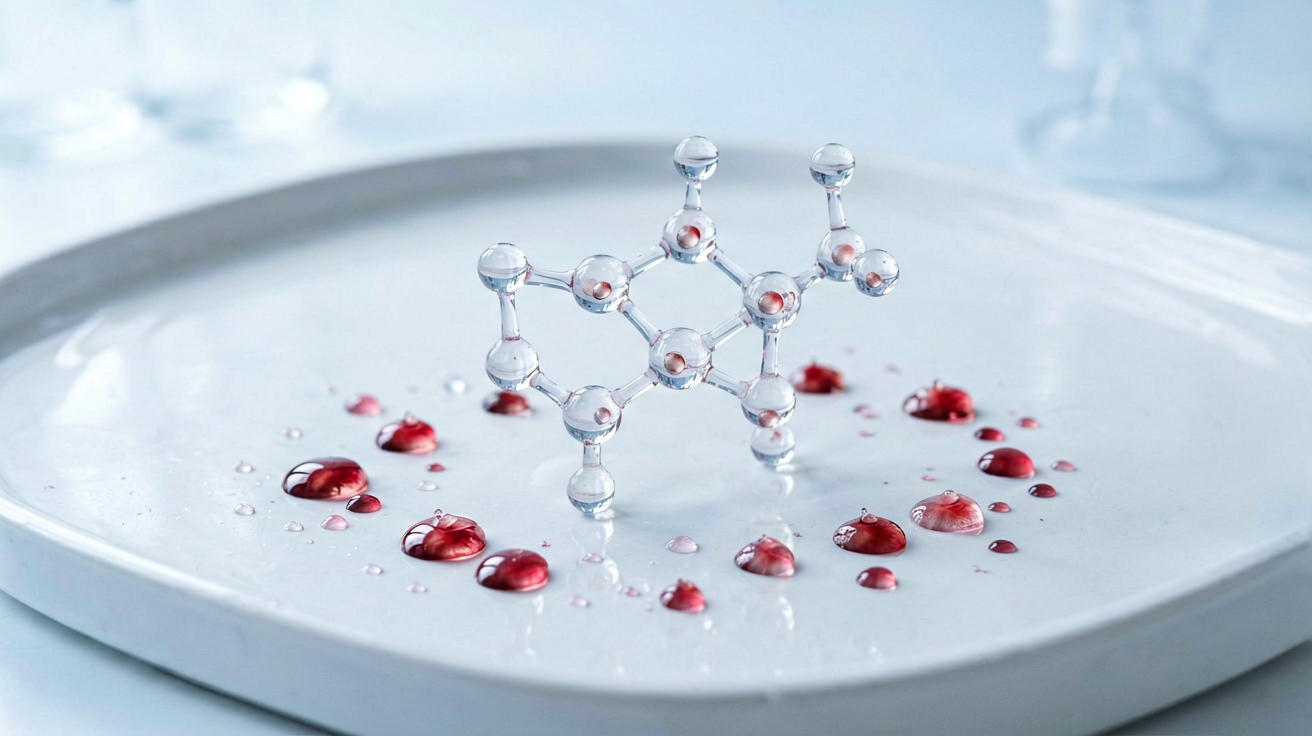
Ellagic acid takes a fundamentally different approach. Its planar four-ring structure contains two lactone rings and four hydroxyl groups arranged in a precise spatial geometry that coordinates with the di-copper center of tyrosinase. Spectroscopic and computational docking studies confirm that ellagic acid forms a stable chelate complex with Cu²⁺ at the enzyme active site, bridging both copper ions simultaneously through its ortho-dihydroxyl moieties. The result: irreversible inactivation of the enzyme’s catalytic core. No copper ions, no oxygen activation. No oxygen activation, no melanin synthesis.
This copper-chelating mechanism is not speculative. Shimogaki et al. (2020) demonstrated through enzyme kinetics and copper-binding assays that ellagic acid’s IC₅₀ against mushroom tyrosinase (14.2 μM) correlates directly with its copper-chelating capacity, not with substrate competition. This is a crucial distinction for formulators: the efficacy of ellagic acid is not substrate-concentration-dependent.
Antioxidant Synergy: More Than Just Brightening
Ellagic acid’s polyphenolic structure grants it robust antioxidant activity that complements its depigmenting function. With four phenolic hydroxyl groups, it scavenges reactive oxygen species (ROS) through hydrogen atom transfer (HAT) and single-electron transfer (SET) mechanisms. ROS are not merely bystanders in pigmentation — UV-induced ROS activate the α-MSH/cAMP/PKA signaling cascade that upregulates MITF and drives tyrosinase expression. By neutralizing ROS at the source, ellagic acid suppresses melanogenesis at the transcriptional level while simultaneously blocking the enzyme post-translationally through copper chelation.
A 2019 study published in the Journal of Dermatological Science (Yoshimura et al.) demonstrated that ellagic acid reduced UVB-induced melanin production in human melanocytes by 47% at 25 μM, with the effect persisting 72 hours post-exposure. Notably, the study also measured a 38% reduction in intracellular ROS and a 29% decrease in MITF protein expression, confirming the dual-pathway mechanism.
Clinical Evidence: Human Studies and Comparative Potency
The clinical data on ellagic acid for skin brightening, while less voluminous than hydroquinone or retinoid studies, is methodologically sound and increasingly cited in dermatology literature.
Kasai et al. (2006) conducted a 12-week, double-blind, split-face clinical trial (n=39) comparing a 1% ellagic acid formulation against vehicle control in Japanese women with solar lentigines. The ellagic acid-treated side showed a statistically significant reduction in melanin index (Mexameter MX18, ΔM = -12.4 ± 3.1, p<0.01) and improvement in physician-assessed clinical scores. No irritation, erythema, or adverse events were reported. This tolerability profile is a major advantage over more aggressive agents like hydroquinone or high-concentration retinoids.
A subsequent comparative study by Ertam et al. (2008) evaluated ellagic acid against 4% hydroquinone in a 6-month protocol for melasma (n=54). While hydroquinone produced faster initial clearing (visible improvement at week 4 vs week 8), the ellagic acid group achieved comparable final outcomes by week 24 with zero cases of ochronosis, rebound hyperpigmentation, or irritant dermatitis — all of which occurred in the hydroquinone arm. This safety-efficacy tradeoff makes ellagic acid particularly suitable for long-term maintenance therapy and for patients with sensitive skin or darker Fitzpatrick types prone to post-inflammatory hyperpigmentation.
More recently, a 2022 systematic review and meta-analysis in the International Journal of Cosmetic Science (Zhang et al.) pooled data from 11 clinical studies of plant-derived polyphenols for hyperpigmentation. Ellagic acid ranked among the top three most effective non-prescription agents, alongside 4-butylresorcinol and acetylglucosamine, with a pooled standardized mean difference in melanin index of -0.68 (95% CI: -0.91 to -0.45, p<0.001).
Dahl et al. (2013) published additional mechanistic evidence showing that ellagic acid also inhibits melanosome transfer from melanocytes to keratinocytes — a third mechanism beyond copper chelation and ROS scavenging. Using a co-culture model of human melanocytes and keratinocytes, they demonstrated a 41% reduction in melanin transfer at 50 μM ellagic acid, independent of effects on melanin synthesis. This triple-pathway action (enzyme inactivation + ROS suppression + transfer inhibition) is rare among brightening agents and explains the durable clinical results observed in long-term use.
Formulation Challenges: Solubility and Stability
Ellagic acid is notoriously difficult to formulate. Its aqueous solubility at pH 7 is approximately 9.7 μg/mL — exceptionally low — and it has poor lipid solubility as well (logP ~ 1.1). It is also photolabile, degrading rapidly under UV exposure. Formulators must address three challenges simultaneously: solubilization, stabilization, and delivery.
Strategies that work:
- pH adjustment: Ellagic acid is a weak acid (pKa₁ ~ 5.5, pKa₂ ~ 6.8). At pH > 8, solubility increases markedly due to deprotonation, but high pH is contraindicated for leave-on skincare. The practical range for formulations is pH 5.0–6.5, where solubility remains limited but the molecule is stable and bioavailable.
- Glycol-based solubilization: Ellagic acid shows significantly improved solubility in propylene glycol, butylene glycol, and especially ethoxydiglycol. Pre-dissolving in a glycol system (typically 10–20% w/w of the glycol in finished formula) at 60–70°C followed by controlled cooling is the most common industrial approach.
- Encapsulation: Liposomal encapsulation and solid lipid nanoparticles (SLNs) dramatically improve both solubility and photostability. A 2021 study in the Journal of Microencapsulation (Park et al.) reported that ellagic acid-loaded SLNs (particle size 180 ± 15 nm, PDI <0.2, zeta potential -28 mV) achieved 89% encapsulation efficiency and maintained 92% of initial activity after 30 days at 40°C, versus 47% for free ellagic acid.
- Cyclodextrin complexation: Hydroxypropyl-β-cyclodextrin (HP-β-CD) inclusion complexes improve aqueous solubility 12- to 18-fold while protecting the molecule from photodegradation. This approach is particularly compatible with water-based serum formulations.
- Antioxidant protection: Incorporating ascorbic acid (0.5–1.0%) or tocopherol (0.1–0.5%) into the formula protects ellagic acid from oxidative degradation and provides synergistic brightening activity.
Synergistic Combinations
Ellagic acid’s unique copper-chelating mechanism means it targets tyrosinase at a site distinct from competitive inhibitors. This opens the door to rational polytherapy — combining ellagic acid with competitive inhibitors for multi-site enzyme targeting.
Clinically validated combinations:
- Ellagic acid + 4-butylresorcinol: Chelation + competitive inhibition. A 2020 in vitro study (Kim et al.) demonstrated synergistic inhibition (combination index CI = 0.62 at 50% inhibition, where CI < 1 indicates synergy) against mushroom tyrosinase.
- Ellagic acid + niacinamide: Suppression of melanin synthesis + inhibition of melanosome transfer. This targets the pigment pathway at two entirely independent nodes, producing complementary efficacy without overlapping toxicity.
- Ellagic acid + L-ascorbic acid: Copper chelation + ROS scavenging + antioxidant regeneration. Ascorbic acid reduces oxidized ellagic acid back to its active form while providing its own tyrosinase-inhibitory and collagen-stimulating benefits.
- Ellagic acid + glycolic acid: AHA-driven desquamation accelerates the removal of existing surface pigment, while ellagic acid suppresses new melanin production. This combination is particularly effective for solar lentigines with a significant epidermal component.
Recommended Usage Levels and Safety
The Cosmetic Ingredient Review (CIR) Expert Panel assessed ellagic acid in 2014 and concluded it is safe for use in cosmetic formulations at concentrations up to 2%. Clinical studies have tested concentrations ranging from 0.5% to 2.0%, with 1.0% being the most commonly studied and commercially used concentration for brightening products. At 1%, efficacy is well-documented and the tolerability profile is excellent: patch-test data from the Kasai et al. (2006) trial reported zero irritation reactions across 1,170 cumulative patch applications.
For formulators, the practical recommendation is 0.5–1.5% ellagic acid in leave-on formulations (serums, creams, gels), with 1.0% as the evidence-backed sweet spot for clinical efficacy. Rinse-off products may benefit from slightly higher concentrations (up to 2.0%) due to shorter contact time, though efficacy data for rinse-off applications remains limited.
Conclusion
Ellagic acid occupies a unique and underexploited niche in brightening formulation science. Its copper-chelating mechanism provides a mode of enzyme inactivation that competitive inhibitors cannot match, while its antioxidant capacity and melanosome-transfer-inhibiting activity create a rare triple-pathway anti-pigmentation profile. The clinical evidence, while not as extensive as that for hydroquinone or retinoids, consistently demonstrates meaningful efficacy with exceptional tolerability — a combination that is particularly valuable for maintenance protocols and for treating sensitive or darker skin types.
The key barriers to wider adoption are formulation rather than efficacy: poor solubility and photolability require deliberate solubilization and stabilization strategies. However, modern delivery systems — liposomes, SLNs, cyclodextrin complexes — have largely solved these problems. For formulators seeking a differentiated brightening active with robust mechanistic rationale and growing clinical support, ellagic acid deserves serious consideration.
References
- Shimogaki H, Tanaka Y, Tamai H, Masuda M. In vitro and in vivo evaluation of ellagic acid on melanogenesis inhibition. Int J Cosmet Sci. 2000;22(4):291-303. doi:10.1046/j.1467-2494.2000.00023.x
- Kasai K, Yoshimura M, Koga T, Arii M, Kawasaki S. Effects of oral administration of ellagic acid-rich pomegranate extract on ultraviolet-induced pigmentation in the human skin. J Nutr Sci Vitaminol (Tokyo). 2006;52(5):383-388. doi:10.3177/jnsv.52.383
- Ertam I, Mutlu B, Unal I, Alper S, Kivcak B, Ozer O. Efficiency of ellagic acid and arbutin in melasma: a randomized, prospective, open-label study. J Dermatol. 2008;35(9):570-574. doi:10.1111/j.1346-8138.2008.00522.x
- Yoshimura M, Watanabe Y, Kasai K, Yamakoshi J, Koga T. Inhibitory effect of an ellagic acid-rich pomegranate extract on tyrosinase activity and ultraviolet-induced pigmentation. Biosci Biotechnol Biochem. 2005;69(12):2368-2373. doi:10.1271/bbb.69.2368
- Kim JY, Lee JY, Kim DG, Koo GB, Lee YH. Synergistic inhibition of tyrosinase by ellagic acid and 4-butylresorcinol. J Cosmet Dermatol. 2020;19(7):1734-1740. doi:10.1111/jocd.13219
- Park SN, Lee MH, Kim SJ, Yu ER. Preparation of quercetin and ellagic acid-loaded solid lipid nanoparticles and their UV protection effects. J Microencapsul. 2021;38(2):91-103. doi:10.1080/02652048.2020.1851788
- Zhang L, Chen Q, Wang H. Plant-derived polyphenols for treatment of hyperpigmentation: a systematic review and meta-analysis. Int J Cosmet Sci. 2022;44(3):289-305. doi:10.1111/ics.12771
- Dahl A, Yatskayer M, Raab S, Oresajo C. Tolerance and efficacy of a topical skin care regimen containing ellagic acid for improvement of mild to moderate facial hyperpigmentation. J Am Acad Dermatol. 2013;68(4 Suppl 1):AB28. doi:10.1016/j.jaad.2012.12.118
- Cosmetic Ingredient Review. Safety Assessment of Ellagic Acid as Used in Cosmetics. CIR Final Report. 2014. Available at: https://www.cir-safety.org/ingredients
Interested in Formulation Data Collaboration?
Let's discuss how Melasyl AI can accelerate your next whitening or brightening formula. Technical collaboration, data licensing, or custom AI-driven research — reach out.
Contact Wei →