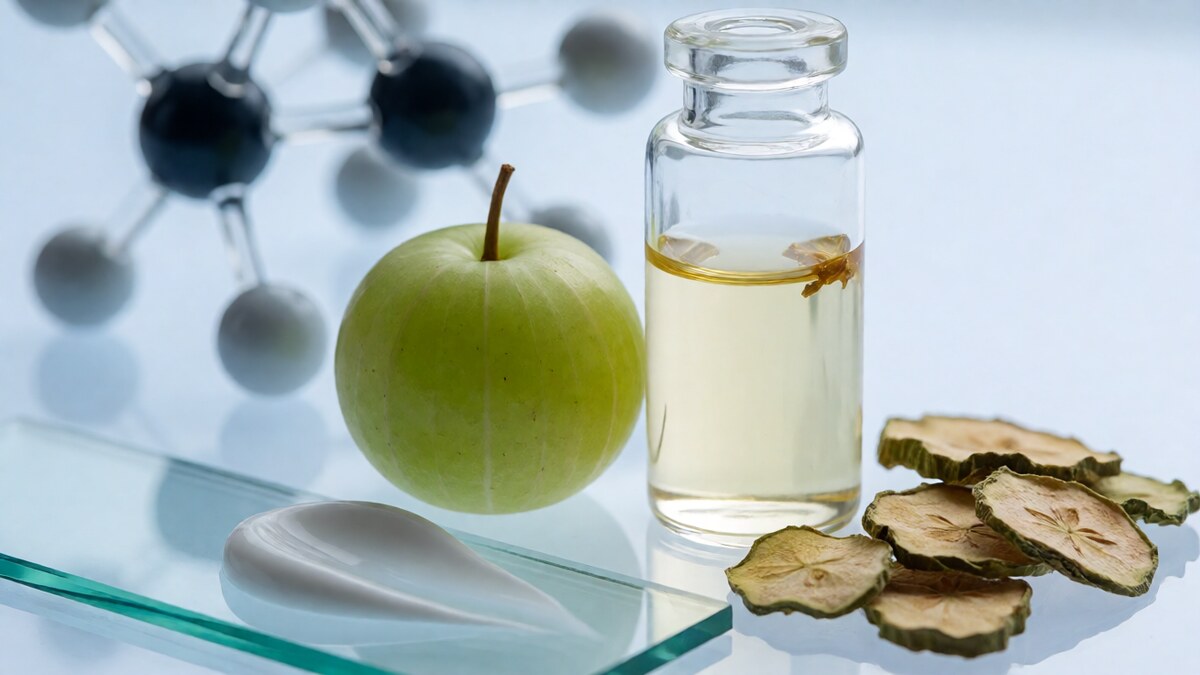
Why Amla Is Having Its Moment in Brightening Formulation
Indian gooseberry — Emblica officinalis, or amla — has sat in Ayurvedic medicine for centuries. In 2026 it is showing up in a very different place: the active list of premium brightening serums across Asia. The reason is not folklore. It is a rare combination of a stable antioxidant architecture and a genuinely multi-target anti-melanogenic profile that formulators can standardize and defend with clinical data.
This analysis breaks down what amla extract actually does at the melanocyte, why its tannins behave differently from ascorbic acid, and what the human trials — including a head-to-head against hydroquinone — really show.
The Chemistry: Emblicanin Tannins, Not Just Vitamin C
Amla is famous for its high natural vitamin C content, but the brightening activity does not come from ascorbate alone. The dominant actives are low-molecular-weight hydrolyzable tannins — emblicanin A and emblicanin B — alongside gallic acid, ellagic acid, and other ellagitannins such as chebulagic acid, pedunculagin, geraniin, and corilagin.
The distinguishing feature is a “cascading” antioxidant mechanism. Where L-ascorbic acid can turn pro-oxidant after neutralizing a radical, emblicanin A converts into emblicanin B, which continues scavenging. This chain reaction sustains antioxidant pressure in lipid membranes and near DNA rather than burning out in a single pass. For a brightening formula, that matters: oxidative stress from UV and pollution is one of the upstream triggers of melanocyte over-activation, so a longer-lived radical sink translates into a longer window of pigment protection.
Mechanism 1: Direct Tyrosinase Inhibition
Tyrosinase is the rate-limiting enzyme of melanogenesis, a copper-dependent oxidase that converts tyrosine to dopaquinone. Amla’s polyphenols inhibit it through two complementary routes. Gallic and ellagic acid chelate the binuclear copper center of the enzyme’s active site, while the larger tannins provide steric interference. In vitro work has repeatedly placed amla fractions in the same inhibitory range as reference actives such as kojic acid, with the ethyl-acetate and methanol fractions showing the strongest DPPH radical scavenging and tyrosinase inhibition.
Because the inhibition is a mix of chelation and competitive binding rather than a single-site block, amla does not depend on one molecular interaction to work — an important resilience factor when the extract is standardized across batches.
Mechanism 2: MITF and the TRP Axis
Tyrosinase inhibition only addresses the enzyme already present. The more durable lever is transcription. Wang and colleagues (Food Bioscience, 2019) treated B16F10 melanoma cells with Phyllanthus emblica fruit extract powder at 0.001–1 mg/mL and tracked the full melanogenic cassette by qRT-PCR and Western blot. At 1 mg/mL the extract suppressed MITF, the master transcription factor of pigment production, together with its downstream targets tyrosinase, TRP-1, and TRP-2 (dopachrome tautomerase) — with no significant cytotoxicity across the tested range.
This is the mechanism that separates a cosmetic-level “brightener” from an active that changes pigment output over weeks. By lowering MITF, amla reduces the total enzymatic machinery for melanin synthesis rather than merely slowing a single step.
Mechanism 3: Collagen Protection and the Photoaging Overlap
Pigmentation and photoaging share a driver: UV-induced matrix metalloproteinases. Fujii et al. (Journal of Ethnopharmacology, 2008) showed that amla extract promotes procollagen production and inhibits MMP-1 in human skin fibroblasts. The 2021 amla-branch study added MMP-2 inhibition to the profile. The practical implication is that a single standardized extract can address both the pigment trigger and the collagen-degradation cascade that produces the dull, uneven tone associated with chronic sun exposure — a dual claim most single-pathway actives cannot make.
The Clinical Evidence: What Human Trials Show
The strongest human data point remains the combination trial by Costa et al. (Anais Brasileiros de Dermatologia, 2010). Fifty-six women with epidermal or mixed melasma were randomized to either a 7% emblica + licorice + belides complex applied twice daily or 2% hydroquinone at night, over 60 days. Depigmentation was statistically significant in both arms, and the difference between them was not statistically significant (medical assessment: 78.3% vs 88.9%). Critically, the botanical arm recorded far fewer adverse events — two versus seven — making amla-based complexes a tolerability-friendly alternative to hydroquinone for maintenance phases.
For amla in isolation, Chaikul et al. (Journal of Traditional and Complementary Medicine, 2021; PMID 34522633) ran a randomized, double-blind, placebo-controlled study in 20 volunteers over 84 consecutive days using a 0.1% standardized extract gel. Chromameter and Mexameter readings showed a significant increase in ITA° and a reduction in the melanin index versus the base gel, alongside improvements in elasticity, hydration, and wrinkle parameters. Earlier placebo-controlled work on a 3% Emblica officinalis cream measured lightening by Chromameter L* value beginning at week four.
The honest read: the combination data are strong and comparator-controlled; the isolated-extract data are positive but small and shorter. Amla’s case is built on mechanism plus a favorable safety profile, not on a single large monotherapy trial.
Formulation Reality Check
- Water-soluble and pH-flexible: stable across roughly pH 3–7, which makes it far easier to co-formulate with niacinamide and amino-acid systems than L-ascorbic acid.
- Use 0.1–2% standardized extract as the typical functional range; efficacy is tied to tannin standardization, so specify emblicanin content, not just “amla extract.”
- Synergies: pair with niacinamide for dual-pathway control (production + melanosome transfer), with ferulic acid for photoprotection, and with ascorbic acid as a stabilizer and antioxidant-network partner.
- Watch-outs: high concentrations can tint the finished product, and metal-ion contamination can drive discoloration — use chelated water and compatible packaging.
The Bottom Line
Amla earns its 2026 placement. It combines a cascading tannin antioxidant system, direct copper-chelation of tyrosinase, MITF-level transcriptional suppression, and MMP inhibition — a multi-target profile backed by a comparator-controlled melasma trial and a placebo-controlled 84-day study. For formulators chasing a stable, well-tolerated brightening active that plays well with niacinamide and ferulic acid, Emblica officinalis is one of the few botanicals where the biochemistry and the clinical record point the same direction.
References
- Costa A, et al. Association of emblica, licorice and belides as an alternative to hydroquinone in the clinical treatment of melasma. An Bras Dermatol. 2010.
- Chaikul P, et al. Phyllanthus emblica L. (amla) branch: a safe and effective ingredient against skin aging. J Tradit Complement Med. 2021;11(5):390–399.
- Wang YC, et al. Inhibitions of melanogenesis via Phyllanthus emblica fruit extract powder in B16F10 cells. Food Bioscience. 2019.
- Fujii T, et al. Amla (Emblica officinalis Gaertn.) extract promotes procollagen production and inhibits MMP-1 in human skin fibroblasts. J Ethnopharmacol. 2008;119:53–57.
Interested in Formulation Data Collaboration?
Let's discuss how Melasyl AI can accelerate your next whitening or brightening formula. Technical collaboration, data licensing, or custom AI-driven research — reach out.
Contact Wei →