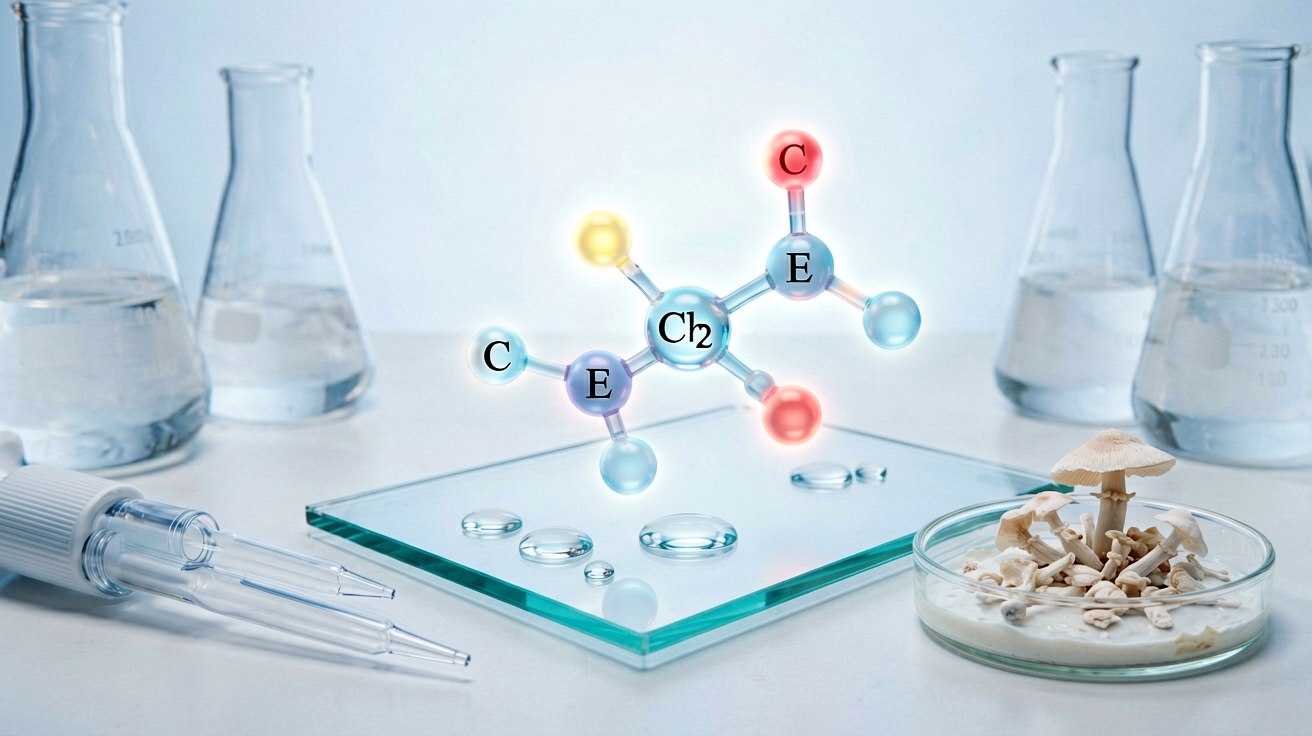
Ergothioneine has moved from a niche biochemistry footnote to one of the most talked-about actives of 2026. Positioned at the intersection of the “longevity beauty” movement and the mature antioxidant category, ergothioneine skincare is being reframed not as another free-radical scavenger, but as a cell-protective “longevity vitamin” with a dedicated transport system in human skin. This review examines the mechanism, the clinical and preclinical evidence, and why formulators across Southeast Asia and beyond are prioritising this amino-acid-derived compound.
What Is Ergothioneine, and Why the 2026 Momentum?
Ergothioneine (EGT) is a naturally occurring, sulphur-containing amino acid derivative synthesised primarily by fungi and certain bacteria. Humans cannot make it; we obtain it through diet, with mushrooms being the richest source. What sets EGT apart from typical topical antioxidants is that the body treats it as something worth actively conserving.
The interest surge tracks a broader shift. Market analysts including WGSN and Mintel have named “longevity” and “skin cell health” among the defining beauty themes of 2025-2026, moving the conversation from surface correction toward cellular resilience. Grand View Research values the global cosmetic antioxidants market at several billion USD with a high-single-digit CAGR through the decade, and ergothioneine has emerged as a premium ingredient riding that wave — commanding formulation attention despite a historically high raw-material cost that biofermentation has recently begun to lower.
Mechanism: A Transporter-Backed Cytoprotectant
The scientific case for ergothioneine rests on a discovery that reframed how researchers view it. In 2005, Gründemann and colleagues identified that ergothioneine is the physiological substrate of a specific membrane transporter, OCTN1 (encoded by the gene SLC22A4), published in the Proceedings of the National Academy of Sciences. The existence of a dedicated transporter strongly implies a physiological role — cells invest energy to import and retain EGT.
This logic underpins the “longevity vitamin” hypothesis advanced by Bruce Ames (PNAS, 2018), which groups ergothioneine among compounds that are not strictly essential for short-term survival but appear to protect against long-term degenerative decline. Cheah and Halliwell, in a series of authoritative reviews (2012, 2021), characterise EGT as a stable, cytoprotective antioxidant that concentrates in tissues exposed to high oxidative stress.
For skin specifically, the relevant mechanisms include:
- Direct radical scavenging: EGT neutralises reactive oxygen species (ROS), including hydroxyl radicals and singlet oxygen generated during UV exposure.
- Mitochondrial protection: EGT accumulates in mitochondria, shielding this ROS-generating organelle and supporting cellular energy integrity.
- Metal-ion chelation: It binds transition metals such as copper and iron that otherwise catalyse damaging Fenton reactions.
- Regeneration of other antioxidants: EGT is unusually stable and is thought to help preserve the activity of partner systems such as glutathione and vitamin C.
Clinical and Preclinical Evidence in Skin
A pivotal 2009 study by Markova and colleagues in Free Radical Biology and Medicine demonstrated that human keratinocytes and skin tissue actively take up L-ergothioneine via OCTN1 and incorporate it into their antioxidant defence, reducing UV-induced oxidative markers and cell death. This established EGT not as a passive topical additive but as a functional participant in the skin’s endogenous protection.
Complementary work by Dong and colleagues reported that ergothioneine suppressed UV-induced matrix metalloproteinase-1 (MMP-1) — the collagen-degrading enzyme central to photoageing — while protecting fibroblast viability. Botta and colleagues (2008) similarly showed keratinocyte protection against UVA-driven damage. Together these datasets support two positioning claims that resonate commercially: photoprotection support and photoageing defence.
The pigmentation angle is where ergothioneine intersects with the brightening category that defines much of the current market. Melanogenesis is significantly driven by oxidative stress: UV-generated ROS activate signalling cascades that upregulate tyrosinase and stimulate melanocytes. By dampening the oxidative trigger upstream, ergothioneine acts as a complementary “pigmentation defence” ingredient rather than a direct tyrosinase inhibitor — a mechanistic partner to established actives. This makes it a logical pairing with the enzyme-level agents covered in our reviews of glutathione and antioxidant amplifiers such as ferulic acid.
Formulation Realities for 2026
Ergothioneine’s formulation profile is one of its commercial advantages. It is water-soluble, highly stable across a broad pH range, and heat-tolerant relative to more fragile antioxidants — a meaningful benefit for products shipped through warm Southeast Asian supply chains. Typical use levels reported in cosmetic formulations range from roughly 0.1% to 1%, with branded biofermentation-derived grades (such as Mibelle’s mushroom-derived ergothioneine ingredient) offering standardised purity and supporting mitochondrial-protection messaging.
Key formulation considerations include:
- Synergy stacking: EGT pairs well in multi-antioxidant systems, where its stability helps buffer more oxidation-prone partners.
- Cost management: Historically expensive, EGT prices are trending downward as fermentation-based supply scales, improving feasibility for mid-tier launches.
- Claims discipline: Evidence supports “antioxidant,” “photoprotection support,” and “cellular resilience” narratives; direct “whitening” claims should still rest on paired active-ingredient data.
Market Outlook: The Longevity Antioxidant Category
Ergothioneine sits squarely inside the fastest-growing narrative in skincare science: cellular longevity. As consumers in emerging premium markets — Indonesia, the Philippines, Vietnam, and Thailand among them — graduate from single-benefit products toward mechanism-led routines, ingredients with credible cell-biology stories command a pricing premium. Ergothioneine offers exactly that: a peer-reviewed mechanism, a named human transporter, and a clean stability profile.
The strategic takeaway for 2026 product development is that ergothioneine is best deployed as a foundational protective layer beneath targeted correctors. It will not replace tyrosinase inhibitors or exfoliating acids, but it strengthens the oxidative-defence base on which those actives perform — a positioning that aligns antioxidant science with the pigmentation-focused demand shaping the regional market.
Conclusion
Ergothioneine has earned its 2026 spotlight not through marketing novelty but through unusually solid biology: a dedicated human transporter, mitochondrial accumulation, and reproducible photoprotective and anti-photoageing data. For brands building mechanism-led brightening and anti-ageing lines, it represents a stable, differentiated, and increasingly cost-accessible foundation for the longevity-antioxidant era.
References: Gründemann et al., PNAS (2005); Markova et al., Free Radical Biology and Medicine (2009); Ames, PNAS (2018); Cheah & Halliwell, Biochim Biophys Acta (2012) and Antioxidants (2021); Dong et al. and Botta et al. (2008), keratinocyte photoprotection studies. Market context: WGSN and Mintel 2025-2026 trend reporting; Grand View Research cosmetic antioxidants market analysis.
Interested in Formulation Data Collaboration?
Let's discuss how Melasyl AI can accelerate your next whitening or brightening formula. Technical collaboration, data licensing, or custom AI-driven research — reach out.
Contact Wei →