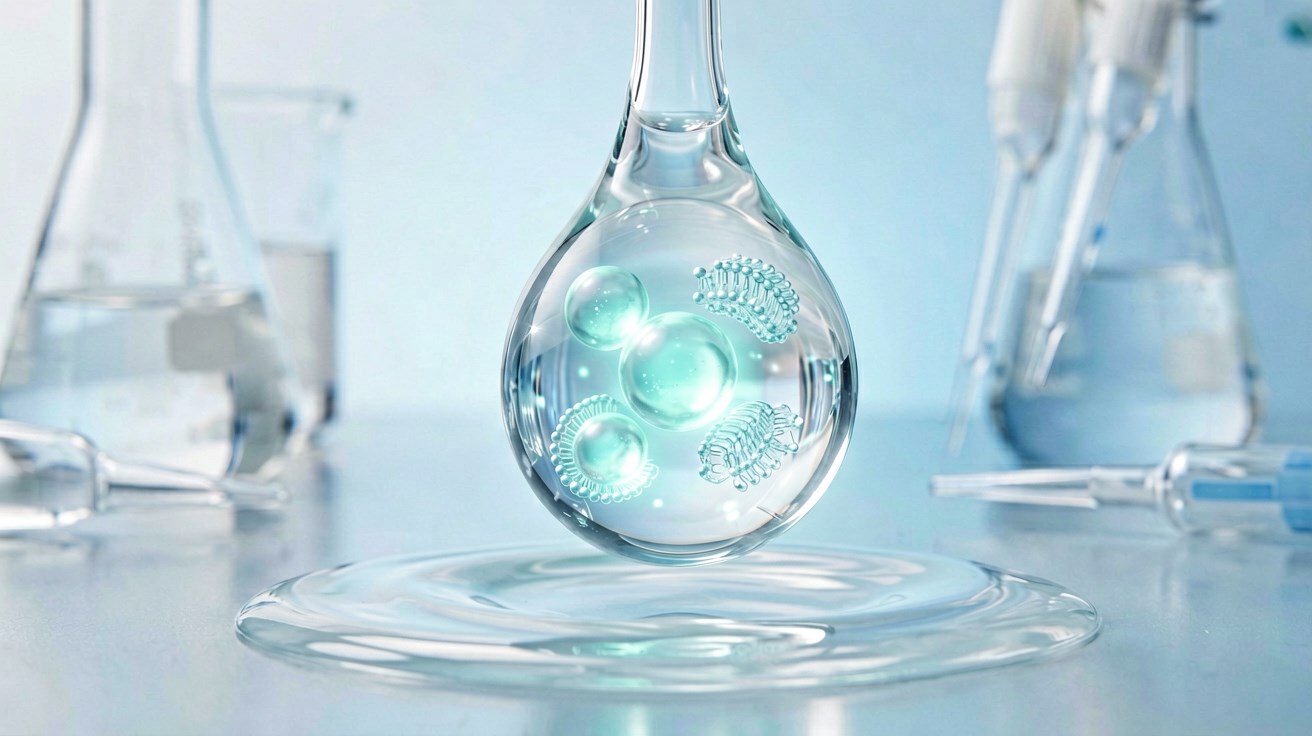
Few cosmetic ingredient stories have moved from lab bench to consumer shelf as quickly as exosomes. Search interest has climbed sharply across Southeast Asia since 2024, “exosome” is now a routine line item on professional skincare brand decks, and a growing share of clinical-aesthetic clinics market post-procedure kits built around extracellular vesicles. The result is an ingredient category that sits awkwardly between cosmetics and biologics, and a 2026 marketplace where claims, regulation, and clinical evidence are no longer in step.
This Industry Insights piece reviews the current size of the category, the regulatory posture across the US, EU, and Southeast Asia, and what the peer-reviewed evidence actually says about exosome efficacy in pigmentation, barrier, and post-procedure skin recovery.
What an Exosome Actually Is
Exosomes are a subset of extracellular vesicles (EVs): nanoscopic, lipid-bilayer particles roughly 30–150 nm in diameter, secreted by virtually all cell types. They carry a defined cargo of proteins, lipids, mRNAs, and microRNAs, and function as intercellular messengers. In skincare the relevant species are usually derived from mesenchymal stem cells (MSC), induced pluripotent stem cells (iPSC), keratinocytes, fibroblasts, or plant cells.
Cosmetic exosomes are acellular: they contain no living cells. The commercial value proposition is that the cargo — particularly growth-factor-related proteins and regulatory miRNAs such as miR-21, miR-146a, and miR-125b — can modulate recipient cell behaviour (proliferation, inflammation, melanogenesis) when delivered topically or via microneedling.
Market Size and the 2026 Trajectory
Industry analyst estimates broadly converge on a fast-growing category, though methodologies vary. Reported figures place the global cosmetic exosome market in the low-to-mid hundreds of millions USD in 2024, with forecasts suggesting a multi-hundred-million to low-single-digit-billion range by the early 2030s and compound annual growth rates in the high-teens. Reported CAGR estimates for 2024–2030 cluster in the 14%–22% band. Mintel and Spherical Insights are among the firms that have published in this range; independent verification of any specific figure is difficult because category definitions vary — some reports include exosome isolation kits and instrumentation, others strictly topical products.
In Southeast Asia the picture is skewed by Korean influence: K-beauty “exosome” launches from 2023 onward have driven regional awareness, and clinics in Singapore, Thailand, Malaysia, and the Philippines have introduced in-clinic exosome infusions paired with microneedling, fractional laser, or radiofrequency. Indonesia and Vietnam are the fastest-growing retail markets by SKU count based on Q1–Q2 2026 platform listings.
Regulatory Reality by Region
Regulation is the single biggest variable for any brand working with exosomes, and it differs sharply by jurisdiction.
United States: FDA Position Has Hardened
In December 2019 the U.S. Food and Drug Administration issued a Safety Communication on Exosome Products, warning consumers that no exosome products are currently FDA-approved for any indication, and that exosomes used to treat or cure diseases are regulated as drugs and biological products under the Public Health Service Act and the Food, Drug, and Cosmetic Act.
The November 2024 FDA enforcement action against a stem-cell and exosome clinic operator in California reinforced the position that exosomes for unapproved therapeutic claims are illegal. As of mid-2026, the FDA has not approved a topical cosmetic exosome product, and “regenerative” or “anti-aging” claims tied to exosome mechanisms on cosmetic labels remain a regulatory risk.
European Union: Cosmetics Catalogue Status
Under EU Cosmetics Regulation (EC) No 1223/2009, exosomes of human or animal origin are not permitted in cosmetic products as listed in the CosIng database restrictions. Plant-cell-derived extracellular vesicles are generally permissible subject to standard safety assessment, but claims must be substantiated. The Scientific Committee on Consumer Safety (SCCS) has not yet issued a dedicated opinion on extracellular vesicles as of mid-2026.
South Korea: Tightened in 2024
The Ministry of Food and Drug Safety (MFDS) issued revised guidance effective in 2024 restricting stem-cell-derived exosomes in functional cosmetics and clarifying that products making cell-therapy-adjacent claims require a quasi-drug or biologics pathway. This effectively redirected the K-beauty exosome trend toward plant-cell and fermentation-derived EVs for over-the-counter cosmetics.
Southeast Asia: Patchwork
ASEAN markets operate under the ASEAN Cosmetic Directive framework. Singapore’s Health Sciences Authority (HSA) treats human-derived exosomes as biological products requiring notification. Thailand’s FDA and Indonesia’s BPOM have issued consumer advisories about unverified exosome claims. Malaysia’s NPRA has not issued specific guidance, leaving brands to rely on general cosmetic notification rules.
What the Pigmentation Evidence Actually Shows
This is the question that matters most to a Southeast Asian brightening-focused brand: do exosomes reduce hyperpigmentation? The peer-reviewed answer in 2026 is genuinely mixed.
Mechanistic Signals: Cautionary, Not Confirmatory
In vitro work has documented that exosomes from various cell sources can influence melanogenesis. Importantly, some studies report that keratinocyte-derived or MSC-derived exosomes can stimulate tyrosinase activity and melanin synthesis under certain conditions, via transfer of melanogenic miRNAs. This is not a hypothetical concern: it has been reported in published melanocyte co-culture work, and it is the reason responsible brands do not market generic exosomes as “brightening” actives.
Clinical Evidence in Skin
The strongest clinical signal for exosomes is not pigmentation — it is post-procedure recovery. Studies combining human adipose-derived MSC exosomes with fractional CO2 laser have reported improved recovery metrics and acne-scar endpoints versus laser alone. Reports of reduced post-inflammatory hyperpigmentation (PIH) after laser + exosome combination exist, but these typically compare combination therapy to laser alone and confound the anti-inflammatory and wound-healing contribution of the exosome with its direct melanogenic effect.
For melasma specifically, randomized controlled data are scarce. The honest 2026 reading is that exosome-containing post-procedure regimens appear to reduce PIH risk in Fitzpatrick III–V skin, but there is no peer-reviewed RCT demonstrating direct melasma clearance superior to standard tyrosinase-inhibitor regimens.
What This Means for Brand Development
For a Southeast Asia-market brand working on brightening, exosomes are best treated as a recovery and barrier-support adjunct, not a primary brightening active. Three operational notes follow from the current regulatory and scientific picture:
- Source matters. Plant-cell and fermentation-derived EVs carry a cleaner regulatory profile in 2026 than human MSC exosomes across the US, EU, and Korea.
- Claims must stay inside what the in vivo evidence supports. “Supports skin recovery,” “helps reinforce the moisture barrier,” and “complements professional aesthetic procedures” are defensible. “Reduces dark spots,” “treats melasma,” and “repairs pigment damage” are not, given the current evidence base.
- Combination framing is honest. Position exosomes alongside established brightening actives — niacinamide, alpha-arbutin, tranexamic acid, thiamidol — and emphasize that exosomes address the recovery and barrier dimensions of post-inflammatory pigmentation rather than the melanogenesis pathway directly.
Outlook
Expect three developments through the rest of 2026 and into 2027: (1) at least one major regulator — most likely Korea’s MFDS or the EU SCCS — issuing a formal exosome-specific opinion; (2) the first well-designed randomized trial in melasma or post-inflammatory hyperpigmentation, which will either lift or constrain the category’s brightening claim ceiling; and (3) continued growth in plant-cell and fermentation-derived EVs as the compliant workhorse for cosmetic-grade exosome claims.
References
- U.S. Food and Drug Administration. Consumer Alert on Regenerative Medicine Products Including Stem Cells and Exosomes. December 2019; updated 2024.
- Kwon HH, et al. Combination therapy with human adipose-derived stem cell exosomes and fractional CO2 laser for acne scars. J Cosmet Dermatol. 2020;19(8):2109-2116.
- Lo Cicero A, et al. Exosomes released by keratinocytes modulate melanocyte pigmentation. J Invest Dermatol. 2015;135(12):3103-3111.
- Sheller-Miller S, et al. Exosomes and microRNAs in the regulation of melanocyte biology. Pigment Cell Melanoma Res. 2019;32(3):351-363.
- Ministry of Food and Drug Safety (Republic of Korea). Guidance on the Use of Stem Cell and Exosome-Derived Ingredients in Functional Cosmetics. 2024 revision.
- ASEAN Cosmetic Directive. Annexes to the ASEAN Cosmetic Directive. Current edition 2024.
- Singapore Health Sciences Authority. Regulatory Guidance for Cell, Tissue and Gene Therapy Products including Exosomes. Current as of 2025.
Interested in Formulation Data Collaboration?
Let's discuss how Melasyl AI can accelerate your next whitening or brightening formula. Technical collaboration, data licensing, or custom AI-driven research — reach out.
Contact Wei →