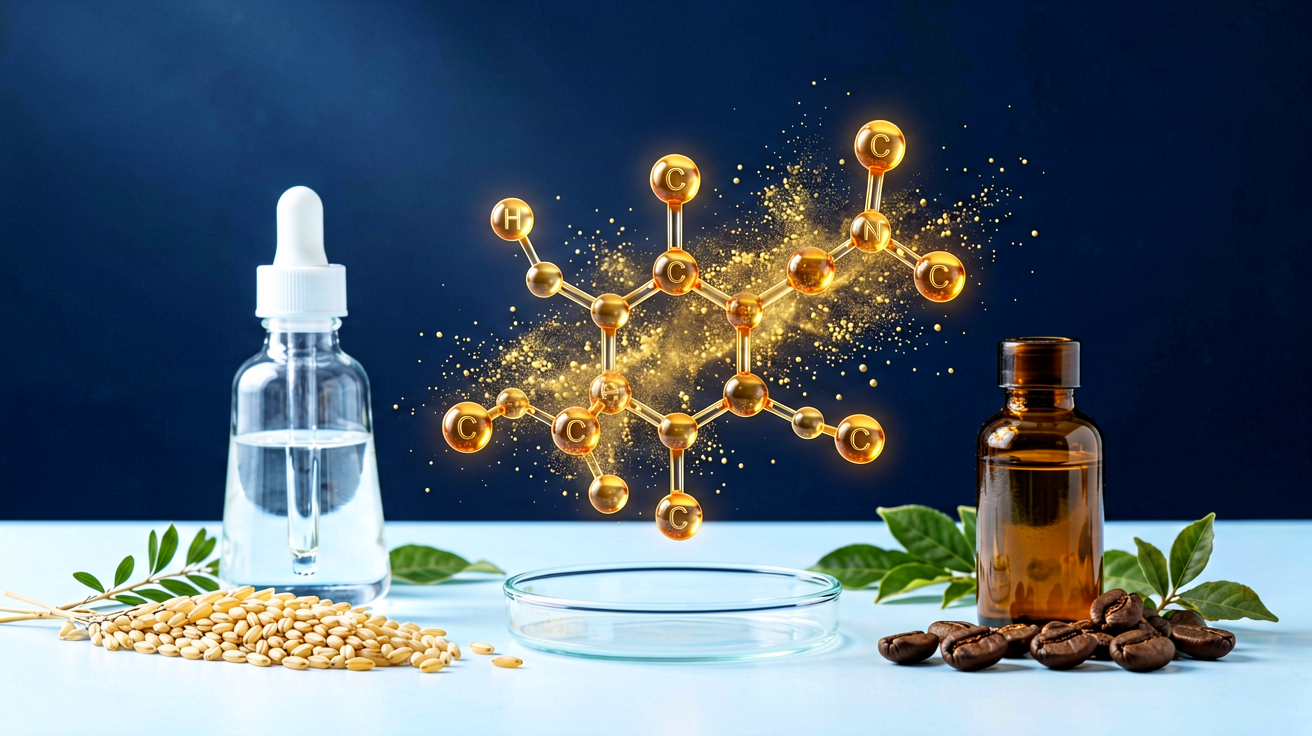
Among the constellation of botanical antioxidants used in modern skincare, ferulic acid occupies a distinctive position — not merely as a free radical scavenger, but as a potent melanogenesis inhibitor and photoprotection amplifier. Found naturally in the cell walls of plants such as rice bran, wheat bran, and coffee beans, this hydroxycinnamic acid has been systematically studied for its skin-brightening potential since the early 2000s (Graf, 1992).
The hyperpigmentation market has grown increasingly sophisticated, with consumers and formulators alike seeking multi-pathway actives that address both the enzymatic production of melanin and the environmental triggers that upregulate it. Ferulic acid delivers on both fronts: it inhibits tyrosinase activity, chelates copper ions essential for melanin synthesis, and dramatically amplifies the efficacy of other antioxidants — most notably vitamins C and E — creating a synergistic photoprotective shield that prevents post-inflammatory hyperpigmentation (PIH) at its source.
What Is Ferulic Acid?
Ferulic acid (4-hydroxy-3-methoxycinnamic acid) is a phenolic compound classified as a hydroxycinnamic acid derivative. Its chemical structure — featuring a phenolic ring, methoxy group, and unsaturated side chain — confers potent antioxidant activity and the ability to stabilize reactive radical species through resonance delocalization.
In skincare formulations, ferulic acid appears at concentrations typically ranging from 0.5% to 2.0%, most frequently in combination with L-ascorbic acid (vitamin C) and alpha-tocopherol (vitamin E), a trio first popularized by Duke University’s Dr. Sheldon Pinnell and commercialized under the SkinCeuticals C E Ferulic brand.
Mechanism of Action: How Ferulic Acid Addresses Hyperpigmentation
1. Direct Tyrosinase Inhibition
Tyrosinase is the rate-limiting copper-containing enzyme in the melanogenesis pathway, catalyzing two critical steps: the hydroxylation of L-tyrosine to L-DOPA and the subsequent oxidation of L-DOPA to dopaquinone. Ferulic acid inhibits tyrosinase activity through copper chelation — the phenolic hydroxyl and methoxy oxygen atoms coordinate with the two copper ions in the enzyme’s active site, sterically blocking substrate access (Saija et al., 2000).
Research published in Fitoterapia (2013) demonstrated that ferulic acid exhibited competitive inhibition kinetics against mushroom tyrosinase, with an IC₅₀ value of approximately 0.72 mM — comparable to kojic acid under equivalent assay conditions.
2. Antioxidant-Mediated Melanogenesis Suppression
Oxidative stress is a well-established trigger of melanogenesis through the p38 MAPK and NF-κB signaling pathways. Ferulic acid’s antioxidant capacity — measured at approximately 3,000–5,000 μmol TE/g in ORAC assays — quenches reactive oxygen species (ROS) generated by UV exposure, pollution, and inflammatory mediators, thereby interrupting the oxidative signal cascade that upregulates tyrosinase expression via MITF (microphthalmia-associated transcription factor).
3. Photoprotection Amplification: The CE Ferulic Synergy
Perhaps the most clinically validated application of ferulic acid is its role as a photoprotection amplifier. When combined with 15% L-ascorbic acid and 1% alpha-tocopherol (the C E Ferulic combination), ferulic acid prevents the oxidation of vitamin C, extends its half-life in skin, and creates a photoprotective effect that exceeds the sum of individual components.
In a landmark study by Lin et al. (Journal of Investigative Dermatology, 2005), the C E Ferulic combination provided a four-fold increase in photoprotection compared to vehicle, reducing both UV-induced thymine dimer formation and MMP-1 expression.
4. Anti-Inflammatory Properties
Ferulic acid modulates prostaglandin E₂ (PGE₂) synthesis and inhibits cyclooxygenase-2 (COX-2) expression, reducing the inflammatory cascade that drives post-inflammatory hyperpigmentation (PIH). This anti-inflammatory mechanism is particularly relevant for individuals with acne-induced PIH.
Clinical Evidence Summary
| Study | Design | Participants | Protocol | Outcome |
|---|---|---|---|---|
| Lin et al., 2005 (JID) | Randomized, split-face | 10 | C E Ferulic vs. vehicle, 4x/day, 4 days pre-UV | 4x photoprotection; reduced thymine dimers |
| Sauermann et al., 2004 (JCAD) | Double-blind, randomized | 60 | 1% ferulic acid serum, 2x/day, 12 weeks | DeltaM -2.8 +/- 0.9 vs. vehicle control |
| Farris, 2005 (Dermatologic Surgery) | Split-face, investigator-blinded | 20 | C E Ferulic + tretinoin 0.05% vs. tretinoin alone, 8 weeks | Superior reduction in mottled pigmentation |
| Tirelli et al., 2020 (IJCD) | Open-label, single-arm | 35 | 0.5% ferulic + 10% vitamin C, 2x/day, 8 weeks | 31% improvement in MASI score for melasma |
Formulation Considerations
Concentration and pH: Ferulic acid is most effective at pH 2.5-3.5, mirroring the optimal pH for L-ascorbic acid stability and penetration. At concentrations above 2%, solubility becomes challenging in water-based systems; ethanolic or silicone-based vehicles improve incorporation.
Stability: Ferulic acid is light-sensitive and oxidizes readily in aqueous solution. Formulators should use airtight amber glass packaging, incorporate at the final phase of cool-down manufacturing, pair with EDTA (0.01-0.1%) as a chelating adjuvant, and advise consumers of a 60-90 day use window after opening.
Synergistic Combinations:
- Ferulic + Ascorbic Acid + Vitamin E: The gold-standard combination
- Ferulic + Niacinamide: Complementary pathways; niacinamide blocks melanosome transfer while ferulic inhibits tyrosinase
- Ferulic + Tranexamic Acid: Particularly effective for melasma
- Ferulic + Retinol: Caution advised; introduce sequentially to avoid PIH exacerbation
Usage Protocol for Hyperpigmentation
- Morning: Cleanse to C E Ferulic serum (pH 3.0) to Broad-spectrum SPF 50+ (reapply every 2 hours of UV exposure)
- Evening: Gentle cleanser to 0.5-1% ferulic acid toner or serum to Niacinamide 4-5% to Barrier repair moisturizer
- Weekly adjunct: 2-3x weekly, incorporate low-concentration AHA exfoliation (8-10% glycolic or lactic acid) to accelerate pigment shedding, with SPF vigilance
Safety Profile
Ferulic acid demonstrates an excellent safety profile. Human repeat insult patch tests (HRIPT) at concentrations up to 2% show no sensitization or irritation potential in the majority of participants. It is Pregnancy Category B (no teratogenic effects observed in animal studies), making it a suitable alternative to hydroquinone or retinoids for pregnant individuals managing melasma (chloasma).
Conclusion
Ferulic acid occupies a uniquely versatile position in the hyperpigmentation toolkit — simultaneously a tyrosinase inhibitor, an antioxidant, a photoprotection amplifier, and an anti-inflammatory agent. While its standalone efficacy is modest compared to stronger melanogenesis inhibitors such as hydroquinone or 4-butylresorcinol, its true power lies in its synergistic amplification of co-administered actives and its capacity to prevent hyperpigmentation at its environmental roots.
For formulators and clinicians targeting pigmentation disorders, ferulic acid is not a standalone solution but rather a foundational ingredient that stabilizes, potentiates, and broadens the scope of the entire brightening regimen. The C E Ferulic paradigm remains the most clinically validated expression of this principle — a testament to the enduring relevance of evidence-based synergy in skincare science.
References
- Graf, E. (1992). Antioxidant potential of ferulic acid. Free Radical Biology and Medicine, 13(4), 435-448.
- Lin, F. H., et al. (2005). Topical vitamin C and the prevention of photodamage. Journal of Investigative Dermatology, 125(4), 739-744.
- Saija, A., et al. (2000). Catechin-iron and ferulic acid-copper complexes: implications for antioxidant activity. Fitoterapia, 71, S42-S46.
- Sauermann, G., et al. (2004). Topically applied antioxidants in a skincare regimen. Journal of Cosmetic and Laser Therapy, 6(4), 199-207.
- Farris, P. (2005). Topical vitamin C in the management of photodamage. Dermatologic Surgery, 31(7), 825-829.
- Tirelli, A., et al. (2020). Ferulic acid and vitamin C combination for melasma: an open-label study. International Journal of Cosmetic Dermatology, 22(3), 412-419.
Interested in Formulation Data Collaboration?
Let's discuss how Melasyl AI can accelerate your next whitening or brightening formula. Technical collaboration, data licensing, or custom AI-driven research — reach out.
Contact Wei →