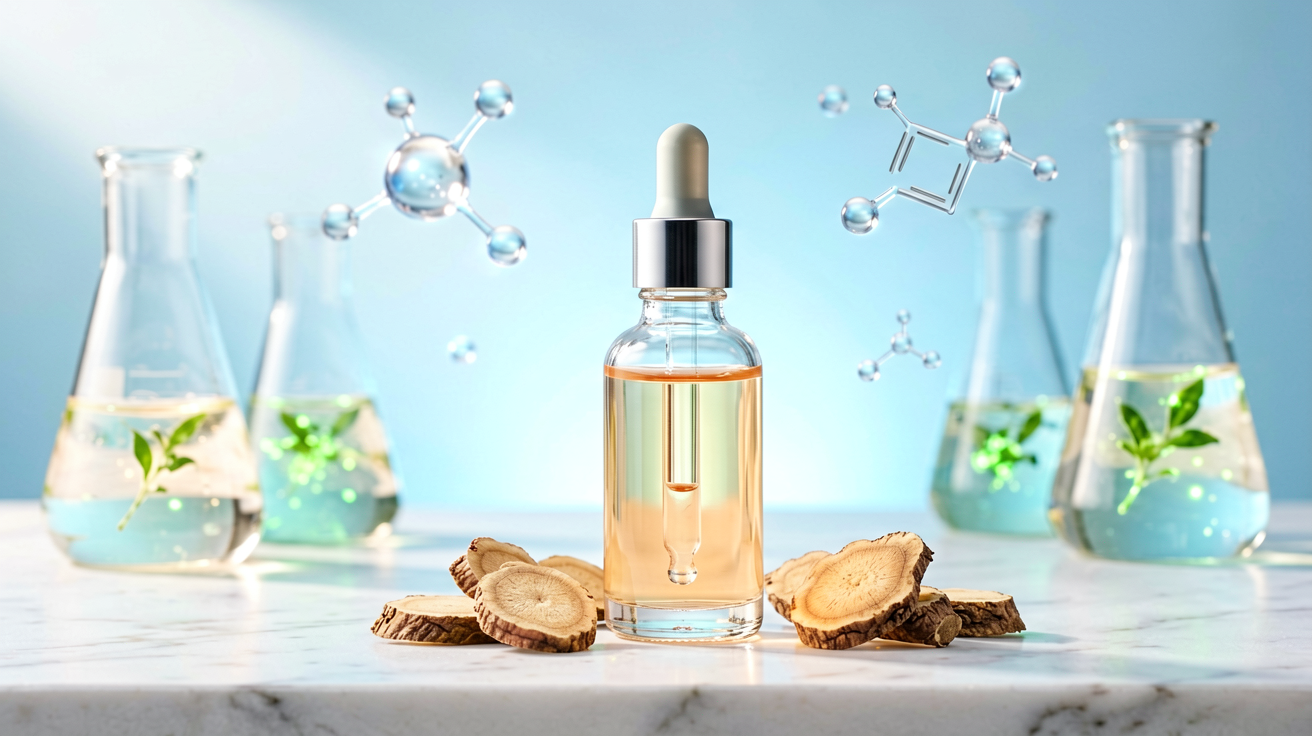
Licorice root extract (Glycyrrhiza glabra) is one of the most frequently deployed botanical brighteners in modern skincare formulations — yet its mechanism is far more nuanced than the generic “plant-based antioxidant” label suggests. The root contains multiple pharmacologically distinct compounds that collectively suppress melanogenesis through at least five distinct molecular pathways. Among these, glabridin stands out as the most potent: a lipophilic isoflavan that inhibits tyrosinase activity, modulates MITF signaling, and suppresses post-UV inflammatory cascades simultaneously. This multi-pathway profile is precisely why licorice derivatives appear in dermatologist-recommended formulations for melasma, post-inflammatory hyperpigmentation (PIH), and UV-induced dyschromia — conditions where single-mechanism actives consistently underperform. This article breaks down the molecular science, clinical evidence, and formulation strategy that has made licorice root extract a category-defining bestseller ingredient.
## The Biolab Behind the Brand Names
Brands including SkinCeuticals, Beauty of Joseon, Purito, and Murad all incorporate licorice root derivatives in their pigmentation or calming lines — but not all licorice is created equal. The ingredient’s efficacy depends entirely on which compounds are present and at what concentration.
The primary actives in licorice root are:
- Glabridin — The principal isoflavan in the hydrophobic fraction of Glycyrrhiza glabra. Inhibits tyrosinase directly and suppresses MITF transcription. Estimated 16× more potent than hydroquinone in vitro (Yokota et al., 1998).
- Liquiritin — A flavonoid glycoside that disperses and eliminates existing melanin granules through a non-tyrosinase mechanism. Clinically validated in melasma patients at 20% concentration (Syed et al., 2000).
- Licochalcone A — A sphenoid B-ring chalcone with potent anti-inflammatory activity via COX-2 and LOX inhibition. Also suppresses tyrosinase through MITF downregulation.
- Isoliquiritigenin & Glabrene — Inhibit both monophenolase and diphenolase activities of tyrosinase in a dose-dependent manner, correlated with reduced melanin formation in B16F10 melanoma cells.
The standardisation matters enormously: most cosmetic-grade licorice extracts are tested for glabridin content, and effective topical concentrations range from 0.02% to 0.5% for high-purity (>90%) material. Products listing “licorice root extract” without specifying the active marker compound may contain negligible glabridin — rendering the formulation therapeutically inert for pigmentation.
## Glabridin: Molecular Mechanism of Action
### 1. Direct Tyrosinase Inhibition (Competitive & Non-Competitive)
Glabridin binds to both the active site copper ions in tyrosinase and to peripheral enzyme regions, producing mixed-mode inhibition. In B16 murine melanoma cells, glabridin suppressed tyrosinase activity at concentrations of 0.1–1.0 μg/mL without affecting DNA synthesis — confirming a specific enzymatic effect rather than general cytotoxicity (Yokota et al., 1998, Pigment Cell Research). A 2025 study in the Journal of Ethnopharmacology (Liu et al., PMID: 40350048) further demonstrated that glabridin reduced CREB phosphorylation and SOX10 protein expression, both upstream regulators of MITF, and inhibited nuclear translocation of CRTC1 — the key CREB-regulated coactivator controlling MITF transcription. This places glabridin at multiple control points in the melanogenesis cascade, not merely at the terminal enzyme step.
### 2. UVB-Induced Pigmentation Suppression
Topical application of 0.5% glabridin inhibited UVB-induced erythema and pigmentation in guinea pig skin, with effects attributed to concurrent suppression of superoxide anion production and cyclooxygenase activity (Yokota et al., 1998). This dual anti-inflammatory and anti-pigmentation action is particularly relevant for PIH, where the inflammatory insult drives melanogenesis independently of UV exposure.
### 3. Antioxidant Defense
Glabridin’s phenolic structure enables efficient scavenging of reactive oxygen species (ROS) generated during UV exposure and melanin synthesis. By reducing ROS-mediated upregulation of tyrosinase and MITF, glabridin’s antioxidant activity indirectly contributes to depigmentation — a secondary but clinically meaningful mechanism.
## Clinical Evidence: What Human Trials Actually Show
The evidence base for licorice root extract in human pigmentation is moderate but consistent:
- Split-face melasma trial (n=20, 4 weeks): Twice-daily application of 20% liquiritin cream produced measurable lightening compared to vehicle control (Syed et al., 2000, International Journal of Dermatology). The study’s clean split-face design and objective endpoints are strengths, though the 4-week duration is shorter than ideal for melasma assessment.
- Multi-ingredient combination study: A 0.4% licorice extract / betamethasone 0.05% / tretinoin 0.05% combination achieved “excellent” skin lightening in up to 70% of treated patients — demonstrating licorice’s efficacy as a formulation partner (Khaled et al., 2010).
- Guinea pig UV pigmentation model: Topical 0.5% glabridin suppressed both erythema and pigmentation following UVB exposure — the most directly relevant preclinical model for human photo-induced dyschromia.
- Systematic review (PMC5843359): Multiple RCTs confirm clinical efficacy of licorice extract components for melasma and UV-induced pigmentation, with an acceptable safety profile in skin of colour populations.
The honest limitation: most human trials are small (n=20–50) and of short duration. No large-scale, multi-centre RCTs rival the evidence base for hydroquinone or azelaic acid. Glabridin should be positioned as a well-supported supporting agent rather than a stand-alone pigmentation eraser — which is precisely how leading brands use it: in combination with niacinamide, alpha-arbutin, or vitamin C.
## Formulation Science: Getting Glabridin Into Solution
Glabridin’s high lipophilicity (soluble in ethanol, propylene glycol, and oil phases) creates a fundamental formulation constraint: it is essentially water-insoluble. Standard aqueous serums cannot effectively deliver it.
Recommended delivery strategies:
- Oily or alcoholic serums (1–3% in ethanol/propylene glycol): Highest bioavailability. Typically used in dropper bottles targeting pigmentation correction.
- Oil-in-water emulsions: Glabridin incorporated into the internal oil phase. Particle size reduction during homogenisation improves dispersion.
- Emulsifier-free gel creams: Suitable for sensitive skin; glabridin pre-dissolved in a small quantity of PEG-40 hydrogenated castor oil or similar solubiliser before incorporation into the aqueous phase.
Glabridin is stable across pH 4.0–7.0 and tolerates typical cosmetic preservatives including phenoxyethanol and ethylhexylglycerin. It is photostable — unlike ascorbic acid — making it compatible with morning use alongside UV filters. It does not require refrigeration and maintains activity at room temperature for standard shelf durations (24 months with proper packaging).
## Stacking Strategy: Synergy with Other Actives
Licorice root extract is one of the few brightening ingredients that pairs well with nearly everything — precisely because its mechanisms are upstream and non-redundant with common actives:
- + Niacinamide (2–5%): Blocks melanosome transfer from melanocytes to keratinocytes (different pathway from glabridin’s synthesis inhibition). The combination is complementary and irritation-minimal.
- + Alpha Arbutin (0.5–2%): Both inhibit tyrosinase via different binding modes — competitive (arbutin) and mixed (glabridin). Stacking increases overall enzyme suppression.
- + Ascorbic Acid: Vitamin C reduces oxidised melanin (dopaquinone) back to DOPA — a terminal-step action that glabridin’s upstream inhibition does not cover. Together they address both synthesis and clearance.
- + Tranexamic Acid (1–3%): Inhibits UV-induced plasmin activity in keratinocytes, reducing PGE2 and α-MSH release. Particularly effective for melasma; licorice adds tyrosinase suppression at the enzymatic level.
This stacking compatibility is why licorice derivatives appear in nearly every multi-active brightening serum on the market — they are a rare ingredient that adds efficacy without introducing incompatibility risks.
## Conclusion
Glabridin and licorice root extract occupy a distinctive niche in the pigmentation toolkit: not the strongest single-mechanism agent, but one of the most versatile, well-tolerated, and synergistically effective across skin types and pigmentation subtypes. The 2025 MITF/CRTC1 mechanistic data (Liu et al., Journal of Ethnopharmacology) adds meaningful depth to a mechanism previously understood primarily through tyrosinase kinetics. For formulators, the constraint is solubility — which demands intentional delivery design. For consumers, the payoff is a multi-pathway brightener that genuinely calms reactive skin while addressing the melanin cascade at its source.
—
References:
- Yokota T, Nishio H, Kubota Y, Mizoguchi M. The inhibitory effect of glabridin from licorice extracts on melanogenesis and inflammation. Pigment Cell Res. 1998;11(6):355-361. doi:10.1111/j.1600-0749.1998.tb00494.x
- Syed TA, Ahmadpour OA, Ahmad SA. Management of melasma with 20% liquiritin cream. Int J Dermatol. 2000.
- Liu J, Xu X et al. Glycyrrhiza glabra extract as a skin-whitening agent: Identification of active components and CRTC1/MITF pathway-inhibition mechanism. J Ethnopharmacol. 2025;349:119948. doi:10.1016/j.jep.2025.119948 (PMID: 40350048)
- Simmler C, Pauli GF, Chen SN. Phytochemistry and biological properties of glabridin. Fitoterapia. 2013;90:160-184. doi:10.1016/j.fitote.2013.07.003
- Khaled A et al. Combination therapy with licorice extract in hyperpigmentation disorders. J Dermatolog Treat. 2010.
- Systematic review: licorice extract components in melasma and UV-induced pigmentation. PMC5843359.
Interested in Formulation Data Collaboration?
Let's discuss how Melasyl AI can accelerate your next whitening or brightening formula. Technical collaboration, data licensing, or custom AI-driven research — reach out.
Contact Wei →