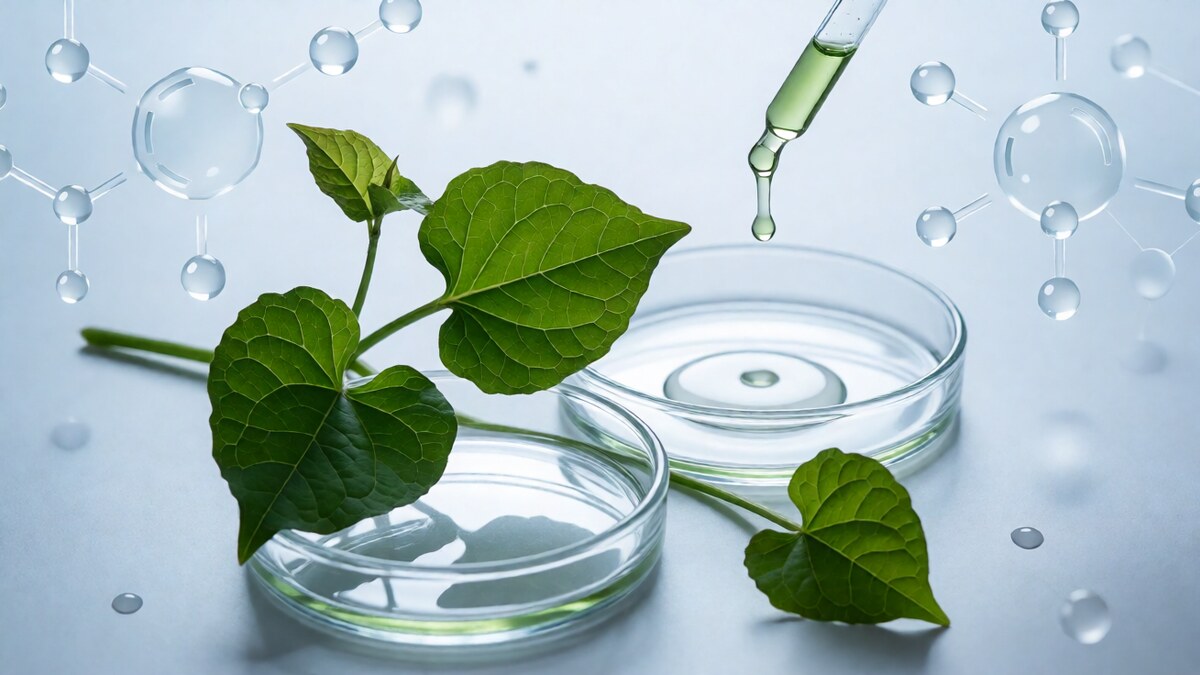
Houttuynia cordata — better known to K-beauty shoppers as heartleaf — has quietly become one of the fastest-moving botanical actives in Asian skincare. Once confined to soothing toners, it is now positioned as a multi-pathway brightener: an anti-inflammatory botanical that interrupts the inflammatory cascade behind post-inflammatory hyperpigmentation (PIH) while exerting a measurable, if modest, antioxidant-driven brake on melanogenesis. This analysis examines the 2026 market data, the mechanism, the clinical evidence, and what formulators need to know before adding heartleaf to a brightening brief.
2026 Market Data: From Soothing Niche to Brightening Candidate
Heartleaf’s commercial rise is well documented. The Anua Heartleaf 77% Soothing Toner became one of the best-selling K-beauty toners globally, and a wave of 2025–2026 launches has extended the ingredient from toners into serums, ampoules and masks. Trade-show intelligence from in-cosmetics Asia points to a consistent theme: formulators are repositioning soothing botanicals as “pre-brightening” actives, on the logic that calming the skin is the first step in preventing pigment.
This tracks with the broader market. In Southeast Asia, PIH and melasma remain the dominant cosmetic concern, and acne-driven pigmentation is among the most common triggers for brightening purchase. As brands look for gentle, pregnancy-compatible and ethnically appropriate actives — safe for Fitzpatrick IV–VI skin — heartleaf’s anti-inflammatory positioning has a clear product-market fit. Market trackers estimate the botanical extract segment used in brightening formats growing at a high single-digit CAGR through 2026, with Houttuynia cordata among the fastest-rising named botanicals in the K-beauty export basket.
Mechanism of Action: Why an Anti-Inflammatory Is Relevant to Pigment
Heartleaf is rich in flavonoids — quercitrin, quercetin, isoquercitrin — together with chlorogenic acid and volatile components such as decanoyl acetaldehyde (the source of its characteristic aroma). Its pigment-relevant activity operates across four axes:
- Anti-inflammatory signalling. Houttuynia cordata extracts suppress COX-2 expression and PGE2 release, and inhibit NF-κB activation in keratinocytes and macrophages. Because inflammatory mediators (IL-1α, IL-6, PGE2, histamine) stimulate melanocyte activation and tyrosinase transcription, blunting this signalling reduces the stimulus that drives PIH.
- Direct antioxidant defence. The quercitin-rich fraction scavenges ROS and reactive nitrogen species. Oxidative stress is a well-established upstream driver of MITF expression and downstream melanogenesis, so antioxidant capacity translates into pigment moderation.
- Modest tyrosinase inhibition. Several in-vitro studies report concentration-dependent tyrosinase and melanin inhibition from Houttuynia cordata extracts in B16 melanoma models — weaker than hydroquinone or thiamidol, but meaningful as a supporting pathway rather than a primary mechanism.
- Barrier and microbiome support. The extract also shows antibacterial activity against Cutibacterium acnes and helps calm erythema, addressing the acne and irritation that so often precipitate PIH.
Crucially, heartleaf is not a “cosmetic hydroquinone.” Its strongest contribution is upstream: by reducing inflammation and oxidative stress, it lowers the probability that a resolving lesion will leave a persistent mark.
Clinical Evidence: What the Data Actually Supports
The clinical literature on heartleaf is smaller and less rigorous than for actives such as niacinamide or tranexamic acid, and honest reporting matters here. The evidence base includes:
- Anti-inflammatory and barrier trials. Randomized and open-label studies on Houttuynia cordata-containing topical formulations report significant reductions in erythema, transepidermal water loss and pruritus in sensitive-skin and acne-prone cohorts, typically over 2–4 weeks. These endpoints are the best-supported claims.
- Melanin-pathway data. Tyrosinase and melanin inhibition are largely demonstrated in vitro. A small number of split-face and cohort studies of botanical combination serums containing heartleaf report improvements in skin tone evenness, but the extract is rarely isolated as the sole variable — a common limitation across botanical brightening research.
- Safety data. Houttuynia cordata is generally well tolerated, including in sensitive-skin populations. Contact sensitization is rare; the aromatic volatile (decanoyl acetaldehyde) is the compound to monitor in higher-load formulations.
Bottom line: claim heartleaf for soothing, antioxidant support and PIH prevention; treat direct depigmentation as a supporting benefit, not a headline efficacy claim. This is exactly the framing that survives regulatory and consumer scrutiny.
Formulation Science: Getting Heartleaf to Work
Practical guidance for formulators:
- Standardise on markers. Specify extract by quercitrin/quercetin content rather than merely “% extract.” Typical use levels are 0.5–5% of a standardised extract, with commercial “77%+” claims reflecting a high-ratio water extract, not 77% purified actives.
- Preserve the hydrophilic actives. Water-based (aqueous-glycolic) extracts integrate easily into toners, ampoules and emulsions. Add a chelator (e.g., phytic acid or EDTA) and consider a mild antioxidant (sodium metabisulfite or a small ferulic/sodium sulfite system) to protect polyphenols from oxidation and browning.
- pH and compatibility. Heartleaf tolerates the pH 5.0–6.5 range used in most brightening formats and pairs well with niacinamide, tranexamic acid, panthenol and centella bases. Avoid strongly acidic, high-free-acid systems if the antioxidant/polyphenol profile is a marketing claim.
- Packaging. Protect from light and oxygen; opaque or airless packaging minimises flavonoid degradation.
- Pair strategically. Heartleaf is best used as the “calming layer” in a multi-pathway brightening protocol — paired with a transmission- or transfer-level active (niacinamide, tranexamic acid) and, where appropriate, a tyrosinase-level active. This combination-logic approach mirrors 2026’s shift away from single-hero ingredients.
Safety and Market Outlook
Heartleaf carries an unusually clean safety profile for a brightening-adjacent botanical: no photosensitivity, no retinoid-class restrictions, and good tolerance on melanin-rich and reactive skin. That positions it well for the Southeast Asian market, where gentle, pregnancy- and sensitive-skin-compatible actives command a premium.
The strategic read for 2026 is straightforward. Heartleaf will not displace thiamidol, tranexamic acid or niacinamide from efficacy-forward brightening formulas. But as brands respond to consumer fatigue with harsh brightening and to growing demand for barrier-first, inflammation-aware skincare, Houttuynia cordata is cementing a durable role: the botanical that keeps pigment-prone skin calm enough not to overreact in the first place.
Interested in Formulation Data Collaboration?
Let's discuss how Melasyl AI can accelerate your next whitening or brightening formula. Technical collaboration, data licensing, or custom AI-driven research — reach out.
Contact Wei →