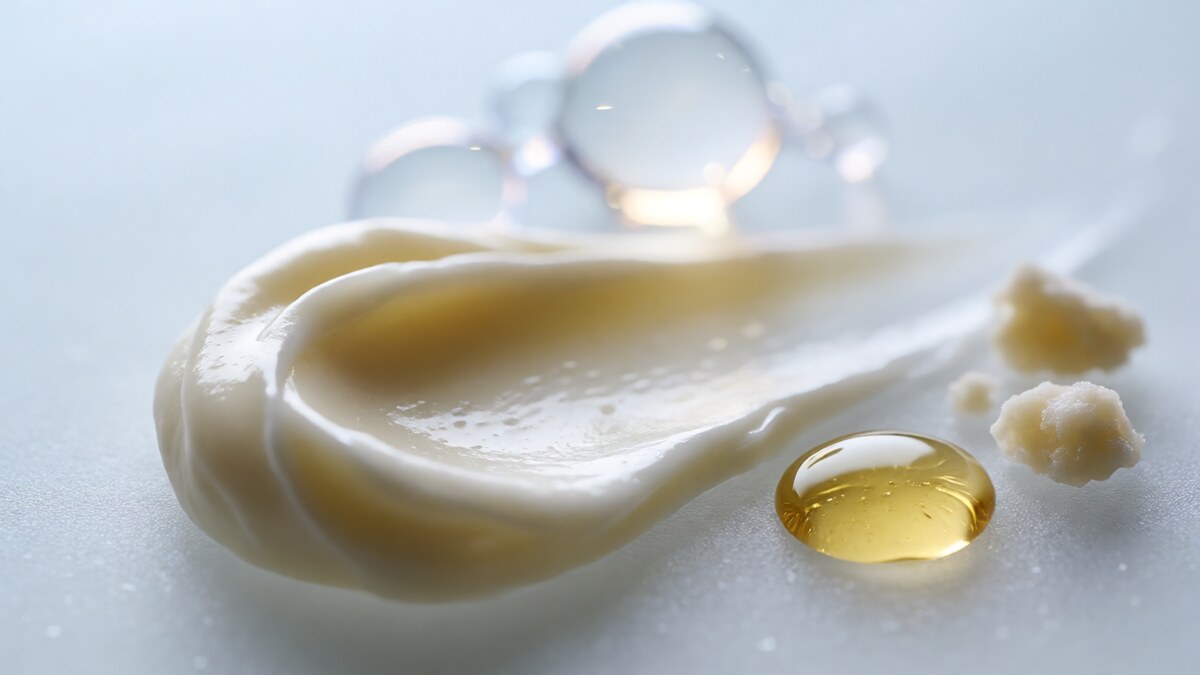
Why Body Butter Is the Hardest Format for Brightening Actives
A body butter is not a thickened lotion. It is an anhydrous system — essentially zero water, no emulsifier, no classic preservative — built from butters, oils, waxes and a small amount of oil-soluble active. That architecture makes it a genuinely different vehicle for pigmentation actives, and it is why most formulators get it wrong.
The problem is chemical, not marketing. The best-evidenced brightening actives — L-ascorbic acid, kojic acid, arbutin, tranexamic acid, niacinamide — are all water-soluble. Put them in an anhydrous butter and they cannot dissolve; they sit as grit, or you add water, at which point you no longer have a body butter and you inherit a preservation burden. The solution is to formulate around oil-soluble actives and to treat the carrier oil as the delivery system. This guide walks through a complete anhydrous brightening body butter — actives, a worked formula, processing and stability — for the Southeast Asian market, where uneven tone on knees, elbows and underarms is a primary concern.
Step 1 — Choose the Right Active Chemistry
With no water phase, the active shortlist collapses to molecules with real oil solubility. Three families carry clinical weight.
Oil-soluble vitamin C: tetrahexyldecyl ascorbate (THD ascorbate)
THD ascorbate is an L-ascorbic acid ester that dissolves in the oil phase and converts intracellularly to free ascorbic acid. Unlike water-soluble ascorbic acid it needs no acidic pH, so it is compatible with the skin’s neutral pH and with co-actives that acid systems would destroy. A 2026 randomized, double-blind trial in the Journal of Cosmetic Dermatology found a 30% THD ascorbate serum improved tone evenness and visible pigmentation, with ex vivo work showing a 24% reduction in melanin. The same study found THD alone degrades rapidly under oxidative stress — so pair it with acetyl zingerone or a tocopherol/ferulic system.
Ascorbyl tetraisopalmitate (VC-IP)
VC-IP is the most thermally robust oil-soluble vitamin C ester — stable to roughly 80°C without discolouration, which matters because body butters are processed warm. Its lipophilicity (logP ≈ 6) gives far better stratum corneum partitioning than water-soluble ascorbate. Ochiai et al. (Journal of Dermatological Science, 2006) showed a 3% VC-IP cream applied for three weeks significantly suppressed UVB-induced pigmentation.
Botanical tyrosinase inhibitors: glabridin from licorice
Glabridin is lipophilic (logP ≈ 3.2), so it dissolves naturally in the oil phase — a rare case where the botanical active and the vehicle are chemically compatible. It inhibits tyrosinase non-competitively and spares the auto-oxidisable DOPA form, reducing pro-oxidant side reactions. A 2006 double-blind, vehicle-controlled study in Archives of Dermatological Research reported that 0.1% glabridin cream applied twice daily significantly reduced melanin index after eight weeks with no irritation or sensitisation. In a body butter it doubles as an anti-inflammatory, useful for friction-prone areas such as the underarm and inner thigh.
Step 2 — The Base: Butters, Oils and the Crystallisation Problem
An anhydrous butter is a semi-solid lipid matrix: its texture, melt point and stability are set by the ratio of solid fats to liquid oils and the crystalline polymorph the fats adopt.
- Shea butter (Butyrospermum parkii), 25–35%. The backbone. Gives the rich, occlusive body and crystallises in the stable β′ polymorph — which is why pure shea butter is smooth rather than grainy.
- Cocoa butter, 5–10%. Adds structure and a higher melt point (~34–36°C) but is polymorph-prone — it can bloom into grainy β crystals if cooled too slowly. Use it sparingly or substitute a hydrogenated oil.
- Mango seed butter, 10–15%. Softer than shea; improves spreadability and cuts the heavy “drag” of pure shea.
- Caprylic/capric triglyceride, 20–30%. The workhorse emollient and primary solvent for the actives — non-comedogenic, odourless and oxidatively stable, unlike virgin coconut oil.
- A light carrier oil with its own actives, 8–12%. Squalane (biomimetic, non-greasy) or rice bran oil (rich in γ-oryzanol and vitamin E).
- Waxes / structuring agents, 3–6%. Candelilla wax or cera alba raises the melt point and prevents heat collapse — essential for Southeast Asian distribution. Add fumed silica (1–2%) if the product must survive 40°C storage.
The classic failure mode is graininess — unstable crystal growth during cooling, fixed by process discipline (Step 4), not more emulsifier.
Step 3 — A Worked Formula (Anhydrous Brightening Body Butter)
- Shea butter — 30%
- Mango seed butter — 12%
- Cocoa butter — 6%
- Caprylic/capric triglyceride — 24%
- Squalane — 10%
- Rice bran oil — 5%
- Candelilla wax — 4%
- Fumed silica — 1.5%
- Tocopherol (vitamin E) — 0.5%
- THD ascorbate — 3%
- Ascorbyl tetraisopalmitate (VC-IP) — 2%
- Licorice extract standardised to ≥8% glabridin — 1.5%
- Acetyl zingerone (THD stabiliser) — 0.3%
- Fragrance / essential oil blend — 0.2% (optional; fragrance-free is safer for PIH-prone skin)
Total oil-soluble actives sit at ~6.5% — enough to be claim-supportable, low enough to stay elegant. The absence of water is what removes the preservative requirement and lets the vitamin C esters perform without an acidic environment.
Step 4 — Processing: Temperature Is Everything
- Melt the hard phase gently. Combine shea, mango, cocoa butter and candelilla wax; heat to 70–75°C with slow stirring until clear. Do not exceed 80°C — you will drive off shea’s natural antioxidant fraction and risk colour drift.
- Add the liquid phase warm. Stir in caprylic/capric triglyceride, squalane and rice bran oil at 65–70°C until the blend is uniform.
- Disperse the silica. Add fumed silica slowly under high shear to avoid lumps. It forms a weak thixotropic network that resists settling and heat collapse.
- Cool to 45–50°C, then add the actives. This is the critical control point. Add THD ascorbate, VC-IP, glabridin and acetyl zingerone only below 50°C. These actives are heat-sensitive above that threshold; adding them hot is the most common cause of a “brightening” butter that tests at a fraction of its label claim.
- Cool with controlled shear — the tempering step. How you beat graininess: cool to 30–32°C with continuous stirring, then pour and let it set undisturbed at a stable 20–22°C. Agitated cooling forces fine, uniform crystals; slow cooling at a warm ambient grows large β crystals and a grainy, sand-like texture. If your climate cannot hold 20–22°C, use a setting room.
Step 5 — Stability, Testing and Claims
Anhydrous systems are microbially safe but oxidation-prone. Accelerated testing — three months at 40°C / 75% RH — is the minimum bar. Watch for rancidity, colour drift as the esters oxidise, texture bloom, and active assay loss, which you should measure directly rather than assume.
Two guardrails matter for claims. Glabridin degrades under direct UV, so package in opaque or UV-protective jars. And the vitamin C esters work best paired with tocopherol plus a stabiliser — the pigment evidence for THD ascorbate in the 2026 trials came from stabilised systems, while unstabilised THD alone showed only marginal pigment reduction.
Be honest about evidence scope: the strongest human data for these actives comes from facial and forearm studies, and whole-body trials on a finished body butter are scarce.
The Takeaway
A brightening body butter succeeds or fails on three decisions: choosing oil-soluble actives (THD ascorbate, VC-IP, glabridin) instead of the water-soluble defaults; building a lipid matrix that stays smooth and heat-stable in your target climate; and adding the actives below 50°C during processing. Get those right and the anhydrous format becomes an advantage — an occlusive, preservative-free system that keeps unstable actives stable and carries them into the skin’s lipid barrier, where a water-soluble serum struggles to go.
Interested in Formulation Data Collaboration?
Let's discuss how Melasyl AI can accelerate your next whitening or brightening formula. Technical collaboration, data licensing, or custom AI-driven research — reach out.
Contact Wei →