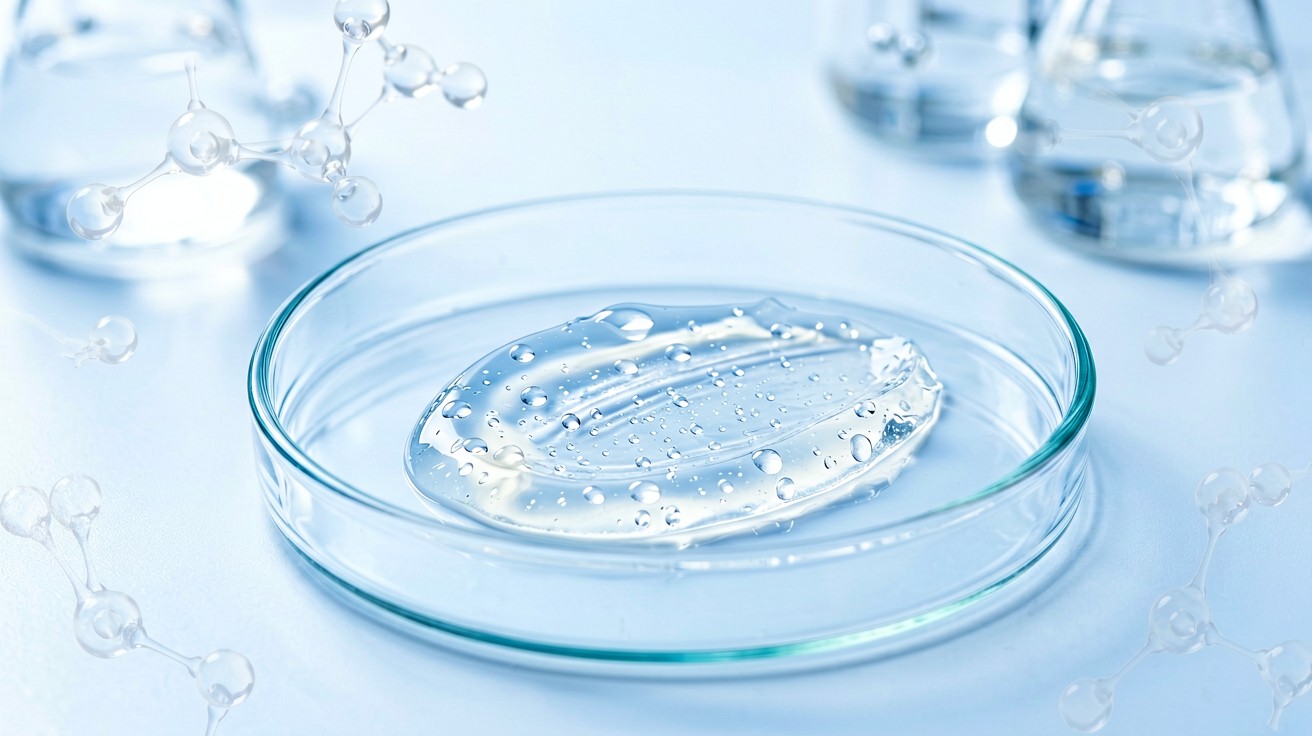
A sleeping mask is the one step in a brightening routine where occlusion, delivery, and time all work together. Applied as the final layer before bed, it stays on the skin for six to eight hours — enough contact time for actives that would normally be rinsed off or photodegraded to actually reach the melanocyte. This guide is a complete, bench-ready brief for a brightening sleeping mask, with the clinical rationale behind every number in the formula.
Why the Overnight Format Changes the Brief
Most brightening products are optimized for fast absorption and daytime elegance. A sleeping mask inverts those priorities. You want a light, breathable film that reduces transepidermal water loss (TEWL) without feeling heavy or transferring to the pillow.
That occlusive layer matters for more than comfort. Raising stratum corneum hydration increases the diffusion gradient for hydrophilic actives and loosens corneocyte packing — the same principle behind wet-wrap and occlusion-enhanced delivery. Two constraints then shape everything downstream: the film must not pill on the skin, and the actives must survive six to eight hours at skin-surface pH without oxidizing or hydrolyzing.
Design Targets
- pH 5.0–5.5 — the compatibility window that lets niacinamide, arbutin, and tranexamic acid coexist without degrading.
- Viscosity 8,000–15,000 cP — a spreadable gel-cream that levels itself but does not run.
- ≥25% TEWL reduction at two hours versus untreated control.
- Fragrance-free and non-comedogenic — it is worn all night on skin that may already be compromised.
Phase-by-Phase Formula (per 100 g)
Phase A — Water phase
| Ingredient | % | Function |
|---|---|---|
| Aqua | to 100 | Solvent |
| Glycerin | 5.0 | Humectant |
| Panthenol | 1.0 | Soothing / barrier support |
| Sodium hyaluronate (low MW) | 0.2 | Hydration |
| Xanthan gum | 0.3 | Rheology modifier |
| Disodium EDTA | 0.05 | Chelator |
Phase B — Oil phase
| Ingredient | % | Function |
|---|---|---|
| Squalane | 4.0 | Emollient |
| Caprylic/Capric Triglyceride | 3.0 | Emollient |
| Dimethicone | 2.0 | Breathable occlusive film |
| Cetearyl Alcohol | 1.5 | Structure / body |
| Cetearyl Glucoside + Cetearyl Alcohol | 2.5 | Primary emulsifier |
| Glyceryl Stearate | 1.0 | Co-emulsifier |
Phase C — Active phase (add below 40 °C)
| Ingredient | % | Function |
|---|---|---|
| Niacinamide | 4.0 | Melanosome transfer inhibition |
| Tranexamic Acid | 3.0 | Plasmin-pathway inhibition |
| Alpha-Arbutin | 2.0 | Tyrosinase inhibition |
| Ascorbyl Glucoside | 2.0 | Antioxidant / anti-tyrosinase |
| Bisabolol | 0.5 | Anti-inflammatory |
Phase D — Preservation
Phenoxyethanol 0.8% + Ethylhexylglycerin 0.2%. Add below 35 °C.
Process: heat Phase A and Phase B separately to 75 °C. Add B to A under homogenization for three minutes, then switch to sweep agitation and begin cooling. At 40 °C, add Phase C slowly against the vessel wall to avoid aeration. Below 35 °C add Phase D and adjust pH to 5.2 with a 10% citric acid solution. The finished emulsion should be a translucent-to-opaque gelled cream that holds a soft peak on the spatula.
Concentration Science: What the Evidence Supports
Niacinamide 4%. The foundational work by Hakozaki and colleagues showed that niacinamide suppresses melanosome transfer from melanocytes to keratinocytes rather than inhibiting tyrosinase directly. A 4% concentration produced measurable reductions in facial hyperpigmentation over eight weeks, and 4–5% remains the evidence-backed sweet spot before flushing and irritation risk climbs.
Alpha-Arbutin 2%. A competitive tyrosinase inhibitor with markedly better hydrolytic stability than its beta isomer. Controlled studies at 2% show significant lightening of UV-induced pigmentation, and it holds up across the pH range used here — unlike kojic acid, which discolors and loses potency.
Tranexamic Acid 3%. Works upstream by blocking plasminogen activation in keratinocytes, cutting the inflammatory signal that drives melanocyte overactivity. Topical 3% reduced MASI scores in melasma trials as early as eight weeks, and in a leave-on overnight format it pairs naturally with UV-independent pigmentation pathways.
Ascorbyl Glucoside 2%. A stable vitamin C prodrug that is enzymatically converted to ascorbic acid in skin. Unlike L-ascorbic acid it survives an overnight residence without oxidizing, and studies show prolonged radical-scavenging and tyrosinase inhibition after topical application.
The combination is deliberate: one active blocks the enzyme, one blocks transfer, one blocks the inflammatory trigger, and one controls oxidative stress. Multi-pathway is the entire point of an overnight formula — no single agent closes all four doors.
The Occlusion Paradox
There is a trap here. Heavy occlusives can reduce the partition of some lipophilic actives into skin by saturating the upper layers. Dimethicone at 2% gives a breathable film that lowers TEWL without creating a barrier that sequesters your actives. If you push petrolatum above about 5%, you can actually lower niacinamide flux. Measure TEWL and penetration, not just texture.
Stability and Testing Protocol
- Accelerated: 12 weeks at 40 °C / 75% RH, plus three freeze-thaw cycles.
- pH drift: monitor monthly — niacinamide hydrolyzes to nicotinic acid above pH 6, which both irritates and erodes efficacy.
- Color: arbutin and ascorbyl glucoside discolor on oxidation; a well-preserved sample should stay within ΔE ≤ 2.
- Preservative efficacy: challenge test to ISO 11930.
- Clinical: a 28-day use test measuring mexameter melanin index, corneometry, and TEWL.
Five Mistakes That Kill the Formula
- Adding actives hot. Niacinamide and arbutin degrade above 50 °C — cool-down addition is not optional.
- Chasing heavier occlusion. More petrolatum is not more penetration; it can be less.
- Ignoring pH. A pH of 6.5 quietly converts your niacinamide into an irritant.
- Overloading humectants. Glycerin above 8% feels tacky and pulls water from the film overnight, defeating the purpose.
- No pillow-transfer test. A formula that smears off at hour two delivers nothing by hour six.
Conclusion
The sleeping mask is an underused brightening vehicle. It buys you contact time, hydration, and a multi-pathway active payload that a rinse-off or daytime product simply cannot match. Anchor the formula at pH 5.2, keep the film breathable, add your actives cool, and validate with TEWL plus mexameter data. Done right, an overnight brightening mask is one of the most clinically defensible SKUs a brightening line can carry.
References
- Hakozaki T, et al. The effect of niacinamide on reducing cutaneous pigmentation and suppression of melanosome transfer. British Journal of Dermatology. 2002;147(1):20–31.
- Morag M, et al. Alpha-arbutin: a review of its efficacy and safety in hyperpigmentation. Journal of Cosmetic Dermatology. 2019.
- Ebrahimi B, Naeini FF. Topical tranexamic acid as a promising treatment for melasma. Journal of Research in Medical Sciences. 2014;19(8):753–757.
- Del Rosario E, et al. Randomized, double-blind study of topical tranexamic acid 3% in melasma. Journal of Drugs in Dermatology. 2018.
- Kumano Y, et al. Prolonged biological activities of 2-O-α-D-glucopyranosyl-L-ascorbic acid (AA-2G) in skin. Journal of Nutritional Science and Vitaminology. 1998.
- Angelova-Fischer I, et al. Occlusion and stratum corneum hydration: effects on transepidermal water loss and penetration. Skin Pharmacology and Physiology. 2015.
- Draelos ZD. The science of overnight leave-on formulations and barrier occlusion. Journal of Cosmetic Dermatology. 2020.
Interested in Formulation Data Collaboration?
Let's discuss how Melasyl AI can accelerate your next whitening or brightening formula. Technical collaboration, data licensing, or custom AI-driven research — reach out.
Contact Wei →