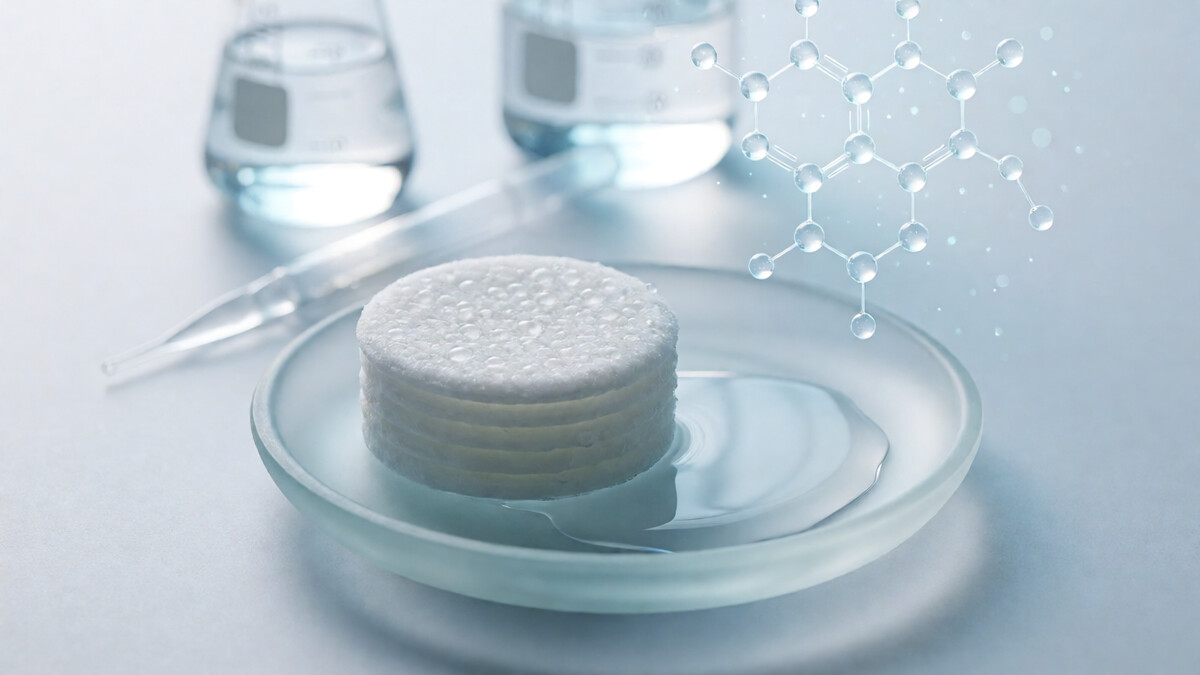
As a product format, the toner pad moved from niche to mainstream faster than almost any other category in the 2026 K-beauty cycle. Pads promise what a liquid toner cannot: a controlled dose, a mild mechanical assist, and a format that fits a thirty-second routine. For anyone building a brightening line, that combination is attractive — but pre-saturated pads are also one of the most technically unforgiving formats to formulate, because the actives sit in a wet, oxygen-exposed, repeatedly-opened environment for months. This guide walks through a practical brightening toner pad formulation, from pad substrate selection to preservation, active choice and pH.
What Actually Defines a “Brightening Toner Pad”
A toner pad is a pre-saturated non-woven disc, sold in a tub or individually wrapped, that delivers a treatment liquid when wiped across the skin. Unlike an exfoliating peel pad, a brightening pad is designed for daily leave-on or gentle wipe-off use, and its job is to deposit pigment-pathway actives — niacinamide, arbutin derivatives, tranexamic acid — rather than to strip the skin. The category sits between toner and essence, and that positioning should drive every formulation decision.
Step 1 — Choose the Pad Substrate Before the Liquid
The pad is not packaging; it is part of the delivery system. Three practical choices dominate:
- Plain non-woven (cotton/rayon blends): low cost, soft, ideal for everyday leave-on pads.
- Textured or embossed non-woven: adds mild mechanical exfoliation; useful for a once- or twice-weekly pad.
- Hydrogel or jelly pads: higher liquid retention and a cooling feel; slower release, better for sensitive skin.
Two specifications matter commercially: thickness (typically 0.3-0.5 mm) and liquid retention. A pad should hold roughly 2.5-3.5x its own dry weight in liquid without dripping. Test absorption on the exact pad stock you intend to buy before you finalise the liquid phase — the same formula behaves differently on a 40 gsm and a 60 gsm substrate.
Step 2 — Pick Actives That Survive a Wet Pad
The single biggest mistake in this format is putting an unstable active into a jar that will be opened ninety times. Brightening actives with solid clinical backing and reasonable wet-phase stability include:
- Niacinamide (2-5%). The most pragmatic brightening active for pads: water-soluble, stable at mildly acidic pH, and clinically validated. A double-blind trial found 4% niacinamide reduced melasma pigmentation comparably to hydroquinone 4% over 8 weeks (Navarrete-Solis et al., 2011).
- Alpha-arbutin (1-2%). Hydroquinone-beta-D-glucopyranoside is hydrolysed to hydroquinone inside melanocytes; it is far more stable than free hydroquinone and is well suited to a daily, leave-on pad.
- Tranexamic acid (2-3%). Targets the plasmin/plasminogen pathway and inflammation-driven pigmentation rather than tyrosinase alone. Topical 3% tranexamic acid significantly improved melasma in a randomised trial (Kanechorn Na Ayuthaya et al., 2012).
- Vitamin C derivatives. Use a stable derivative — 3-O-ethyl ascorbic acid or ascorbyl glucoside — not L-ascorbic acid, which oxidises rapidly in an opened tub. Ascorbic acid derivatives are documented to penetrate the skin and exert antioxidant and brightening effects (Stamford, 2012).
- Gluconolactone / PHA (2-4%). Polyhydroxy acids give gentle surface renewal with far less sting than AHAs, making daily brightening pads tolerable for sensitive and melanin-rich skin.
Step 3 — Build the Liquid Phase
A working starting formula for a 200 ml soak (enough for roughly 60-70 pads):
- Phase A (water). Aqua to 100%; add humectants: glycerin 5%, butylene glycol 4% (which also supports preservation), betaine 1%.
- Phase B (actives). Niacinamide 4%, alpha-arbutin 2%, tranexamic acid 2%, gluconolactone 3%. Dissolve fully under gentle heat (40-45 °C), never above 50 °C for the arbutin.
- Phase C (soothing). Panthenol 1%, allantoin 0.2%, and a centella or madecassoside extract.
- Phase D (preservation and chelation). Phenoxyethanol/ethylhexylglycerin, a chelator such as phytic acid, and pH adjustment with a mild acid to pH 4.5-5.5.
Adjust viscosity with a small amount of a non-sticky humectant thickener (for example a low-level xanthan or a glycerin-based gel) so the liquid clings to the pad rather than pooling. Target a liquid that reads as a light essence — a viscosity of roughly 5-20 cP.
Step 4 — Solve the Preservation Problem
This is where brightening pads fail in the field. A saturated pad in an imperfectly sealed tub is a high-water-activity, high-surface-area environment; every dip of a fingertip introduces flora. Practical controls:
- Use a robust, broad-spectrum preservative system and validate it with a challenge test on the finished saturated pad, not just on the liquid.
- Prefer a flip-tab or tong-supplied tub to reduce finger contact; individual sachets remove the problem entirely at a higher unit cost.
- Keep pH inside the preserved window and avoid over-loading the liquid with proteins or ferment extracts that can feed microbes.
- Run an accelerated stability test (12 weeks at 40 °C / 75% RH) with periodic microbial and pH checks.
Step 5 — Stability, Packaging and the “Opened Tub” Reality
Actives in a soaked pad degrade faster than in an opaque airless pump. Mitigations: opaque, UV-blocking tub material; a tight inner seal; and, on the marketing side, a realistic claim window. If a long shelf life is non-negotiable, choose a more robust active set (niacinamide + tranexamic acid + alpha-arbutin) and reserve the less stable ingredients for sachet or single-use formats.
Step 6 — How to Position and Use It
There are two usage models: a daily leave-on pad for tone maintenance, or a textured pad used 2-3 times per week for mild resurfacing. Do not combine a PHA pad with strong retinoids or an AHA on the same night. As with every brightening routine, daily broad-spectrum sun protection is what determines the visible result — the pad supports tone, but UV exposure is what drives the pigment.
Bottom Line
A brightening toner pad is a legitimate, on-trend vehicle for pigment-pathway actives — provided the formula is designed for the pad and the pad is chosen for the liquid. Solve substrate absorption, actives that survive an opened tub, and microbiology first; the positioning then follows naturally. Start with niacinamide, alpha-arbutin and tranexamic acid, keep pH at 4.5-5.5, and challenge-test the finished pad. That is the difference between a pad that brightens and one that merely feels nice.
References
- Navarrete-Solis J, et al. “A double-blind, randomized clinical trial of niacinamide 4% versus hydroquinone 4% in the treatment of melasma.” Dermatology Research and Practice. 2011;2011:379173.
- Hakozaki T, et al. “The effect of niacinamide on reducing cutaneous pigmentation and suppression of melanosome transfer.” British Journal of Dermatology. 2002;147(1):20-31.
- Maeda K, Fukuda M. “Arbutin: mechanism of its depigmenting action in human melanocyte culture.” Journal of Pharmacology and Experimental Therapeutics. 1996;276(2):765-769.
- Kanechorn Na Ayuthaya P, et al. “Topical 3% tranexamic acid cream in the treatment of melasma.” Journal of the Medical Association of Thailand. 2012;95(7):927-932.
- Stamford NPJ. “Stability, transdermal penetration, and cutaneous effects of ascorbic acid and its derivatives.” Journal of Cosmetic Dermatology. 2012;11(4):310-317.
- Green BA, et al. “Clinical and cosmeceutical applications of polyhydroxy acids.” Cosmetics & Toiletries and clinical review, 2009.
Interested in Formulation Data Collaboration?
Let's discuss how Melasyl AI can accelerate your next whitening or brightening formula. Technical collaboration, data licensing, or custom AI-driven research — reach out.
Contact Wei →