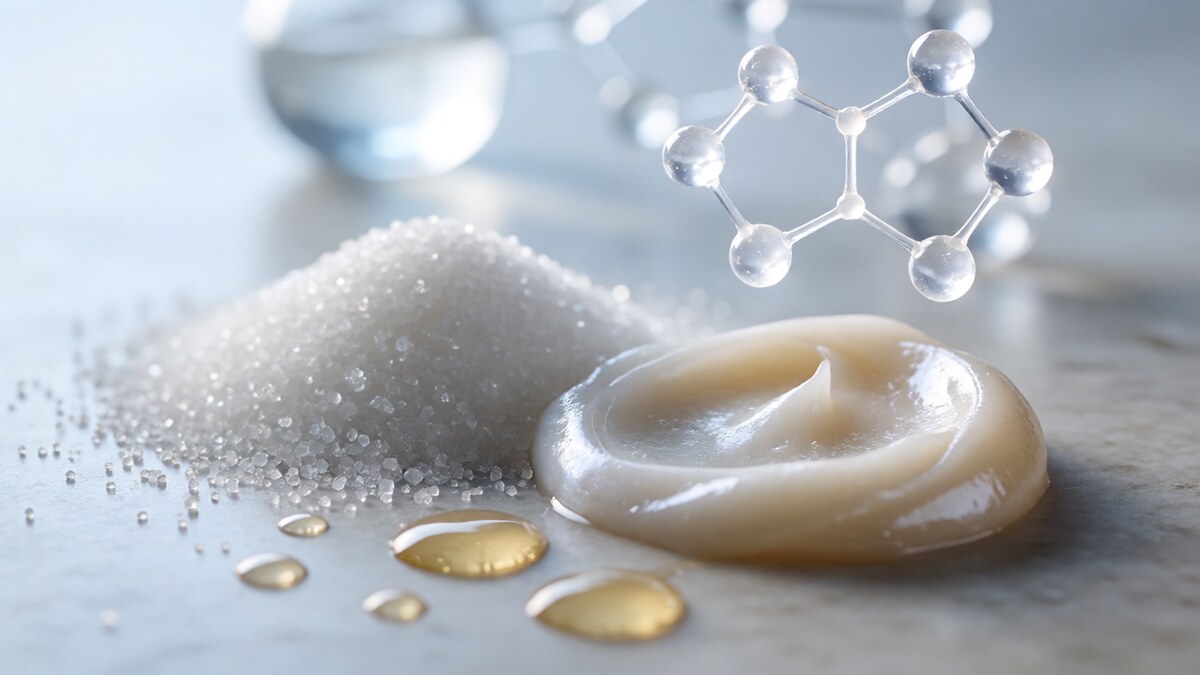
A body scrub looks like the easiest product in the brightening routine to formulate. It is not. The moment you try to combine real exfoliation with a defensible brightening claim, three problems collide: a rinse-off contact time measured in seconds, an abrasive particle that has to stay suspended in the base, and a pH conflict between the acids that exfoliate and the actives that brighten. This guide works through a bench-ready brightening body scrub, from target definition to a 100 g formula.
Why a Body Scrub Is Harder Than It Looks
Four constraints drive every decision in this format:
- Rinse-off contact time. A scrub is on the skin for 30–90 seconds. Actives have almost no time to partition into the stratum corneum, so most of the visible brightening comes from physically removing pigment-laden corneocytes, not from deep delivery. Formulating a scrub like a leave-on serum is the single most common mistake.
- Mechanical plus chemical exfoliation. Abrasive particles and acids do not always stack cleanly. Harsh, irregular particles create microtrauma, and in skin of colour microtrauma is a recognised trigger for post-inflammatory hyperpigmentation (Davis & Callender 2010).
- Particle suspension. In an emulsion scrub the exfoliant must stay suspended and must not settle into a brick at the bottom of the jar. That requires a yield value, not merely viscosity.
- pH conflict. Alpha-hydroxy acids need pH 3.5–4.2 to exfoliate, while niacinamide must stay at pH 5 or above or it hydrolyses to nicotinic acid, which can cause flushing. At full strength you generally cannot have both.
Step 1 – Define the Target and Pick the Exfoliation Route
Decide what the scrub is actually for before you choose a single ingredient. The three realistic targets point to different routes.
| Target | Exfoliation route | Primary brightening logic |
|---|---|---|
| Rough texture / keratosis pilaris | Chemical (lactic or salicylic acid) | Turnover of keratin plugs; secondary fade of surrounding marks |
| Dullness with surface pigment | Physical (fine sugar or jojoba esters) | Removal of pigmented corneocytes for immediate radiance |
| Post-inflammatory marks on the body | Gentle physical + transfer inhibitors | Niacinamide and alpha-arbutin to interrupt new pigment formation |
For a general-purpose brightening body scrub aimed at skin of colour, the safest and most defensible brief is gentle physical exfoliation plus transfer-inhibiting actives at skin-friendly pH. Reserve the acid route for texture-focused variants.
Step 2 – Choose the Exfoliant System
Physical exfoliants. Sucrose is the workhorse: fine grades give a soft, dissolving scrub, and sugar also acts as a humectant as it dissolves. Sea salt gives a sharper, more aggressive feel and is better suited to oily backs than to dry arms. Jojoba esters are spherical and uniform, which makes them the gentlest option and the most forgiving on skin of colour, at the cost of a higher raw-material price. Avoid irregular ground shell and pumice powders in any product marketed to melanin-rich skin.
Chemical exfoliants. Lactic acid (5–8%) is the best default for a body scrub because it is a larger AHA: it hydrates as it exfoliates and irritates less than glycolic acid at equal strength. Glycolic acid (5–10%) penetrates faster and suits thickened, sun-damaged areas. Salicylic acid (0.5–2%) is lipophilic and targets follicular keratin, which makes it the right choice for keratosis pilaris. Gluconolactone, a polyhydroxy acid, exfoliates gently and adds antioxidant capacity.
Step 3 – The Brightening Active System and the Evidence
Niacinamide reduces melanosome transfer from melanocytes to keratinocytes rather than blocking tyrosinase directly, so it stacks cleanly with tyrosinase inhibitors. Hakozaki and colleagues showed a dose-dependent reduction in melanosome transfer in a reconstructed skin model (Hakozaki 2002), and a randomised trial found 4% niacinamide produced a good-to-excellent response in roughly a quarter of melasma subjects versus about 6% on placebo (Castanedo-Cázares 2013). It is water-soluble and pH-tolerant above 5, which makes it ideal for the non-acid route.
Alpha-arbutin is a competitive tyrosinase inhibitor and is far more stable in water than ascorbic acid, so it survives an emulsion base without discolouring (Sugimoto 2004). At 1% it is a supporting active, not a headline claim.
Tranexamic acid interrupts plasmin-mediated signalling in keratinocytes, damping the inflammatory cross-talk that sustains pigment; topical use has shown benefit in melasma (Ebrahimi & Naeini 2014; Kim 2016). It is worth adding when the target is post-inflammatory marks.
Centella asiatica supplies madecassosides with documented anti-inflammatory and barrier-supporting activity, useful when the scrub also contains an acid or when the skin is reactive (Bylka 2014).
On the exfoliation itself: alpha-hydroxy acids accelerate stratum corneum turnover, and both lactic and glycolic acid have been shown to improve the appearance of photodamaged skin in controlled studies (Smith 1996; Ditre 1996). That turnover effect is the real brightening engine of an acid scrub — the actives are supporting cast.
Step 4 – Sample 100 g Formula (Transfer-Inhibitor Route, pH 5.5)
| Phase | Ingredient | % w/w |
|---|---|---|
| A | Purified water | to 100 |
| A | Glycerin | 5.0 |
| A | Xanthan gum | 0.3 |
| A | Magnesium aluminium silicate | 0.5 |
| A | Disodium EDTA | 0.05 |
| B | Caprylic/capric triglyceride | 8.0 |
| B | Jojoba oil | 4.0 |
| B | Shea butter | 3.0 |
| B | Cetearyl alcohol | 2.0 |
| B | Glyceryl stearate & PEG-100 stearate | 3.0 |
| B | Tocopheryl acetate | 0.2 |
| C | Niacinamide | 4.0 |
| C | Alpha-arbutin | 1.0 |
| C | Panthenol | 1.0 |
| C | Centella asiatica extract | 0.3 |
| D | Phenoxyethanol & ethylhexylglycerin | 1.0 |
| D | Citric acid / sodium hydroxide | q.s. to pH 5.5 |
| E | Fine sucrose | 20.0 |
Acid-route variant. Drop the niacinamide, add lactic acid at 6.0% and buffer to pH 3.8. Keep alpha-arbutin, which is stable at low pH, and keep Centella for tolerance. Do not run niacinamide and a strong AHA together at full strength.
Anhydrous variant. For a preservative-free sugar scrub, replace the water phase with caprylic/capric triglyceride and add 3–5% coco-glucoside so the product rinses clean; use oil-soluble actives such as ascorbyl tetraisopalmitate. Anhydrous bases have no water activity to support growth, but the jar will be contaminated with wet hands in use, so a preservation strategy is still advisable.
Step 5 – Process
- Hydrate the xanthan gum and magnesium aluminium silicate in Phase A water with slow, high-shear mixing until fully swollen and uniform. This step sets the yield value that keeps the exfoliant suspended.
- Heat Phase A to 70–75 °C. In a separate vessel, melt Phase B to 70–75 °C.
- Add Phase B to Phase A under homo-mixing for 5 minutes, then sweep-mix and cool to below 40 °C.
- Add Phase C actives one at a time, allowing each to dissolve fully. Keep the batch below 40 °C to protect alpha-arbutin and to avoid niacinamide hydrolysis.
- Adjust pH to 5.5 with the citrate buffer, then add Phase D preservative.
- Fold in Phase E sucrose last, under low-shear mixing, just until dispersed. High shear after this point will dissolve the crystals and destroy the scrub.
Step 6 – pH, Stability, Preservation and Packaging
Target pH 5.5 for the transfer-inhibitor route and 3.8 for the acid route. Because an emulsion scrub contains a substantial water phase, run a preservative efficacy test to ISO 11930 rather than trusting a single preservative. Phenoxyethanol with ethylhexylglycerin at 1% is a robust starting pair, supported by a chelant. Run 12 weeks at 40 °C plus a freeze–thaw cycle; watch specifically for sucrose dissolution, particle settling and any colour drift from the arbutin.
Packaging matters more than usual here. A wide-mouth jar invites wet-hand contamination, so a flip-top tube or a pump with a wide orifice keeps the product cleaner and keeps the crystals in suspension during normal use. If the formula settles in the jar, the yield value is too low — increase the suspending clay or add a small amount of a second rheology modifier rather than simply adding more xanthan.
Step 7 – Claim Substantiation
Do not claim “whitening”. Build claims from the ingredient evidence base at the levels you actually use, and support them with a consumer-perception study on the finished product. Keep on-pack language to “brightening”, “smoother-looking skin”, “helps fade the look of dark spots”, and retain raw-material dossiers and stability data. For a rinse-off product, expect regulators and reviewers to scrutinise any efficacy claim closely, because contact time is short and the deposition of actives is limited.
Bottom Line
A brightening body scrub succeeds on three boring things: an exfoliant system gentle enough not to cause the very pigmentation you are targeting, a yield value high enough to keep that exfoliant suspended, and a pH decision made deliberately rather than by accident. Choose the physical-and-transfer-inhibitor route for skin of colour, keep the acid route for texture, and treat the rinse-off contact time as the hard constraint it is.
References
- Hakozaki T, et al. The effect of niacinamide on reducing cutaneous pigmentation and suppression of melanosome transfer. Br J Dermatol. 2002;147(1):20–31.
- Castanedo-Cázares JP, et al. A double-blind, randomized trial of 4% niacinamide vs. 0.05% desonide for melasma. Clin Cosmet Investig Dermatol. 2013;6:29–36.
- Sugimoto K, et al. Inhibitory effects of alpha-arbutin on melanin synthesis. Biol Pharm Bull. 2004;27(4):510–514.
- Ebrahimi B, Naeini FF. Topical tranexamic acid as a promising treatment for melasma. J Res Med Sci. 2014;19(8):753–757.
- Kim SJ, et al. Efficacy and possible mechanisms of topical tranexamic acid in melasma. Clin Exp Dermatol. 2016;41(5):480–485.
- Smith WP. Comparative effectiveness of alpha-hydroxy acids on skin. J Am Acad Dermatol. 1996;35(3 Pt 1):388–391.
- Ditre CM, et al. Effects of alpha-hydroxy acids on photoaged skin. J Am Acad Dermatol. 1996;34(2 Pt 1):187–195.
- Bylka W, et al. Centella asiatica in cosmetology. Phytother Res. 2014;28(8):1117–1124.
- Davis EC, Callender VD. Postinflammatory hyperpigmentation: a review of the epidemiology, clinical features and treatment options in skin of colour. J Clin Aesthet Dermatol. 2010;3(7):20–31.
Interested in Formulation Data Collaboration?
Let's discuss how Melasyl AI can accelerate your next whitening or brightening formula. Technical collaboration, data licensing, or custom AI-driven research — reach out.
Contact Wei →