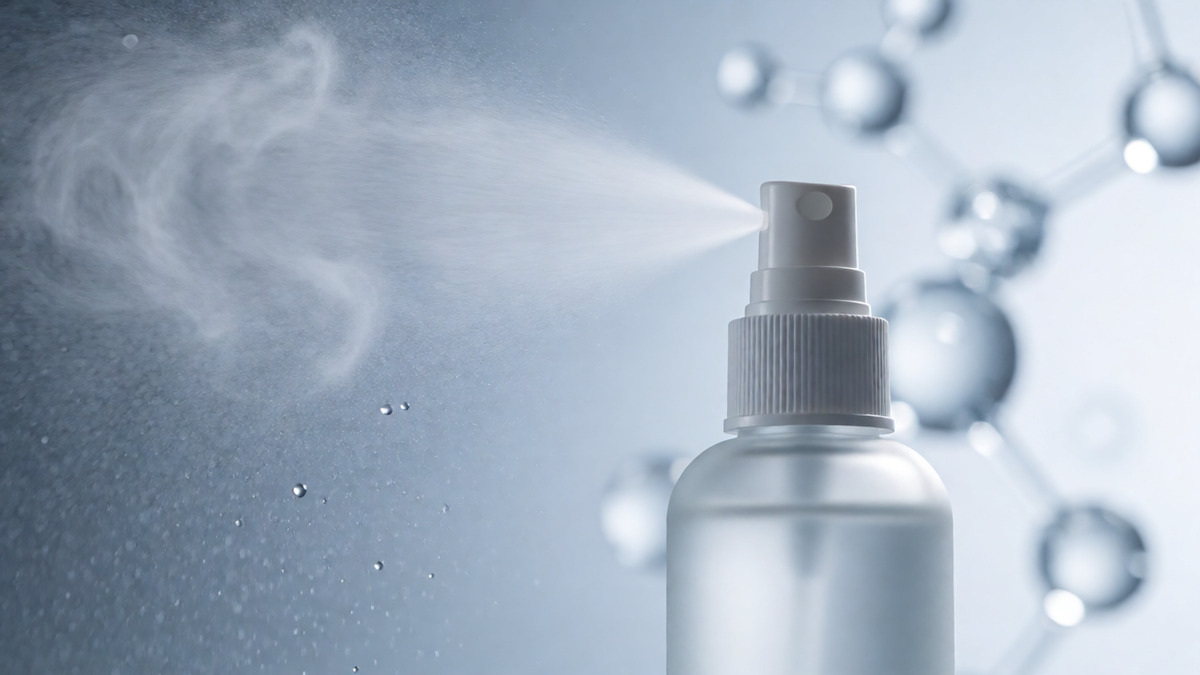
There are few molecules in skincare that crossed the chasm from a sterile wound-care ward to the influencer’s bathroom shelf so quickly as hypochlorous acid. It is the weak, chlorine-based acid your own white blood cells manufacture during a “respiratory burst” to kill invading bacteria — and now you can buy it in a fine mist, pre-stabilized, and spray it across your face after the gym.
The Trend, in Numbers
The commercial signal is unambiguous. Fresha reports 90,000+ average monthly searches for hypochlorous acid products in 2026, up 50% year-over-year, with the spray format leading. Accio’s trend tracking puts Google interest in “hypochlorous acid spray” up 588% versus the prior year. Sonoma Pharmaceuticals’ Lumacyn Clarifying Mist has become a household name, and the post-workout “spritz” ritual turned the molecule into a habit of its own. The underlying HOCl market — dominated by disinfectants but increasingly driven by the wound and skin-care segment — is projected to grow from roughly US$1.9 billion in 2025 toward US$3.3 billion by 2034 at a roughly 6.4% compound annual growth rate (Fortune Business Insights).
Why now? Because the molecule sits at the intersection of three converging forces: consumer fatigue with harsh actives, a microbiome-aware generation, and a clinical evidence base that is finally mature enough to be cited on a label.
The Clinical Evidence That Matters
Acne: A Small but Real Signal
The most-cited clinical result is a double-blind randomized controlled trial that applied 0.005% sodium hypochlorite (the solution that generates HOCl) topically three times daily for one month and found a significant reduction in both papules and pustules — lesion counts fell from 759 to 476 across the treatment group. Papules responded particularly well. The body of acne-specific research remains small, and the honest reading is that HOCl is “encouraging, not definitive.” The tolerability profile is the real story: unlike benzoyl peroxide, it produces far less dryness, stinging, or peeling, making it a gentler entry point for reactive, acne-prone skin.
An in-vitro study in Dermatologic Surgery found 0.01% HOCl killed C. acnes in under a minute — comparable to or faster than several common antiseptics.
Eczema and Atopic Dermatitis: The Strongest Case
The most rigorous clinical support for HOCl comes from dilute bleach baths, which generate HOCl in solution and are a standard American Academy of Dermatology recommendation for atopic dermatitis. Trials comparing dilute HOCl baths to plain water baths show significant reductions in eczema severity scores, attributed to the reduction of Staphylococcus aureus load on compromised skin. A 2025 pilot in Experimental Dermatology on chronic wounds found HOCl reduced S. aureus relative abundance from 34% at baseline to 10% by week 8 while simultaneously increasing bacterial diversity — evidence that HOCl suppresses the pathogen without sterilizing the site.
Post-Procedure Recovery
HOCl is increasingly prescribed for the days following microneedling, laser resurfacing, and chemical peels: it reduces infection risk while calming the inflammatory response, without the irritation of traditional antiseptics. A 2025 clinical review across dermatology, surgery, and ophthalmology documented its anti-inflammatory properties and use in atopic dermatitis, rosacea, and other inflammatory skin conditions.
The Pigmentation Angle
Here is where the honest gap is. HOCl is an antimicrobial and anti-inflammatory, not a tyrosinase inhibitor. For a brand whose entire brief is hyperpigmentation, the direct melanogenic effect is modest. The real value for melanin-rich skin is indirect but meaningful: it calms the inflammatory cascade that triggers post-inflammatory hyperpigmentation in the first place. Reducing S. aureus burden and lowering interleukin-6 and leukotriene B4 signaling — two known PIH triggers — makes HOCl a “calm the skin so the pigment does not settle” ingredient. It is a supporting act, not a lead.
The Formulation Science
HOCl is a weak, unstable acid. Unbuffered formulations degrade rapidly: solutions exposed to sunlight lost their active chlorine by day four of one stability study, while cool, dark, sealed storage held up for about two weeks. Stabilized, pH-neutral formulations maintain efficacy for up to 12 months. The concentration that works topically without disrupting the barrier sits at 0.01% to 0.05%; higher concentrations start to behave like chlorine. And there is one non-obvious rule: HOCl neutralizes antioxidants. Layering it over vitamin C or niacinamide in the same routine reduces both. The practical fix is temporal separation — HOCl in the evening, antioxidants in the morning.
The 2026 Bottom Line
HOCl is one of the most evidence-backed gentle antimicrobials now available for daily skincare use. It is not a standalone acne cure, and it is not a melanogenic workhorse. What it is — a body-identical, broad-spectrum, anti-inflammatory mist that calms reactive skin without stripping the microbiome — is genuinely novel, and it is the rare ingredient where the social-media hype and the clinical literature point in the same direction. For brands, the opportunity is an “everyday calm” layer that sits under every other active; for the consumer, it is the rare product where the search trend is backed by real data.
The 2026 data point that matters: 90,000 monthly searches, 588% YoY search growth, a 6.4% CAGR market, and a clinical record spanning decades of wound care. The molecule is doing exactly what the label claims — quietly.
Interested in Formulation Data Collaboration?
Let's discuss how Melasyl AI can accelerate your next whitening or brightening formula. Technical collaboration, data licensing, or custom AI-driven research — reach out.
Contact Wei →