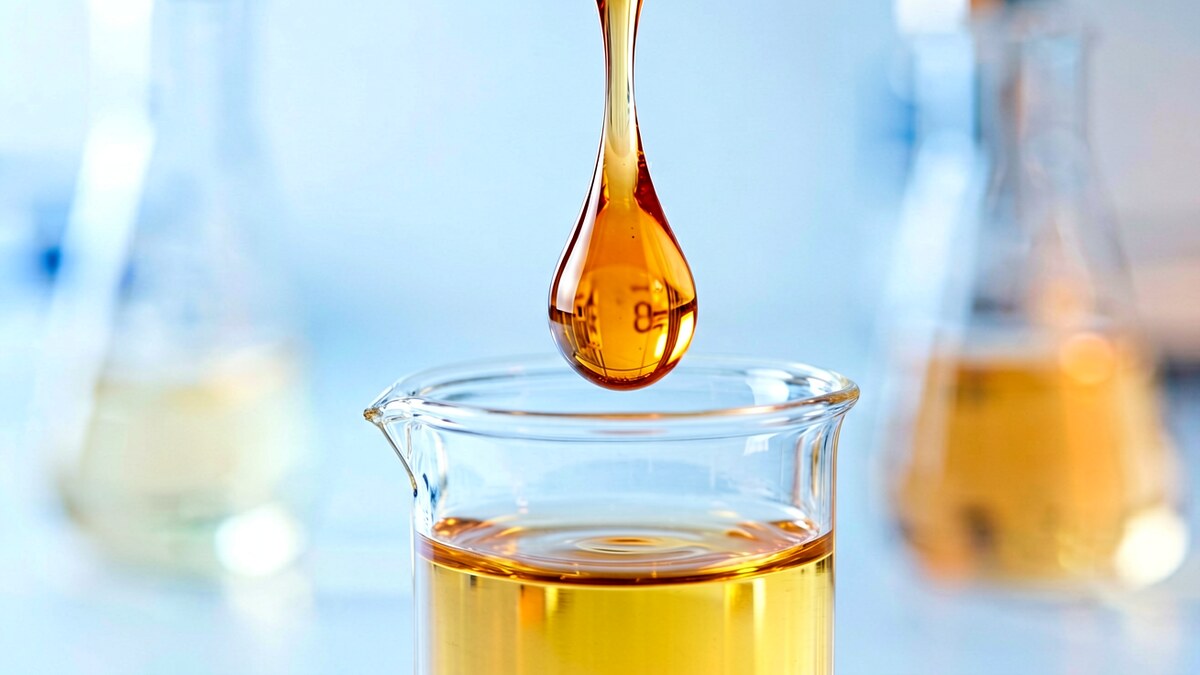
Among the dozens of antioxidants marketed in modern skincare, few have a more unusual origin story than idebenone. Developed in the 1980s as a synthetic analog of coenzyme Q10 (ubiquinone) to treat mitochondrial disease, idebenone was later shown to outperform nearly every conventional antioxidant in a head-to-head bench study — a finding that quietly repositioned it as one of the most interesting photoprotective and brightening actives in cosmetic science. This review examines what idebenone actually does, where the evidence is strong, and how formulators should handle it in 2026.
What Is Idebenone?
Idebenone (INCI: hydroxydecyl ubiquinone) is a short-chain synthetic benzoquinone — a smaller, more polar cousin of coenzyme Q10. Its structure replaces the long lipophilic isoprenoid tail of ubiquinone with a short 10-carbon hydroxydecyl chain, which markedly improves solubility, tissue penetration, and its ability to reach the mitochondrial inner membrane.
Because it is a compact redox-cycling benzoquinone, idebenone functions as both an electron carrier in the mitochondrial electron transport chain and a broad-spectrum free-radical scavenger. That dual role — supporting cellular energy metabolism while neutralizing reactive oxygen species (ROS) — distinguishes it from purely sacrificial antioxidants such as ascorbic acid.
Mechanism: Why a Mitochondrial Target Matters for Skin
Skin is a high-turnover, high-energy tissue, and mitochondria in keratinocytes and melanocytes are major sources of ROS under ultraviolet and visible-light exposure. When ROS outpace a cell’s antioxidant defenses, the resulting oxidative stress drives two processes central to cosmetic concern:
- Photoaging — ROS activate matrix metalloproteinases (MMPs), degrade collagen and elastin, and accelerate the appearance of fine lines and uneven texture.
- Pigmentation — oxidative stress is an upstream trigger of melanogenesis. ROS and reactive nitrogen species activate MITF and upregulate tyrosinase, and they help sustain the inflammatory environment behind post-inflammatory hyperpigmentation (PIH).
By replenishing mitochondrial redox capacity and directly quenching superoxide, peroxyl radicals, and singlet oxygen, idebenone interrupts these cascades at their source rather than bleaching pigment downstream.
The Benchmark Study: Idebenone vs. Conventional Antioxidants
The most cited evidence for idebenone’s potency comes from McDaniel and colleagues, who compared the oxidative-stress protection capacity of idebenone against a panel of established antioxidants in a standardized in vitro model (Journal of Cosmetic Dermatology, 2005). Idebenone provided the greatest protection of the panel, surpassing vitamin C (ascorbic acid), vitamin E (tocopherol), coenzyme Q10, kinetin, and alpha-lipoic acid. In the companion clinical study by the same group, topical 0.5% and 1.0% idebenone applied to photodamaged skin produced measurable improvements in dryness, skin-tone evenness, and fine lines over six weeks.
Reference: McDaniel DH et al., J Cosmet Dermatol 2005;4(1):10–17 (Part I); 2005;4(3):167–173 (Part II).
Independent mechanistic work has confirmed that idebenone scavenges free radicals and protects membrane lipids and mitochondria from oxidative damage at low micromolar concentrations (Mordente A et al., Chem Res Toxicol 1998;11(1):54–63).
Photoprotection Evidence
Idebenone is not a UV filter and cannot replace sunscreen. However, it complements photoprotection by reducing the oxidative aftermath of UV and visible-light exposure:
- It attenuates UV-induced lipid peroxidation and the depletion of endogenous antioxidants in skin models.
- It reduces ROS-mediated MMP activation — the mechanistic link between sun exposure and collagen loss.
- Because it addresses oxidative stress, a driver of both epidermal and dermal pigmentation, it fits naturally into the same routine as broad-spectrum SPF.
For pigment-focused regimens, the practical implication is that idebenone is best positioned as a daytime antioxidant layered under sunscreen, where it can blunt the oxidative signals that perpetuate melasma and PIH.
Idebenone and Brightening: The Upstream Pigment Play
Unlike tranexamic acid, niacinamide, or arbutin, idebenone does not directly inhibit tyrosinase. Its value for pigmentation is indirect but mechanistically sound: it lowers the oxidative load that activates MITF and tyrosinase in the first place. That makes it a genuine complement — rather than a competitor — to tyrosinase-level brightening actives, and a sensible addition to regimens targeting melasma, sun-induced darkening, and PIH.
Formulation Science: Getting Idebenone to Work (2026)
Idebenone’s cosmetic reputation has been limited less by efficacy than by formulation difficulty. Key considerations:
- Solubility and dose. Idebenone is lipophilic but more polar than CoQ10. Typical use levels are 0.1–1.0% w/w; the clinically studied topical range was 0.5–1.0%.
- Oxidative and photostability. Like all benzoquinones, idebenone is itself susceptible to oxidation and degrades under light and heat. It is yellow-orange and will discolor clear formulations as it oxidizes.
- Encapsulation. Liposomal or lipid-nanoparticle encapsulation markedly improves stability and delivery, and is the dominant strategy in premium commercial serums.
- Packaging. Airless, opaque, or amber packaging is essential; idebenone in a clear pump bottle can oxidize within weeks.
- Formulation partners. Idebenone pairs well with other oil-phase antioxidants (vitamin E, ferulic acid) that regenerate its redox state, and with niacinamide or tranexamic acid for pigment control. Avoid strongly alkaline systems.
Idebenone vs. Coenzyme Q10 and Vitamin C
Relative to coenzyme Q10, idebenone is smaller and more bioavailable to mitochondria, though CoQ10 has a larger evidence base in oral supplementation. Relative to vitamin C, idebenone is oil-soluble, more stable in emulsion, and does not require a low pH — but it lacks vitamin C’s direct roles in collagen synthesis and tyrosinase reduction. In practice these actives are complementary, not interchangeable: vitamin C works best in a low-pH aqueous layer, idebenone in a stable oil or encapsulated system.
Safety
Topically, idebenone is well tolerated. Reported adverse effects in clinical cosmetic use are limited to occasional mild irritation, and the molecule has an extensive systemic safety record from its medical use in mitochondrial disorders. As with any antioxidant, irritation is more likely to come from the surrounding vehicle (for example, high-pH or high-alcohol systems) than from idebenone itself.
Conclusion
Idebenone occupies a specific and defensible niche in 2026 skincare: a mitochondrial-targeted antioxidant with benchmark-verified potency, a plausible mechanistic story spanning photoaging and pigmentation, and a formulation challenge — stability — that is now largely solvable through encapsulation and smart packaging. For brightening-focused products, it is best understood as a photoprotective “upstream” partner to tyrosinase-level actives such as tranexamic acid, niacinamide, or arbutin, reducing the oxidative pressure that drives pigment production in the first place. Formulated well and positioned honestly, idebenone earns its place in serious antioxidant and anti-pigmentation regimens.
References
- McDaniel DH, Neudecker BA, DiNardo JC, Clancy JP, Uchida T. “Idebenone: a new antioxidant — Part I. Relative assessment of oxidative stress protection capacity compared to commonly known antioxidants.” Journal of Cosmetic Dermatology. 2005;4(1):10–17.
- McDaniel DH, et al. “Idebenone: a new antioxidant — Part II. Clinical efficacy assessment in photodamaged skin of 0.5% and 1.0% idebenone.” Journal of Cosmetic Dermatology. 2005;4(3):167–173.
- Mordente A, Martorana GE, Minotti G, Giardina B. “Antioxidant properties of idebenone.” Chemical Research in Toxicology. 1998;11(1):54–63.
- Meier T, Buyse G. “Idebenone: an emerging therapy for Friedreich ataxia.” Journal of Neurology. 2009;256(Suppl 1):25–30.
- Kim HE, et al. “Reactive oxygen species in melanogenesis and pigmentation.” Journal of Dermatological Science (review).
Interested in Formulation Data Collaboration?
Let's discuss how Melasyl AI can accelerate your next whitening or brightening formula. Technical collaboration, data licensing, or custom AI-driven research — reach out.
Contact Wei →