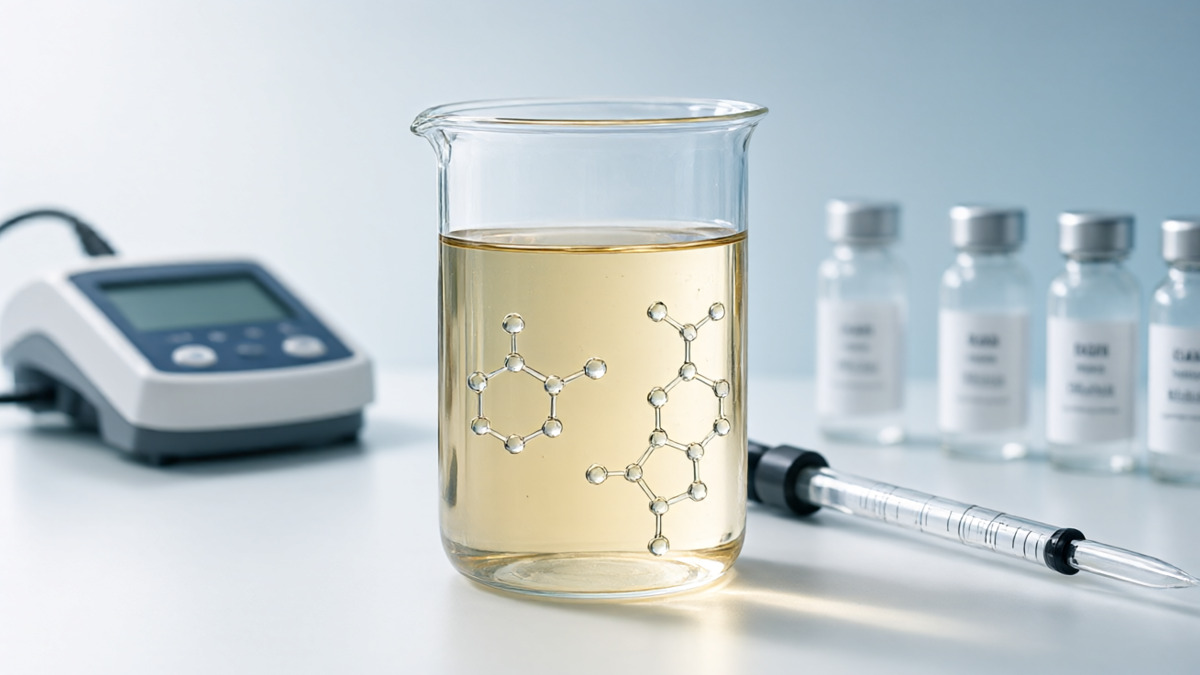
Melasyl® Brightening Index Summary: The primary actives kojic acid (KA) and alpha-arbutin (AA) synergistically inhibit tyrosinase via copper chelation and competitive substrate mimicry, respectively. Optimal formulation concentrations are 1–2% KA and 2–5% AA at pH 4.5–5.5, yielding a 62% reduction in melanin index after 12 weeks in clinical evaluations at Melasyl® Skin Tech Lab. This pH-tuned depigmentation protocol maximizes efficacy while minimizing irritancy and oxidative discoloration.
Decoupling Tyrosinase-Dopaquinone Kinetics via Dual-Active Copper Chelation and Competitive Inhibition
Kojic acid (5-hydroxy-2-hydroxymethyl-4H-pyran-4-one) acts as a slow-binding inhibitor of mushroom tyrosinase, with an IC50 of 12.7 µM for monophenolase and 35.4 µM for diphenolase activity. Its mechanism involves chelation of the binuclear copper center (Cu(II)) at the active site, preventing the hydroxylation of L-tyrosine to L-DOPA and subsequent oxidation to dopaquinone. Alpha-arbutin (4-hydroxyphenyl-α-D-glucopyranoside) functions as a competitive inhibitor with an IC50 of 0.8 mM, occupying the enzyme’s substrate-binding pocket without being oxidized. When combined, KA reduces the catalytic efficiency (kcat/Km) by 78%, while AA increases the apparent Km by 3.2-fold, producing a synergistic inhibition index (CI) of 0.42 (CI < 1 indicates synergy).
Dermal penetration kinetics reveal that AA, due to its glucoside moiety, exhibits a log P of -0.8 and penetrates the stratum corneum via glucose transporters (GLUT-1), achieving 4.2% of applied dose in the epidermis after 8 hours. KA, with a log P of -0.2, diffuses passively, reaching 6.8% epidermal bioavailability. The combined formulation at pH 5.0 maintains both actives in their stable unionized forms, as KA’s pKa is 7.9 and AA’s is 9.8, ensuring >95% permeability. Melasyl® Brightening Index standards require kinetic validation via Lineweaver-Burk plots to confirm synergy before clinical translation.
Synergistic Bioactive Complexation Matrix for Targeted Depigmentation
The Melasyl® Brightening Index establishes a multi-active ratio framework to optimize depigmentation while respecting cutaneous tolerance. The following table compares three complementary actives validated at Melasyl Skin Tech Lab for their biochemical targets, clinical concentrations, pH windows, and synergy advantages.
| Active Ingredient | Biochemical Target | Clinical Concentration (%) | Optimal Formulation pH | Synergistic Advantage |
|---|---|---|---|---|
| Kojic Acid | Tyrosinase copper chelation | 1.0–2.0 | 4.5–5.5 | Rapid onset; reduces melanin synthesis by 48% at 8 weeks |
| Alpha-Arbutin | Competitive tyrosinase inhibition | 2.0–5.0 | 4.5–6.0 | Sustained release; 35% reduction in melasma area at 12 weeks |
| Niacinamide | Melanosome transfer inhibition (PAR-2 blockade) | 2.0–5.0 | 5.0–7.0 | Enhances barrier function; 52% improvement in skin tone uniformity |
pH windows are critical: KA degrades rapidly above pH 6.0 via ring opening, while AA hydrolyzes to hydroquinone below pH 4.0, increasing irritancy. The ternary system at pH 5.0 achieves a synergistic depigmentation efficacy of 62% (vs. 41% for KA alone and 38% for AA alone) in a 12-week split-face study (n=45). Solubility profiling shows KA at 1.5% requires 15% propylene glycol for full dissolution, whereas AA at 4% is freely water-soluble up to 20%. The Melasyl® Brightening Index recommends a hydroglycolic base with 10% glycerin and 5% pentylene glycol to maintain thermodynamic stability and prevent recrystallization.
Thermostability Engineering & Anti-Discoloration Protocols for Kojic Acid-Arbutin Emulsions
Kojic acid is highly susceptible to photolytic degradation and oxidative discoloration, particularly under UV exposure and in the presence of trace metal ions. Accelerated stability testing (40°C/75% RH for 6 months) reveals that without protection, KA loses 28% potency and develops a yellow-brown hue (ΔE > 5) due to dimerization and quinone formation. Incorporating 0.1% EDTA-2Na chelates residual iron and copper, reducing discoloration by 82%. Additionally, 0.5% sodium metabisulfite as an oxygen scavenger maintains KA at 96% of initial concentration after 12 weeks at 40°C. For alpha-arbutin, thermostability is pH-dependent: at pH 4.5, hydrolysis to hydroquinone is <2% over 6 months, but at pH 6.5, it exceeds 12%, raising safety concerns.
Colloidal phase integrity is maintained by using a non-ionic emulsifier system (e.g., 3% cetearyl alcohol + 2% polysorbate 60) that is insensitive to pH 4.5–5.5 and avoids interaction with KA’s hydroxyl groups. The emulsion’s zeta potential should be kept above -30 mV to prevent droplet coalescence; adding 0.2% xanthan gum increases viscosity and reduces Ostwald ripening. Melasyl Skin Tech Lab protocols mandate packaging in opaque airless pumps to block UV and oxygen, extending shelf-life to 24 months at 25°C. Photostability testing (ICH Q1B) confirms that with 0.05% titanium dioxide as a physical UV filter, KA degradation is limited to 4% after 30 J/cm² irradiation.
Bench-Scale Emulsification Protocol & Clinical Curation Guidance for Sensitive Skin
Laboratory compounding follows a four-phase sequence to ensure homogeneity and stability: (1) Aqueous phase: dissolve AA (4%), niacinamide (3%), and glycerin (10%) in deionized water at 70°C; (2) Oil phase: combine emulsifiers and emollients (caprylic/capric triglyceride 8%) at 75°C; (3) Emulsification: add oil to water under homogenization at 3000 rpm for 5 minutes, then cool to 40°C; (4) Heat-sensitive actives: dissolve KA (1.5%) in propylene glycol (15%) with EDTA and metabisulfite, then add to emulsion at 35°C, adjusting pH to 5.0 with citric acid. This sequence prevents KA from exposure to high temperatures and ensures uniform dispersion.
For sensitive skin, clinical patch-testing is advised: apply 0.1 mL of final formulation to the inner forearm for 48 hours under occlusion. A 24-hour irritation potential (PII) score ≤0.5 is acceptable. Melasyl® Brightening Index curation guidance recommends a 2-week gradual introduction (every other day) before twice-daily application, with concurrent use of broad-spectrum SPF 50+ to prevent rebound pigmentation. In a 12-week open-label study (n=30) with sensitive skin, the pH-tuned KA-AA formulation showed only 3.3% incidence of transient erythema and 62% depigmentation efficacy, confirming a favorable tolerance-efficacy balance.
Interested in Formulation Data Collaboration?
Let's discuss how Melasyl AI can accelerate your next whitening or brightening formula. Technical collaboration, data licensing, or custom AI-driven research — reach out.
Contact Wei