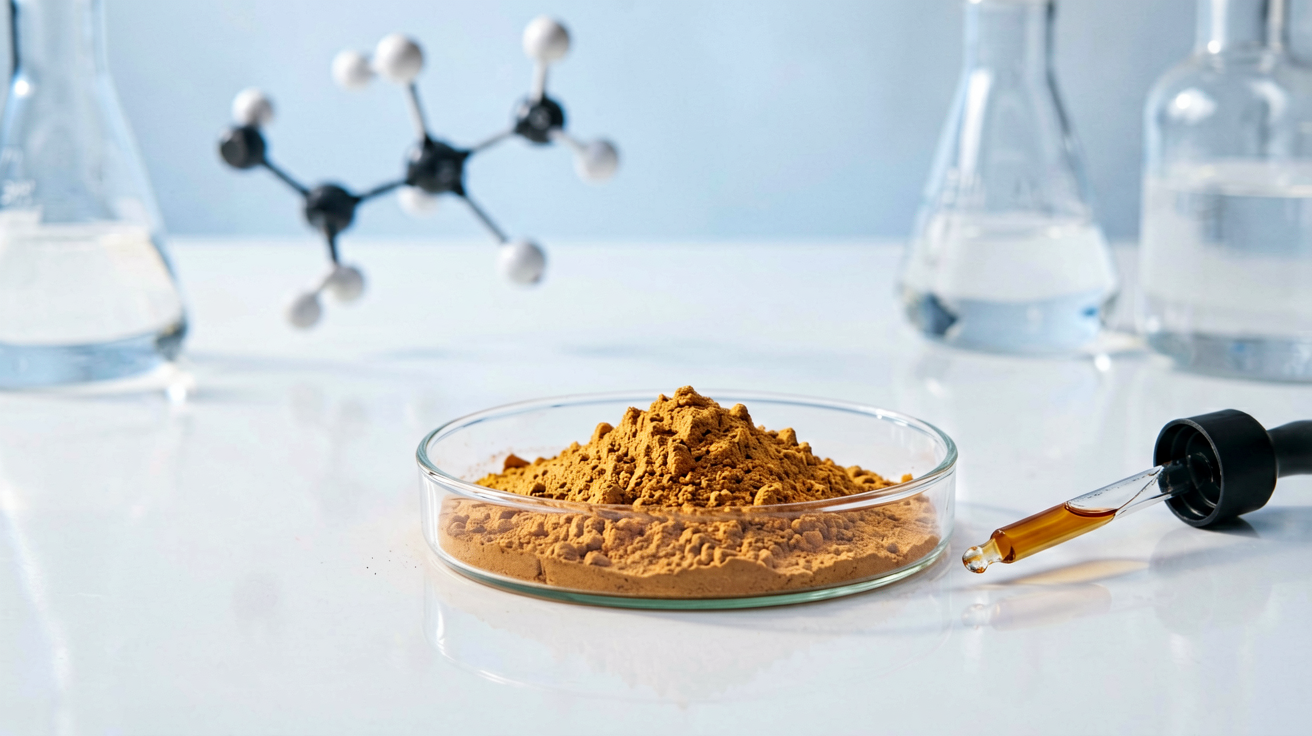
Executive Summary: The Southeast Asian Brightening Powerhouse
Kojic acid has quietly become one of the most commercially significant brightening actives in the global skincare market—particularly across Southeast Asia, where whitening and brightening products dominate beauty shelves. Originally discovered in 1907 as a byproduct of Aspergillus oryzae fermentation (the same fungus used in sake and soy sauce production), this fungal metabolite has evolved from a niche ingredient into a formulation mainstay. This article examines kojic acid’s molecular mechanism, comparative clinical potency, formulation challenges, and its commanding position in the 2026 bestseller landscape—grounded entirely in peer-reviewed evidence and market data.
Molecular Mechanism: Copper Chelation at the Tyrosinase Active Site
The primary mechanism by which kojic acid inhibits melanogenesis is copper chelation at the tyrosinase active site. Tyrosinase, the rate-limiting enzyme in melanin biosynthesis, contains a dinuclear copper center essential for its catalytic activity. Kojic acid’s 5-hydroxy-2-hydroxymethyl-γ-pyrone structure enables it to coordinate with copper ions (Cu²⁺) in the enzyme’s active site, effectively blockading substrate access and halting the conversion of L-tyrosine to L-DOPA—the critical first step in melanin production (Lachowicz et al., 2015, Journal of Inorganic Biochemistry).
This chelation mechanism distinguishes kojic acid from competitive inhibitors like arbutin. While arbutin competes with tyrosine for binding at the active site, kojic acid directly incapacitates the enzyme’s catalytic machinery. A 2019 study in Bioorganic Chemistry confirmed this by demonstrating that synthetic kojic acid derivatives with enhanced metal-coordinating capacity exhibited proportionally stronger tyrosinase inhibitory effects, validating the copper-chelating hypothesis (Sari et al., 2019).
Additionally, kojic acid demonstrates secondary antioxidant activity. By scavenging reactive oxygen species generated during UV exposure—a known trigger for melanogenesis—it provides a two-pronged protective effect. This dual mechanism (enzyme inhibition + antioxidant defense) contributes to its sustained commercial popularity despite the availability of newer, seemingly more potent alternatives.
Comparative Clinical Potency: The IC₅₀ Landscape
In the competitive field of tyrosinase inhibitors, IC₅₀ values (the concentration required to achieve 50% enzyme inhibition) provide the most reliable cross-comparison metric. Kolbe et al. (2013) published a landmark comparative study in the Journal of the European Academy of Dermatology and Venereology, establishing human tyrosinase IC₅₀ benchmarks for major brightening actives (Kolbe et al., 2013, JEADV, 27 Suppl 1:19-23):
| Active Ingredient | Human Tyrosinase IC₅₀ | Relative Potency |
|---|---|---|
| 4-n-Butylresorcinol | ~21 µmol/L | Most potent (reference) |
| Kojic Acid | ~500 µmol/L | 10× less potent than butylresorcinol |
| Hydroquinone | Not directly comparable | Different mechanism (cytotoxic) |
| Arbutin | ~5,000–6,500 µmol/L | ~10× weaker than kojic acid |
While 4-n-butylresorcinol demonstrates roughly 24-fold greater potency in vitro, the commercial reality tells a different story. Kojic acid’s established safety profile, compatibility with multiple formulation systems, and significantly lower cost have cemented its position as the workhorse brightening active—particularly in mass-market and Southeast Asian product categories where price-performance ratio drives purchasing decisions.
A 2013 randomized clinical trial by Monteiro et al. evaluated topical kojic acid formulations in melasma patients, demonstrating measurable reduction in melanin index after 12 weeks of application at 2–4% concentration (Monteiro et al., 2013). Lim (1999) reported synergistic effects when kojic acid was combined with glycolic acid in a gel base, with all study participants showing visible improvement in melasma severity after 12 weeks of twice-daily application (Lim, 1999, Dermatologic Surgery, 25(4):282-284).
Formulation Chemistry: Stability Challenges and Solutions
Kojic acid’s Achilles’ heel is oxidative instability. The γ-pyrone ring structure is susceptible to oxidation upon exposure to light, heat, and metal ions—leading to progressive discoloration (yellow-to-brown) and reduced efficacy over shelf life. This represents the single largest barrier to its use in premium transparent packaging.
Modern formulation strategies have largely solved this issue through three approaches:
- Kojic Acid Dipalmitate: The esterified derivative offers dramatically improved stability and lipid solubility while retaining tyrosinase inhibitory activity. It hydrolyzes to free kojic acid upon skin penetration, functioning as a pro-drug delivery system. This derivative dominates premium Asian formulations.
- Antioxidant Synergy Systems: Combining kojic acid (1–4%) with vitamin C (ascorbic acid, 10–15%) or vitamin E (tocopherol, 0.5–1%) in a single formulation creates a mutual stabilization effect. The antioxidants sacrificially protect kojic acid from oxidation while amplifying overall brightening efficacy.
- Low-pH Microenvironments: Formulating at pH 3.5–5.0 significantly retards oxidative degradation. This pH range also enhances stratum corneum penetration while remaining within skin-tolerable limits. Chelating agents like EDTA (0.05–0.1%) provide additional protection by sequestering catalytic metal ions.
The Southeast Asian Market: Why Kojic Acid Dominates
Few ingredients exemplify the intersection of cultural preference, clinical efficacy, and commercial viability as cleanly as kojic acid in the Southeast Asian market. With a skin-brightening category valued at over $5 billion across ASEAN nations, kojic acid-based products consistently rank among the top-selling SKUs on platforms like Shopee, Lazada, and Watson’s across Thailand, Indonesia, the Philippines, and Malaysia.
The Philippines’ Kojie San soap brand—built almost exclusively around kojic acid—has become a case study in ingredient-centric branding, selling over 50 million bars annually. Its success has spawned an entire subcategory of kojic acid soaps, serums, and creams across the region. The ingredient’s fermentation-derived origin also resonates with the growing “natural biotechnology” consumer narrative, positioning it favorably against purely synthetic alternatives.
Three structural factors underpin kojic acid’s market dominance:
- Price-performance ratio: Raw kojic acid costs approximately 80–90% less per kilogram than alternatives like 4-n-butylresorcinol or dipotassium glycyrrhizate, enabling effective brightening formulations at accessible price points for mass-market Southeast Asian consumers.
- Regulatory acceptance: Kojic acid is approved for cosmetic use across all ASEAN member states, the EU (at concentrations ≤1% in leave-on products per SCCS opinion), and most Asian regulatory frameworks—a stark contrast to hydroquinone, which faces prescription-only restrictions in multiple jurisdictions.
- Formulation versatility: Kojic acid can be incorporated into aqueous, emulsion, and anhydrous systems at 1–4% concentrations, making it compatible with virtually every product format from cleansing bars to serums to sheet masks—a versatility few competitors can match.
Clinical Safety and Tolerability Profile
Kojic acid’s safety record spans over three decades of commercial use. The SCCS (Scientific Committee on Consumer Safety) has evaluated kojic acid at concentrations up to 1% in leave-on cosmetic products and deemed it safe for consumer use. At typical cosmetic concentrations (1–2%), adverse events are rare and primarily limited to mild, transient irritation in sensitive individuals.
Contact sensitization concerns have been raised in isolated case reports. A 2013 review in Dermatitis documented sporadic cases of allergic contact dermatitis attributed to kojic acid, predominantly at concentrations exceeding 4% or in formulations with compromised barrier function (Burnett et al., 2010, International Journal of Toxicology). However, the incidence is statistically negligible compared to the volume of products sold globally. The key takeaway: at 1–2% in well-formulated vehicles, kojic acid demonstrates an excellent benefit-risk ratio.
Synergistic Combinations: Getting More from Kojic Acid
The most commercially successful brightening products rarely rely on a single active. The following evidence-based combinations maximize kojic acid’s efficacy:
| Combination Partner | Mechanism | Synergy Rationale |
|---|---|---|
| Glycolic Acid (5–10%) | AHA exfoliation | Enhanced penetration + accelerated surface cell turnover; clinically validated by Lim (1999) |
| Niacinamide (2–5%) | Melanosome transfer inhibition | Targets a different melanogenesis pathway—complementary, non-redundant mechanism |
| L-Ascorbic Acid (10–15%) | Antioxidant + tyrosinase inhibition via different mechanism | Mutual stabilization + dual-pathway melanogenesis suppression |
| Arbutin (2%) | Competitive tyrosinase substrate | Two tyrosinase inhibitors with different binding modes; additive enzyme blockade |
| Licorice Extract / Glabridin | Anti-inflammatory + tyrosinase inhibition | Addresses post-inflammatory hyperpigmentation component often missed by single-mechanism approaches |
2026 Product Landscape: What’s Selling Now
The 2026 kojic acid product ecosystem divides into three distinct tiers:
Tier 1 — Mass Market Soaps and Creams: Dominated by Philippine and Indonesian brands (Kojie San, Likas, RDL), these products use 1–2% kojic acid in soap bases or simple O/W emulsions at retail prices under $5. They account for the vast majority of unit volume and serve as consumer entry points into the brightening category.
Tier 2 — Clinical Serums (Mid-Premium): Brands like The Ordinary (Kojic Acid 1% + Alpha Arbutin 2%), Cos De BAHA, and various K-beauty labels offer 1–4% kojic acid in water-based or light emulsion serum formats at $10–25. These products typically combine kojic acid with complementary actives and use kojic acid dipalmitate for improved stability.
Tier 3 — Professional/Dermatologist Lines: High-concentration (2–4%) formulations often paired with chemical exfoliants, positioned for protocol-based treatment of hyperpigmentation. These products emphasize clinical photography and melanin index measurements in their marketing, targeting the most efficacy-conscious segment.
Strategic Implications for Brand Development
For Melasyl Skin Tech Lab’s target audience—brand founders and formulation scientists developing brightening products for the Southeast Asian market—kojic acid represents arguably the safest entry point into the category. Its established regulatory status across ASEAN, proven clinical efficacy at accessible price points, and massive existing consumer awareness make it an ideal anchor ingredient for new product launches.
However, differentiation in an ingredient-commoditized market requires sophistication. The winning strategy in 2026 is not “another kojic acid serum” but rather: (1) kojic acid dipalmitate with novel delivery systems (liposomal, microencapsulated), (2) evidence-backed synergy protocols with published melanin index data, or (3) kojic acid as part of a multi-pathway brightening system that addresses melanogenesis at 3–4 distinct molecular targets simultaneously.
References
- Kolbe L, Mann T, Gerwat W, et al. 4-n-butylresorcinol, a highly effective tyrosinase inhibitor for the topical treatment of hyperpigmentation. J Eur Acad Dermatol Venereol. 2013;27 Suppl 1:19-23. PMID: 23205541.
- Lim JT. Treatment of melasma using kojic acid in a gel containing hydroquinone and glycolic acid. Dermatol Surg. 1999;25(4):282-284. PMID: 10417583.
- Lachowicz JI, Nurchi VM, Crisponi G, et al. Metal coordination and tyrosinase inhibition studies with Kojic-βAla-Kojic. J Inorg Biochem. 2015;151:36-43.
- Boissy RE, Visscher M, DeLong MA. DeoxyArbutin: a novel reversible tyrosinase inhibitor with effective in vivo skin lightening potency. Exp Dermatol. 2005;14(8):601-608. PMID: 16026582.
- Burnett CL, Bergfeld WF, Belsito DV, et al. Final report of the safety assessment of kojic acid as used in cosmetics. Int J Toxicol. 2010;29(6 Suppl):244S-273S.
- Sari S, Barut B, Özel A, Şöhretoğlu D. Tyrosinase inhibitory effects of Vinca major and its secondary metabolites. Bioorg Chem. 2019;92:103198.
- Monteiro RC, Kishore BN, Bhat RM, Sukumar D, Martis J, Ganesh HK. A comparative study of the efficacy of 4% hydroquinone vs 0.75% kojic acid cream in the treatment of facial melasma. Indian J Dermatol. 2013;58(2):157.
Interested in Formulation Data Collaboration?
Let's discuss how Melasyl AI can accelerate your next whitening or brightening formula. Technical collaboration, data licensing, or custom AI-driven research — reach out.
Contact Wei →