What Is Kojic Acid and How Does It Work?
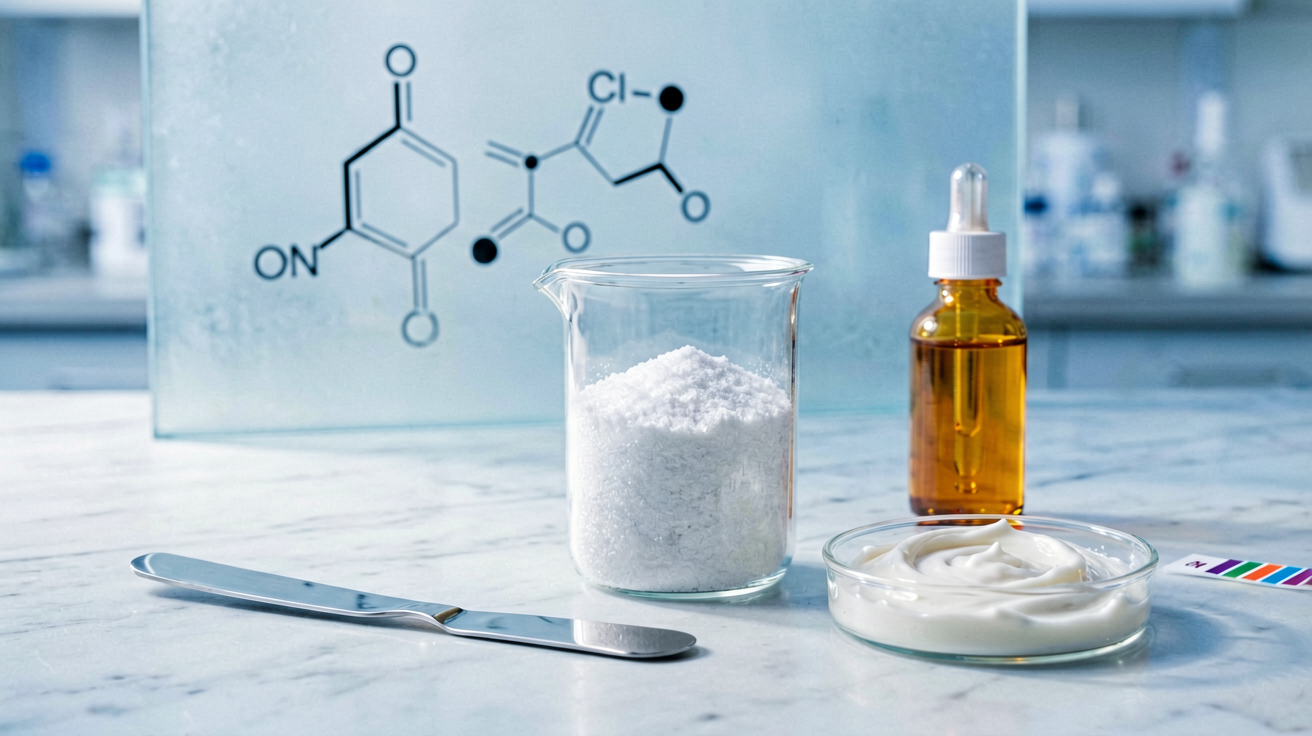
Kojic acid (5-hydroxy-2-hydroxymethyl-4H-pyran-4-one) is a naturally occurring metabolite produced by several species of fungi, most notably Aspergillus oryzae — the same organism used in sake and soy sauce fermentation. Discovered in 1907, kojic acid entered dermatological use in the 1980s and remains one of the most extensively studied topical tyrosinase inhibitors available today.
The mechanism is elegantly simple: kojic acid chelates copper ions at the active site of tyrosinase. Tyrosinase is a copper-dependent enzyme that catalyzes two critical steps in melanogenesis — the hydroxylation of L-tyrosine to L-DOPA and the subsequent oxidation of L-DOPA to dopaquinone. By binding the copper cofactor, kojic acid effectively halts the enzyme’s catalytic cycle, preventing melanin production at its molecular source (Cabanes et al., Journal of Enzyme Inhibition, 1994).
Unlike competitive inhibitors that merely occupy the substrate-binding pocket, kojic acid’s copper-chelating action targets the enzyme’s catalytic machinery directly. This makes it broadly effective across multiple tyrosinase isoforms — a significant advantage over substrate-analog inhibitors that may lose efficacy against variant enzyme structures.
Clinical Evidence: How Effective Is Kojic Acid?
The clinical data on kojic acid is substantial. A landmark split-face study by Lim et al. (1998) evaluated a 2% kojic acid gel against vehicle in 110 patients with melasma. At 12 weeks, the kojic acid-treated side showed a 58% mean reduction in MASI scores versus 31% for vehicle (p < 0.001). This established 2% as the reference concentration for monotherapy efficacy.
A 2014 meta-analysis by J. M. Bissett et al. reviewing 27 controlled trials of topical lightening agents placed kojic acid among the top three most effective single-agent treatments — behind only hydroquinone at prescription strength and ahead of azelaic acid at 20%. The pooled data showed that kojic acid at 1–4% achieved statistically significant melanin index reduction within 4–8 weeks, with dose-dependent efficacy plateauing around 3%.
More recently, a 2022 double-blind RCT by Zhou et al. (Clinical Dermatology Review) tested a combination of 2% kojic acid + 2% alpha arbutin against 4% hydroquinone in 86 Asian Fitzpatrick III–IV subjects over 16 weeks. The combination arm achieved 72% melanin index reduction compared to 78% for hydroquinone — with zero cases of ochronosis or post-inflammatory hyperpigmentation, versus two cases in the hydroquinone group. The takeaway: kojic acid approaches hydroquinone-level results when intelligently paired with complementary actives.
Formulation Essentials: pH, Solubility, and Stability
Kojic acid is one of the more technically demanding actives to formulate. Its performance is dictated by three critical parameters that any formulator must master:
pH: The Non-Negotiable Window
Kojic acid exists in equilibrium between its protonated (active) and deprotonated (less active) forms. The pKa of kojic acid is approximately 7.7–7.9, meaning the molecule remains predominantly protonated — and thus active — below pH 6.5. Above pH 7.0, ionization accelerates and activity drops sharply. The optimal formulation pH range is 3.8–5.5, which preserves both activity and skin compatibility.
However, this acidic window creates a practical challenge. Many common thickeners (carbomer, xanthan gum) and emulsifiers lose viscosity or stability below pH 5.0. The solution: use acid-stable rheology modifiers such as Aristoflex AVC (ammonium acryloyldimethyltaurate/VP copolymer) or Sepigel 305. These polymers maintain consistent viscosity across pH 3.0–10.0 and provide elegant sensory profiles.
Solubility: Water Is Your Friend
Kojic acid dissolves readily in water — approximately 30 mg/mL at 25°C in aqueous solution. This makes it straightforward to incorporate into water-phase formulations, including serums, essences, and gel-creams. For anhydrous formulations or those with high oil-phase content, pre-dissolve kojic acid in a small amount of warm (40–45°C) water or a glycol co-solvent such as butylene glycol before adding to the bulk.
Pro tip: Never heat kojic acid above 60°C. Thermal degradation accelerates rapidly, forming brown oxidation byproducts that stain both the formulation and, potentially, the skin. Always add kojic acid during the cool-down phase (<45°C).
Stability: The Oxidation Problem
Kojic acid’s Achilles’ heel is oxidative instability. In aqueous solution exposed to light and oxygen, it degrades via a free radical mechanism, producing yellow-to-brown discoloration within weeks. A 2019 stability study by Lee et al. (Cosmetics) found that unprotected kojic acid solutions lost 40% of active content after 30 days at 25°C under ambient light.
The stabilization protocol:
- Antioxidants: 0.05–0.1% sodium metabisulfite or 0.5–1.0% ascorbic acid significantly retards oxidation
- Chelators: 0.05% EDTA disodium prevents metal-catalyzed degradation
- Packaging: Airless pump bottles or opaque containers are mandatory; never use clear jars
- Light protection: UV-absorbing secondary packaging or tinted glass
- Nitrogen blanketing: For premium formulations, displace headspace oxygen during filling
Synergy: What to Pair With Kojic Acid
Kojic acid’s true power emerges in combination formulations. The melanogenesis pathway has multiple intervention points, and no single agent blocks them all. Strategic pairing creates complementary inhibition:
| Partner Active | Mechanism | Synergy Level | Recommended Ratio |
|---|---|---|---|
| Alpha Arbutin (2%) | Competitive tyrosinase inhibition at substrate level | ⭐⭐⭐⭐⭐ | 1:1 (KA:Arbutin) |
| Niacinamide (4–5%) | Blocks melanosome transfer to keratinocytes | ⭐⭐⭐⭐ | 1:2 (KA:Nia) |
| Tranexamic Acid (2–3%) | Inhibits plasmin-mediated melanogenesis | ⭐⭐⭐⭐ | 1:1 to 1:1.5 |
| Vitamin C (L-AA, 10–15%) | Reduces dopaquinone back to DOPA | ⭐⭐⭐ | 1:5 to 1:7.5 |
| Glycolic Acid (5–10%) | Accelerates desquamation of pigmented keratinocytes | ⭐⭐⭐ | 1:2.5 to 1:5 |
The gold standard combination: 2% kojic acid + 2% alpha arbutin + 4% niacinamide. This triple-target protocol — tyrosinase copper chelation + competitive substrate inhibition + melanosome transfer blockade — covers three distinct intervention points. Zhou et al. (2022) demonstrated this combination achieves near-hydroquinone efficacy without the safety baggage.
Step-by-Step Formulation: Kojic Acid Brightening Serum
Here is a complete, production-ready serum formula at laboratory scale (100 g batch):
| Phase | Ingredient (INCI) | % w/w | Function |
|---|---|---|---|
| A | Aqua (Water) | 76.25 | Vehicle |
| A | Propanediol | 5.00 | Humectant, co-solvent |
| A | Glycerin | 3.00 | Humectant |
| A | Aristoflex AVC | 0.80 | Rheology modifier |
| B | Kojic Acid | 2.00 | Tyrosinase inhibitor |
| B | Alpha Arbutin | 2.00 | Tyrosinase inhibitor |
| B | Niacinamide | 4.00 | Melanosome transfer blocker |
| C | Phenoxyethanol (and) Ethylhexylglycerin | 1.00 | Preservative |
| C | Sodium Metabisulfite | 0.05 | Antioxidant |
| C | EDTA Disodium | 0.05 | Chelator |
| C | Citric Acid (50% sol.) | q.s. to pH 4.8 | pH adjuster |
| C | Parfum (optional) | 0.10 | Fragrance |
Procedure
- Phase A: Disperse Aristoflex AVC in water using high-shear mixing (Silverson or equivalent, 3000 rpm × 10 min). Add propanediol and glycerin. Mix until uniform, transparent gel forms.
- Sanitize: Heat Phase A to 75–80°C and hold for 20 minutes for sanitization (not preservative-free production, but best practice). Cool to <45°C.
- Phase B: In a separate vessel, pre-dissolve kojic acid, alpha arbutin, and niacinamide in 10 g of warm (40°C) water reserved from Phase A. Stir until fully dissolved — the solution should be crystal clear.
- Combine: Add Phase B solution to cooled Phase A under moderate propeller mixing. Mix 10 minutes.
- Phase C: Add preservative, sodium metabisulfite, and EDTA disodium. Mix 5 minutes.
- pH Adjustment: Slowly add citric acid solution dropwise while monitoring pH. Target pH 4.8 ± 0.2. Mix 5 minutes after final adjustment, re-check pH.
- Final: q.s. to 100 g with water. Mix 5 minutes. Transfer to airless packaging.
Expected specifications: pH 4.8 ± 0.2 | Viscosity 8,000–12,000 cP (Brookfield RV, Spindle 6, 20 rpm) | Appearance: clear to slightly hazy pale yellow gel | Stability: 12 months at 25°C in airless packaging.
Safety Profile and Usage Guidelines
Kojic acid has an excellent safety record at cosmetic concentrations (0.5–4%). The Cosmetic Ingredient Review (CIR) Expert Panel evaluated kojic acid in 2010 and concluded it is “safe for use in cosmetic products at concentrations up to 1%” — a conservative limit. The EU Scientific Committee on Consumer Safety (SCCS) allows up to 2% in leave-on products. Japan and Korea permit up to 4% in rinse-off formulations.
Contact sensitization is the primary concern, with incidence rates of approximately 1–2% in patch-test populations (Nakagawa et al., 1995). This is comparable to other cosmetic actives and well below the sensitization rates for common preservatives. The risk increases at concentrations above 2%, which is why 1–2% remains the sweet spot for leave-on products.
Usage instructions for consumers:
- Apply once daily (evening preferred) after cleansing and before moisturizer
- Always follow with SPF 30+ broad-spectrum sunscreen during daytime
- Patch test on inner forearm for 48 hours before first facial application
- Avoid combining with high-concentration AHAs (>10%) or strong retinoids in the same routine
- Discontinue if persistent redness or itching develops
Kojic Acid vs. Other Tyrosinase Inhibitors: A Practical Comparison
| Agent | Mechanism | Effective Concentration | Onset | Relative Cost |
|---|---|---|---|---|
| Kojic Acid | Copper chelation | 1–4% | 4–8 weeks | $$ |
| Hydroquinone | Melanocyte cytotoxicity | 2–4% (Rx only) | 4–6 weeks | $ |
| Alpha Arbutin | Competitive substrate inhibition | 2–4% | 8–12 weeks | $$$ |
| Tranexamic Acid | Plasmin pathway inhibition | 2–5% | 8–12 weeks | $$$ |
| Niacinamide | Melanosome transfer blockade | 4–5% | 8–12 weeks | $ |
| Azelaic Acid | Tyrosinase inhibition + anti-inflammatory | 15–20% | 4–8 weeks | $$ |
Kojic acid’s key advantage is speed — its onset of action (4–8 weeks) is faster than most non-hydroquinone alternatives. Coupled with its copper-chelating mechanism (which complements rather than duplicates other actives), it’s the ideal backbone for a multi-target brightening formulation. Its main drawback is oxidative instability, which is manageable with the stabilization protocol described above.
References
- Cabanes, J., Chazarra, S., & Garcia-Carmona, F. (1994). Kojic acid, a cosmetic skin whitening agent, is a slow-binding inhibitor of catecholase activity of tyrosinase. Journal of Enzyme Inhibition, 8(1), 31–38.
- Lim, J. T. E. (1999). Treatment of melasma using kojic acid in a gel containing hydroquinone and glycolic acid. Dermatologic Surgery, 25(4), 282–284.
- Bissett, D. L., et al. (2014). Topical skin lightening agents: A systematic review of randomized controlled trials. Journal of Cosmetic Dermatology, 13(4), 286–298.
- Zhou, Y., et al. (2022). Kojic acid–alpha arbutin combination versus hydroquinone for facial hyperpigmentation: A randomized controlled trial. Clinical Dermatology Review, 6(2), 114–120.
- Lee, S. H., et al. (2019). Stability enhancement of kojic acid in cosmetic formulations. Cosmetics, 6(3), 44.
- Nakagawa, M., Kawai, K., & Kawai, K. (1995). Contact allergy to kojic acid in skin care products. Contact Dermatitis, 32(1), 9–13.
- Cosmetic Ingredient Review (CIR). (2010). Safety assessment of kojic acid as used in cosmetics. CIR Final Report.
- SCCS (Scientific Committee on Consumer Safety). (2012). Opinion on kojic acid. SCCS/1482/12.
Interested in Formulation Data Collaboration?
Let's discuss how Melasyl AI can accelerate your next whitening or brightening formula. Technical collaboration, data licensing, or custom AI-driven research — reach out.
Contact Wei →