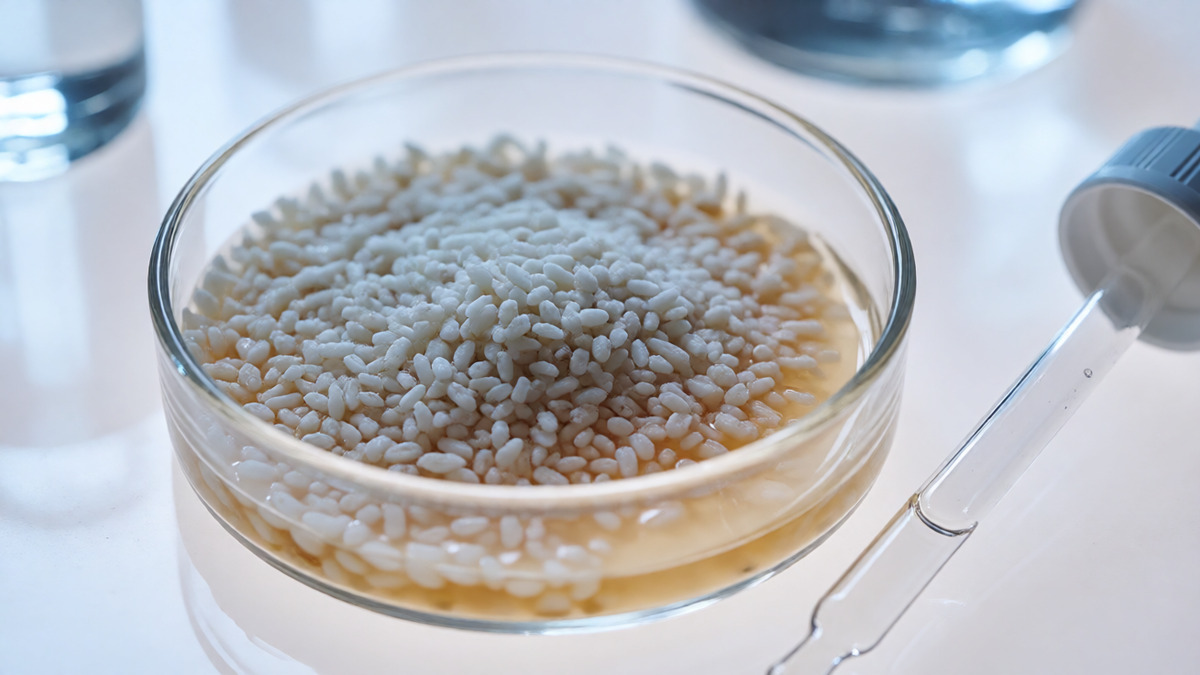
Ask a formulator for the cleanest brightening ingredient in the stack and the answer is rarely a single molecule. It is a matrix — a fermented mixture whose value lives in the ensemble, not in any one constituent. Kojin is exactly that: a rice-bran ferment driven by Aspergillus oryzae, the same koji mold behind sake, miso and shoto. Where kojic acid is the isolated copper-chelating byproduct of that fermentation, kojin is the whole bioactive soup — phenolics, gamma-oryzanol, tocopherols, B vitamins, organic acids and a small but meaningful kojic acid load — delivered in one standardized extract.
What kojin actually means
Kojin (from Japanese koji) refers to rice or rice bran inoculated with A. oryzae and allowed to ferment, then recovered as a filtrate or standardized extract. In cosmetics it appears under INCI-style names such as Aspergillus/Rice/Rice Bran Ferment Filtrate and Aspergillus/Rice Bran Ferment Extract. The fermentation converts the bran larger, poorly skin-available molecules into smaller, more bioavailable fragments. That is the entire pitch: the same chemistry found in the bran layer, but pre-digested.
The multi-pathway mechanism
Kojin does not rely on a single enzyme block. Three pathways converge.
Melanin suppression
The fermented matrix downregulates melanogenesis at the MITF level. Rice-derived phenolics, including ferulic acid and the fermented phenolic profile, dampen melanin-forming pathways in melanocytes, while the kojic acid fraction chelates copper and softens tyrosinase activity. One published dataset reports melanin-synthesis inhibition approaching 18 percent at a filament of a percent inclusion — a striking signal-to-noise ratio for a multi-pathway ingredient rather than a single dose-response curve. The effect is cumulative and gentle rather than ablative, which is why kojin suits sensitive and melasma-prone skin better than a hard tyrosinase inhibitor.
Barrier and hydration
Co-fermentation upregulates aquaporin-3 (AQP3), filaggrin (FLG) and hyaluronan synthase-1 (HAS1) — the three proteins that drive water transport and barrier integrity. In one reported dataset the filtrate improved AQP3 and filaggrin protein levels by roughly 70 percent and 50 percent respectively at higher inclusion levels, while promoting dermal fibroblast proliferation. This is the underrated half of the story: kojin brightens and repairs the barrier, so it does not leave skin thin and reactive the way a purely keratolytic brightener can.
Antioxidant support
The fermented phenolics and tocopherols neutralize oxidative stress and protect existing collagen and elastin fibers. This matters because UV-oxidized melanin is the source of most dark spots; an antioxidant co-action prevents new pigment from forming while the melanin-suppression arm clears existing pigment.
The clinical evidence, honestly weighted
The human evidence base is thinner than the cell-culture base, and a serious formulation article should say so. A 2025 review led by researchers at Huazhong University of Science and Technology in Cosmetics concluded that rice fermentation products can reduce melanin production, lighten dark spots and support collagen, while explicitly calling for standardized production and large-scale human trials before the class claims proven efficacy. A 2025 Frontiers in Pharmacology study found that A. oryzae-fermented rice bran extract raised collagen and elastin in cell culture and improved skin quality in mice. A 2022 review in the Journal of Cosmetic Dermatology grouped rice-derived ingredients as anti-aging, anti-inflammatory, whitening, photoprotective and moisturizing. And in a small double-blind clinical trial, a lotion with a 10 percent standardized black-rice-bran extract reduced both melanin and redness versus placebo.
The honest caveat: most mechanistic data come from concentrated standardized extracts, not the dilute home rinse water that drives consumer curiosity. The standardized extract is the formulation vehicle.
Formulation parameters
Concentration
Reported effective ranges sit between roughly 0.1 percent and 3 percent, with the brightening signal emerging at very low levels and barrier benefits rising with inclusion. A pragmatic working range is 1 to 3 percent for a brightening serum or essence, and up to the upper end of that range for a barrier-first formulation. Below about 0.1 percent, the ingredient is present but rarely worth its cost.
Stability
The fermented actives degrade under heat, strong oxidation and extreme pH. Protect against elevated temperature during manufacturing, and avoid pushing the formula past a mildly acidic pH. Strong oxidizers strip the phenolic profile that carries both the antioxidant and the melanin-suppression benefit. Chelators and a low-oxygen process are standard practice.
Synergy
Kojin pairs well with the brightening stack. Pair it with niacinamide to block melanosome transfer, with a mild AHA to aid desquamation and penetration, and with a vitamin C derivative for antioxidant redundancy. Because kojin is itself a gentle, barrier-supporting matrix, it tolerates combinations that would irritate a harder single-molecule brightener.
Application and handling
Apply to cleansed skin, ideally before heavier actives, and follow with broad-spectrum sun protection — melanin suppression without photoprotection is a losing combination. Once daily is sufficient; the matrix value is sustained exposure, not a spike.
Where kojin fits
Kojin is the formulator answer to a specific brief: brighten and repair in a single, well-tolerated matrix, without a single dominant active. It suits sensitive skin, melasma-prone skin, and any formula where a hard tyrosinase inhibitor is too much for the target audience. It is not a miracle — it is a multi-pathway ingredient whose strength is coherence: melanin suppression, barrier repair and antioxidant protection arriving in one standardized extract, with the safety profile of a ferment rather than the edge of a single molecule.
References
1. Huazhong University of Science and Technology et al. Rice fermentation products for skin: a 2025 review in Cosmetics. 2. Frontiers in Pharmacology (2025): Aspergillus oryzae fermented rice bran extract and collagen and elastin output. 3. Journal of Cosmetic Dermatology (2022): rice-derived anti-aging, anti-inflammatory, whitening and photoprotective properties. 4. Double-blind clinical trial of a 10 percent standardized black-rice-bran extract lotion versus placebo. 5. Aspergillus rice rice bran ferment filtrate melanin-inhibition and AQP3, FLG and HAS1 upregulation dataset.
Interested in Formulation Data Collaboration?
Let's discuss how Melasyl AI can accelerate your next whitening or brightening formula. Technical collaboration, data licensing, or custom AI-driven research — reach out.
Contact Wei →