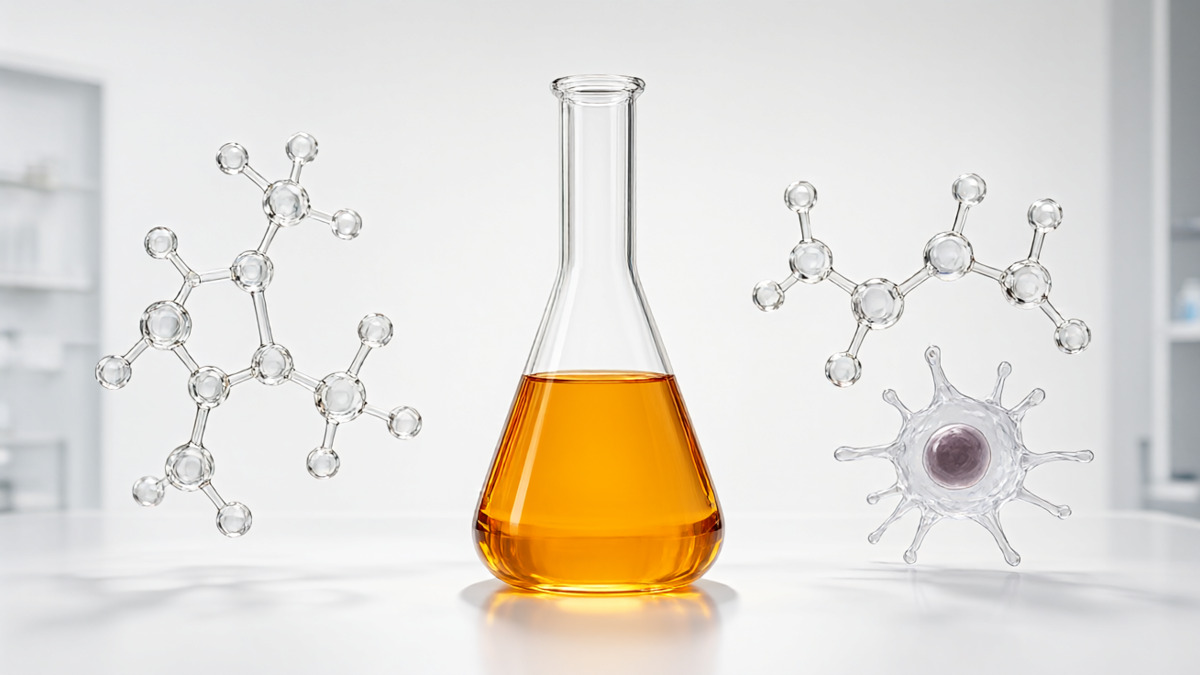
Intercepting Tyrosinase Catalysis: The Redox Shift in Melanogenesis
The primary biochemical challenge in depigmentation lies not merely in blocking tyrosinase, but in modulating the redox potential of the melanocyte cytoplasm. Classic inhibition strategies focus on chelating the copper ions within the tyrosinase active site, yet this often leads to rapid enzyme recovery upon washout. By contrast, L-Ascorbic Acid (AA) operates via a distinct kinetic pathway: it reduces Dopaquinone back to DOPA, effectively creating a reversible loop that prevents the formation of stable melanin polymers without permanently denaturing the enzyme. This precursor interception is critical in hyperpigmentation protocols where sustained, low-level inhibition is preferred over aggressive enzymatic shutdown.
However, the efficacy of AA is intrinsically tied to its oxidation state. In the acidic environment of the skin surface, AA exists in a delicate equilibrium between its reduced and oxidized forms. If the local pH rises above 6.0, the rate of oxidation accelerates exponentially, converting the active AA into dehydroascorbic acid (DAA), which lacks significant melanocyte-inhibiting power. Therefore, the formulation must maintain a strictly acidic microenvironment to ensure that the bioactive species remains dominant throughout the application window, allowing for continuous kinetic suppression of melanin synthesis.
Co-Active Stabilization Matrix: Enhancing Redox Potential
To mitigate the rapid photodegradation of AA, formulators must deploy a synergistic matrix of stabilizers that operate on complementary biochemical principles. The following matrix outlines the optimal co-actives for enhancing AA’s stability and biological half-life in the epidermis.
| Active Ingredient | Biochemical Target | Clinical Concentration (%) | Optimal Formulation pH | Synergistic Advantage |
|---|---|---|---|---|
| Ascorbyl Glucoside | Pro-enzyme Activation | 3.0 – 5.0 | 5.5 – 7.0 | Stable precursor that releases AA upon enzymatic breakdown |
| Vitamin E (Tocopherol) | Lipid Radical Scavenger | 0.5 – 1.0 | 6.0 – 7.0 | Recycles AA by scavenging lipid peroxyl radicals |
| Glutathione | Intracellular Redox Buffer | 0.1 – 0.5 | 5.0 – 6.0 | Enhances intracellular antioxidant capacity |
The inclusion of Ascorbyl Glucoside allows for a dual-phase release mechanism, providing immediate AA for surface-level inhibition while the glucoside moiety provides a stable reservoir. Meanwhile, Vitamin E operates at the lipid-water interface, scavenging radicals generated by UV-induced lipid peroxidation. This synergy is crucial because AA alone cannot protect against lipid-mediated degradation, while Vitamin E lacks the direct tyrosinase-inhibiting capability. By combining these actives, the formulation creates a self-regulating redox buffer that maintains AA in its active state for longer periods.
Furthermore, the pH window must be carefully balanced. While AA requires a pH of 3.5–5.0 for maximum activity, the presence of Glutathione and other peptide-based stabilizers can slightly raise the optimal pH range, allowing for better compatibility with other actives like Niacinamide without triggering immediate oxidation. This nuanced pH management is essential for achieving clinical results without compromising skin barrier integrity.
Preventing Photolytic Degradation & Oxidative Dimerization
Even under optimal formulation conditions, AA remains susceptible to photolytic degradation when exposed to UVA/UVB radiation. This degradation leads to the formation of dehydroascorbic acid and subsequent dimerization products, which can appear as yellowing or browning in the formulation. To prevent this, the formulation must incorporate UV filters that specifically absorb UVA radiation, where most photodegradation occurs. Additionally, the use of opaque packaging materials is critical to minimize light exposure during storage.
Oxidative dimerization is another major stability challenge, particularly in high-humidity environments. AA can undergo self-reaction in the presence of oxygen, forming dimeric byproducts that are biologically inactive. This process is accelerated by heat and light. To mitigate this, formulators must use inert gas blanketing during manufacturing and incorporate antioxidant synergists like BHT (butylated hydroxytoluene) in trace amounts. These steps ensure that the colloidal phase remains stable and that the AA concentration remains consistent throughout the product’s shelf life.
Bench-Scale Emulsification & Clinical Tolerance Protocols
The bench-scale formulation of AA-based serums requires a strict four-phase sequencing protocol. First, the water phase is prepared with humectants and preservatives. Second, the oil phase is formulated with emollients and antioxidants. Third, the AA is dissolved separately in a minimal amount of water to ensure complete dissolution before adding to the main mixture. Finally, the phases are combined and homogenized at low shear speeds to prevent air incorporation, which can accelerate oxidation.
For clinical tolerance, particularly in sensitive skin types, a patch test is recommended before full-face application. Sensitive skin may exhibit transient erythema or tingling upon initial AA application due to the low pH. To mitigate this, formulators can use encapsulated AA derivatives or combine AA with soothing agents like Allantoin and Bisabolol. These additives help buffer the skin’s response, ensuring that the melanocyte-inhibiting benefits are not offset by barrier disruption. Clinical guidance should advise patients to apply AA in the morning under sunscreen to maximize stability and efficacy.
Interested in Formulation Data Collaboration?
Let's discuss how Melasyl AI can accelerate your next whitening or brightening formula. Technical collaboration, data licensing, or custom AI-driven research — reach out.
Contact Wei →