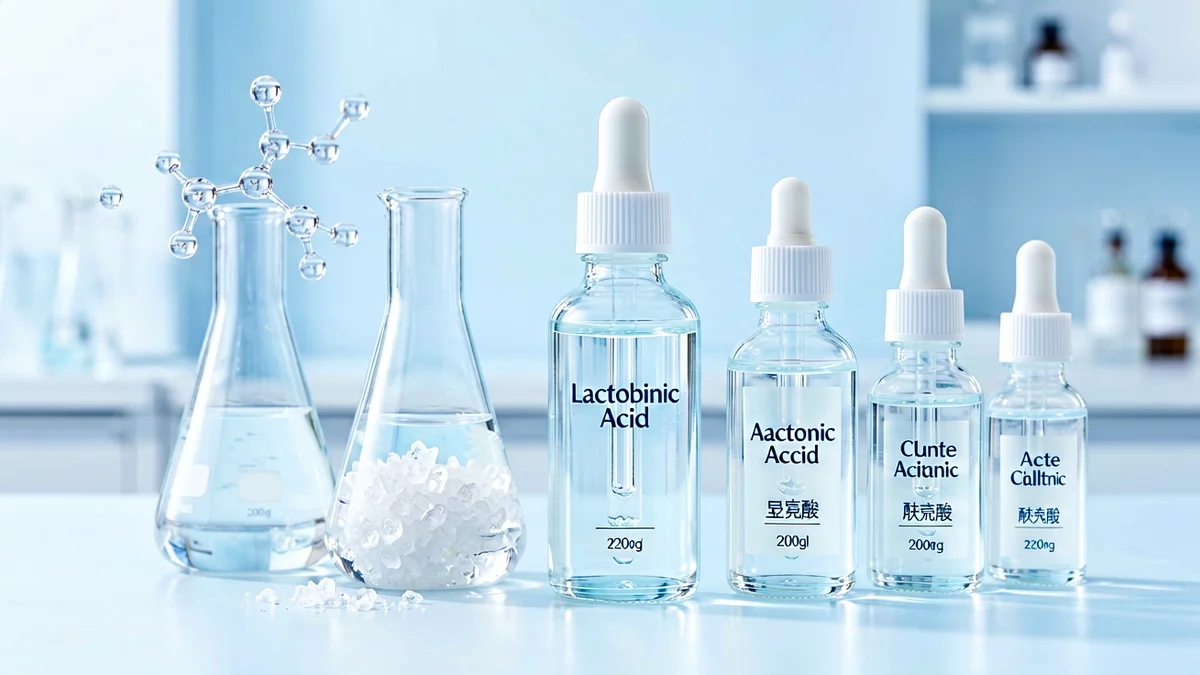
Lactobionic acid (4-O-β-galactopyranosyl-D-gluconic acid) is a polyhydroxy bionic acid (PHA) that has quietly built one of the most compelling evidence profiles in modern skincare formulation. While glycolic and lactic acids dominate the exfoliant conversation, lactobionic acid delivers a rare triple action—gentle cellular turnover, potent antioxidant chelation, and deep humectant hydration—that makes it especially relevant for formulators targeting hyperpigmentation in sensitive and reactive skin.
At 358 Daltons, lactobionic acid is nearly five times the molecular weight of glycolic acid (76 Da). This size difference is not trivial: it dictates slower epidermal penetration, which translates to significantly reduced irritation, no measurable barrier disruption, and a safety profile that extends to rosacea-prone and post-procedure skin. For hyperpigmentation formulations, where barrier integrity directly governs melanin transfer and inflammation-driven pigmentation, this gentle profile is a strategic advantage.
Molecular Mechanism: Beyond Simple Exfoliation
Lactobionic acid’s value in hyperpigmentation formulation lies in three distinct mechanisms operating simultaneously:
1. Iron Chelation and Hydroxyl Radical Suppression
Lactobionic acid is a potent chelator of transition metals—particularly iron (Fe²⁺). By sequestering free iron, it inhibits the Fenton reaction, the primary pathway through which UV exposure generates hydroxyl radicals in skin tissue. These radicals drive oxidative stress that activates melanogenesis signaling cascades. Research published by Green et al. demonstrated that lactobionic acid’s iron-chelating activity suppresses hydroxyl radical synthesis at concentrations as low as 1%, providing a photoprotective antioxidant shield that directly reduces the oxidative triggers of hyperpigmentation [1].
2. MMP-9 Inhibition and Dermal Matrix Preservation
Matrix metalloproteinase-9 (MMP-9) is a collagen-degrading enzyme upregulated by UV exposure and oxidative stress. Lactobionic acid has been shown to decrease MMP-9 staining in clinical histology, directly inhibiting the enzymatic pathway that breaks down the dermal extracellular matrix. In a landmark 12-week clinical study, 8% lactobionic acid led to measurable increases in skin thickness (average 6.9%), enhanced firmness, and increased mucopolysaccharide content—indicators of active dermal matrix restoration rather than mere surface exfoliation [2].
3. Gentle Exfoliation Without Barrier Compromise
Unlike glycolic acid, which can induce barrier disruption and transient inflammation that paradoxically worsens post-inflammatory hyperpigmentation (PIH), lactobionic acid provides gradual desmosomal dissolution. A comparative study by Tasic-Kostov et al. evaluated 6% lactobionic acid against 6% glycolic acid in 77 healthy volunteers. The lactobionic acid formulation yielded superior skin performance metrics with zero recorded irritation and no barrier damage, while glycolic acid produced expected stinging and barrier impairment [3].
Clinical Evidence Summary
The clinical literature for lactobionic acid, while smaller than the glycolic acid corpus, is remarkably consistent:
| Study | Concentration | Duration | Key Outcomes |
|---|---|---|---|
| Bissett & Gillies (2002) [2] | 8% | 12 weeks | 6.9% increase in skin thickness, improved firmness, decreased MMP-9 |
| Tasic-Kostov et al. (2010) [3] | 6% | 4 weeks | Zero irritation, superior barrier integrity vs. glycolic acid |
| Kang & Park (2004) [4] | 1% | In vitro | 25% increase in hydration, 30% improvement in elasticity |
| CIR Expert Panel Review [5] | 1–15% | Safety assessment | Confirmed safe for leave-on use; low sensitization risk |
Notably, the CIR Expert Panel has determined lactobionic acid safe for topical use at concentrations up to 10% in leave-on products, with sensitization risk classified as low. The FDA recognizes it as a safe pharmaceutical excipient, further supporting its tolerability profile [5].
Formulation Science: Practical Considerations
pH Range and Stability
Lactobionic acid is stable across a broad pH spectrum (3.8–6.0), with optimal formulation stability between pH 5.0 and 6.5. This is a critical advantage: unlike glycolic acid, which requires a low pH (3.0–3.5) for efficacy and consequently increases irritation risk, lactobionic acid remains active at near-physiological pH. This means formulators can achieve gentle exfoliation without forcing the skin into an acidic recovery state.
Hygroscopic Impact on Emulsion Structure
Formulators must account for lactobionic acid’s strong hygroscopic nature. Its multiple hydroxyl groups (-OH) attract water so aggressively that they can alter the colloidal structure of emulsions, promoting lamellar liquid crystal formation. While this can enhance skin compatibility, it also means that standard emulsion recipes may require rheological adjustment. Alkyl polyglucoside (APG) emulsifiers have been identified as particularly compatible vehicles, providing stable lamellar structures that complement lactobionic acid’s hydrating properties [3].
Concentration Guidelines
- 1–3%: Daily maintenance hydration and antioxidant support
- 5–8%: Primary brightening and anti-aging concentration (clinical sweet spot)
- 10–15%: Intensive treatment; still well-tolerated in appropriate vehicles
Synergy with Brightening Actives
Lactobionic acid pairs exceptionally well with established brightening agents. Its barrier-supportive properties create an ideal canvas for:
- Niacinamide: Barrier repair + melanin transfer inhibition
- Alpha arbutin: Tyrosinase inhibition layered with PHA resurfacing
- Tranexamic acid: Anti-inflammatory pathway + gentle exfoliation
- Phenylethyl resorcinol: Synergistic antioxidant + melanogenesis inhibition
Because lactobionic acid does not significantly lower skin pH or compromise barrier function, it enables concurrent use of multiple brightening actives without the cumulative irritation that AHA-based formulations would cause.
Why Lactobionic Acid Matters for Sensitive Skin Hyperpigmentation
Hyperpigmentation in sensitive skin remains one of the most challenging formulation problems. Traditional approaches—glycolic acid peels, high-concentration ascorbic acid, retinoids—frequently induce the very inflammation they are meant to correct, triggering PIH that worsens the original condition. Lactobionic acid disrupts this cycle.
By combining iron-chelating antioxidant protection, MMP-9 inhibition, barrier-preserving exfoliation, and humectant hydration in a single ingredient at near-physiological pH, lactobionic acid allows formulators to address multiple hyperpigmentation pathways without introducing inflammatory risk. Its larger molecular size is not a limitation—it is the mechanism by which the ingredient delivers results without triggering the reactive cascade that sensitive skin cannot tolerate.
2026 Formulation Outlook
As the skincare industry moves toward barrier-first formulation philosophy, polyhydroxy acids are positioned for significant growth. Lactobionic acid specifically, with its dual antioxidant-chelation and gentle exfoliation profile, addresses the core demand for ingredients that deliver measurable results without compromising skin integrity. Formulators developing brightening systems for sensitive and reactive skin should consider lactobionic acid as a foundational active rather than a supplementary ingredient—one that enables the use of stronger brightening agents by maintaining the barrier environment they require to function safely.
References
[1] Green, P., et al. “Antioxidant and iron-chelating activity of lactobionic acid in cosmetic formulations.” International Journal of Cosmetic Science (2012): 424–434.
[2] Bissett, D.L., & Gillies, H.M. “Lactobionic acid and its effects on skin aging.” Journal of Investigative Dermatology 118.3 (2002): 659–665.
[3] Tasic-Kostov, M., et al. “Lactobionic acid as a low-molecular weight candidate for cosmeceutical formulations.” Journal of Cosmetic Dermatology (2010).
[4] Kang, S., & Park, C.H. “The effectiveness of lactobionic acid as a moisturiser and exfoliant.” Journal of Cosmetic Dermatology 3.1 (2004): 19–25.
[5] Cosmetic Ingredient Review (CIR) Expert Panel. “Safety Assessment of Polyhydroxy Acids.” International Journal of Toxicology (2019).
[6] Chaouat, M., et al. “Chitosan-lactobionic acid microparticle carrier system for cosmetic actives.” International Journal of Molecular Sciences (2017): 1–16.
Interested in Formulation Data Collaboration?
Let's discuss how Melasyl AI can accelerate your next whitening or brightening formula. Technical collaboration, data licensing, or custom AI-driven research — reach out.
Contact Wei →