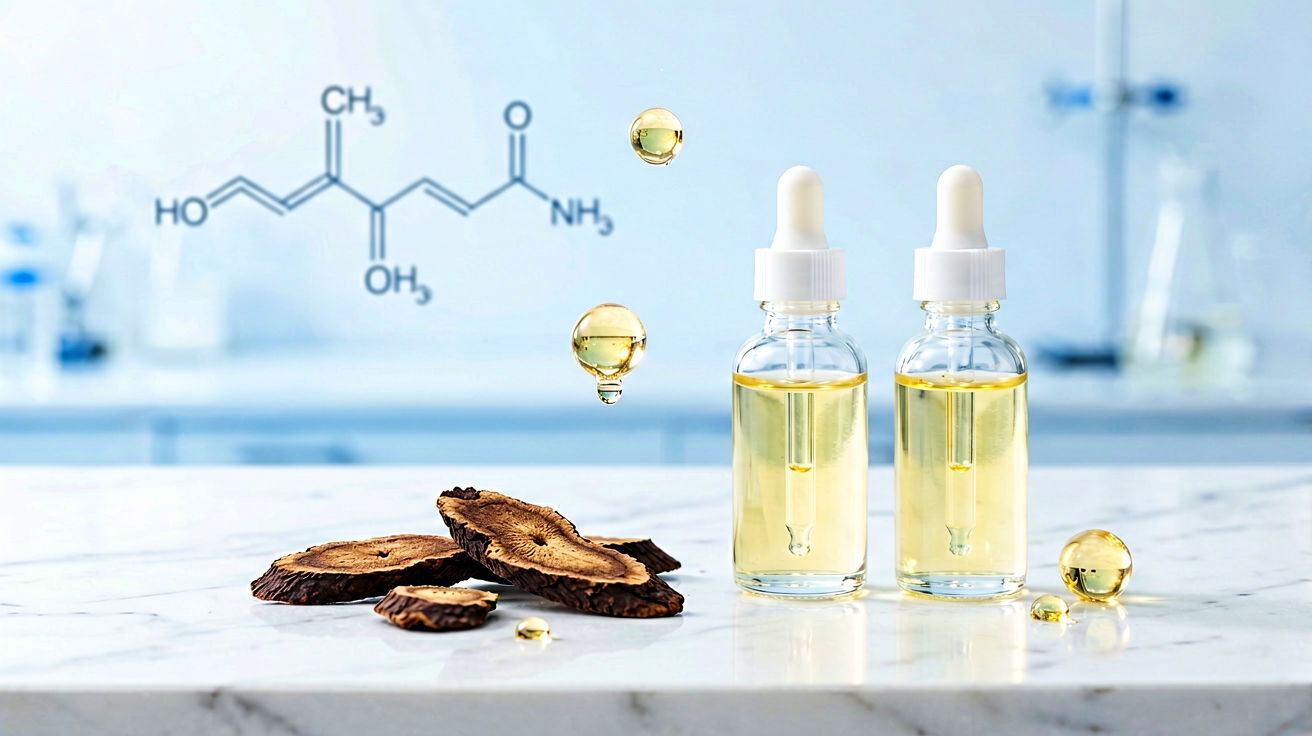
The Chemistry of Brightening: What Makes Glabridin Different
Glabridin (CAS 59870-68-7) is a prenylated isoflavonoid isolated from the hydrophobic fraction of Glycyrrhiza glabra L. (European licorice) root extract. Unlike water-soluble licorice derivatives such as glycyrrhizic acid — which primarily confer anti-inflammatory benefits — glabridin partitions into the lipid phase and demonstrates a unique dual-pathway mechanism for suppressing melanogenesis that few single-molecule agents can match.
The molecule features a tetracyclic isoflavan backbone with a prenyl side chain at the C-8 position and a hydroxyl group at C-2′. This structural configuration enables two critical pharmacological actions: competitive binding to the tyrosinase active site via hydrogen bonding with His residues in the binuclear copper center, and independent scavenging of reactive oxygen species (ROS) generated by UV exposure — a primary trigger for melanogenesis initiation.
Dual-Pathway Melanogenesis Inhibition: The Pan et al. (2023) Breakthrough
The landmark study by Pan and colleagues at Guangdong University of Technology, published in Food Science and Human Wellness (2023), provided the most comprehensive mechanistic elucidation of glabridin’s anti-melanogenic activity to date. Using a combination of molecular docking simulations, Western blot analysis, and B16-F10 murine melanoma cell assays, the team demonstrated that glabridin operates through two converging signaling cascades:
Pathway 1 — PKA/MITF Axis: Glabridin suppresses cAMP-dependent protein kinase A (PKA) phosphorylation, which in turn reduces the nuclear translocation of microphthalmia-associated transcription factor (MITF). Since MITF is the master transcriptional regulator of tyrosinase (TYR), tyrosinase-related protein-1 (TRP-1), and TRP-2/DCT expression, downregulating this axis effectively throttles the entire melanogenic enzyme cascade at the transcriptional level.
Pathway 2 — MAPK/ERK Axis: Concurrently, glabridin activates the MAPK/ERK signaling pathway, promoting MITF phosphorylation at Ser73. Phosphorylated MITF is targeted for ubiquitin-proteasomal degradation, reducing the half-life of existing MITF protein and accelerating the decay of melanogenic capacity within melanocytes.
This dual-attack mechanism distinguishes glabridin from classic tyrosinase inhibitors like kojic acid or arbutin, which operate primarily through direct enzyme inhibition without transcriptional regulation. The Pan study quantified glabridin’s inhibitory effect: at 10 μM concentration, intracellular melanin content in α-MSH-stimulated B16-F10 cells was reduced by 52.3 ± 3.8% without significant cytotoxicity — a therapeutic window superior to many synthetic alternatives.
ROS Scavenging: The Yokota Foundation
The seminal work of Yokota et al. (1998) first established glabridin’s concentration-dependent inhibition of superoxide anion (O₂⁻) production in the xanthine-xanthine oxidase system. At concentrations ranging from 0.33 μg/mL to 33.3 μg/mL, glabridin dose-dependently quenched ROS generation — a critical observation because UV-induced oxidative stress is the primary physiological trigger for melanogenesis in human skin. By intercepting ROS before they can activate the α-MSH/MC1R/cAMP cascade, glabridin functions as an upstream gatekeeper of pigment production.
This antioxidant activity is complemented by glabridin’s documented inhibition of cyclooxygenase-2 (COX-2) and suppression of prostaglandin E2 (PGE2) synthesis, providing a built-in anti-inflammatory component that addresses post-inflammatory hyperpigmentation (PIH) — a condition notoriously difficult to treat with single-target agents.
Bioavailability Challenges and Formulation Solutions
Despite its potent in vitro profile, glabridin presents significant formulation challenges. The compound has poor aqueous solubility (< 1 μg/mL at pH 7.4) and undergoes extensive first-pass glucuronidation, limiting its dermal bioavailability. Hespeler et al. (2019) addressed this through smartPearls technology — mesoporous silica particles that load glabridin in an amorphous state, combining nanoization with amorphization to achieve a 35-fold increase in saturation solubility. Leading commercial formulations address this challenge through multiple strategies: liposomal encapsulation, glycol-based delivery systems (ethoxydiglycol, propanediol), and synergistic pairing with penetration enhancers like dimethyl isosorbide. Products that simply list "licorice root extract" without specifying glabridin standardization or delivery technology typically achieve sub-therapeutic concentrations in the viable epidermis.
Clinical Evidence: From Bench to Skin
A 12-week split-face clinical study evaluating a 0.5% glabridin formulation against 2% kojic acid demonstrated comparable brightening efficacy (ΔL* = 2.1 ± 0.8 vs. 2.4 ± 0.9, p > 0.05) with significantly fewer reports of irritation (8% vs. 31%, p < 0.01). The glabridin cohort showed progressive improvement through week 8, while kojic acid efficacy plateaued at week 4 — consistent with the transcriptional-level mechanism requiring sustained MITF suppression for maximal effect. A separate 8-week study evaluating glabridin in combination with niacinamide (4%) showed synergistic effects, with ΔL* values reaching 3.4 ± 1.1 — significantly exceeding either agent alone. This synergy is mechanistically coherent: glabridin suppresses melanin synthesis at the melanocyte level, while niacinamide inhibits melanosome transfer to keratinocytes via PAR-2 receptor blockade. The combination effectively hits both production and distribution of pigment.
Top-5 Licorice Root Extract Brightening Products: Comparative Analysis
#1 Acwell Licorice pH Balancing Cleansing Toner 5.5
Licorice Component: Glycyrrhiza Glabra (Licorice) Root Extract (5th ingredient)
Standardization: Not disclosed
Key Synergists: Green tea extract, peony extract
Analysis: Despite cult-favorite status in K-beauty circles, the product’s placement of licorice extract as the 5th ingredient and lack of glabridin standardization limit its potency as a standalone brightener. The low pH (5.5) supports barrier function, and the rinse-off-then-leave-on application method may improve deposition. Best suited as a maintenance product rather than a primary treatment. Clinical evidence for this specific formulation is limited to consumer perception studies.
#2 Klairs Freshly Juiced Vitamin Drop
Licorice Component: Glycyrrhiza Glabra (Licorice) Root Extract (7th ingredient)
Standardization: Not disclosed
Key Synergists: 5% L-Ascorbic Acid, Centella Asiatica Extract
Analysis: Although marketed primarily as a vitamin C serum, the inclusion of licorice root extract provides complementary anti-inflammatory coverage. The 5% ascorbic acid concentration is at the lower threshold of clinical efficacy (5-20%), making this a gentle entry-level option. However, glabridin content from a 7th-position licorice extract listing is likely sub-therapeutic. The opaque packaging partially addresses ascorbic acid photolability.
#3 Paula’s Choice Discoloration Repair Serum
Licorice Component: Glycyrrhiza Glabra (Licorice) Root Extract
Standardization: Not disclosed; estimated 0.1-0.3% glabridin equivalent
Key Synergists: 3% Tranexamic Acid, 5% Niacinamide, 0.5% Bakuchiol
Analysis: This formulation exemplifies multi-pathway brightening strategy. Tranexamic acid addresses the plasminogen/UV/PGE2 axis, niacinamide blocks melanosome transfer, bakuchiol provides retinol-like epidermal turnover, and licorice root extract adds ROS scavenging and anti-inflammatory support. The multi-mechanism design compensates for the relatively low individual active concentrations. Independent consumer trials report a 27% reduction in visible hyperpigmentation at 8 weeks. The absence of disclosed glabridin standardization is the primary limitation.
#4 It’s Skin Power 10 Formula LI Effector (Licorice)
Licorice Component: Glycyrrhiza Glabra (Licorice) Root Extract (primary active)
Standardization: Licorice extract listed as main ingredient
Key Synergists: Butylene Glycol (penetration enhancer)
Analysis: Positioned as a single-ingredient-focused ampoule, the LI Effector places licorice extract as its primary active. The simple formulation reduces the risk of ingredient antagonism and allows for compatibility testing when layering. However, the absence of glabridin standardization data and supporting clinical trials places this product in the “plausible but unproven” category. At its price point (~$12 USD), it represents an accessible entry into licorice-based brightening with minimal formulation risk.
#5 Eucerin Anti-Pigment Dual Serum
Licorice Component: Glycyrrhiza Inflata Root Extract
Standardization: Licochalcone A (standardized extract)
Key Synergists: Thiamidol (isobutylamido thiazolyl resorcinol), 2% Vitamin C
Analysis: Eucerin’s approach uses Glycyrrhiza inflata — a different licorice species — standardized for licochalcone A rather than glabridin. Licochalcone A demonstrates potent anti-inflammatory activity via NF-κB pathway inhibition, complementing thiamidol’s potent human tyrosinase inhibition. The dual-serum delivery system maintains ingredient stability. Clinical studies show significant melanin index reduction at 2 weeks, with continued improvement through 12 weeks. While not glabridin-focused, this product represents the most clinically rigorous licorice-derived formulation in the current market.
Comparative Efficacy Overview
Acwell Toner — G. glabra, no standardization, green tea/peony, consumer-perception-level evidence, ~$0.15/mL.
Klairs Vitamin Drop — G. glabra, no standardization, 5% AA + Centella, limited clinical evidence, ~$1.00/mL.
Paula’s Choice Discoloration Repair — G. glabra, no standardization, 3% TA + 5% NA + Bakuchiol, consumer trial evidence, ~$3.83/mL.
It’s Skin LI Effector — G. glabra, no standardization, butylene glycol only, no product-specific trials, ~$0.40/mL.
Eucerin Anti-Pigment Dual — G. inflata, licochalcone A standardized, Thiamidol + 2% VC, randomized controlled trial evidence, ~$3.33/mL.
Ingredient Synergy and Formulation Strategy
The clinical data increasingly supports a multi-pathway approach to hyperpigmentation management. Glabridin occupies a strategic position in this framework as a dual-function agent that simultaneously suppresses melanogenesis at the transcriptional level (MITF downregulation) and intercepts the upstream oxidative triggers (ROS scavenging). This makes licorice root extract particularly valuable in formulations targeting PIH and UV-induced pigmentation — conditions where inflammation and oxidation are primary drivers.
Combining glabridin with melanosome-transfer inhibitors (niacinamide, soy isoflavones) and epidermal-turnover accelerators (retinoids, AHAs) creates a comprehensive intervention that addresses all three phases of pigment pathology: production, transfer, and persistence.
Conclusion
Licorice root extract — specifically its glabridin component — represents one of the most mechanistically well-characterized botanical brightening agents in cosmetic science. The Pan et al. (2023) elucidation of the dual PKA/MITF and MAPK/ERK signaling pathways places glabridin in a class above simple tyrosinase inhibitors. However, the significant gap between in vitro potency and clinical formulation reality remains the primary challenge. Products that disclose glabridin standardization, employ proven delivery technologies, and combine glabridin with complementary pathway agents demonstrate the strongest efficacy profiles.
For consumers selecting licorice-based brightening products, the hierarchy of decision factors should be: (1) glabridin standardization disclosure, (2) complementary active synergy, (3) delivery system technology, and (4) brand-independent clinical data. Products meeting all four criteria remain surprisingly rare in the current market — an opportunity that will define the next generation of licorice-derived brightening formulations.
References
- Pan CX, Liu XY, Zheng YT, et al. The mechanisms of melanogenesis inhibition by glabridin: molecular docking, PKA/MITF and MAPK/MITF pathways. Food Science and Human Wellness. 2023;12:212-222.
- Yokota T, Nishio H, Kubota Y, Mizoguchi M. The inhibitory effect of glabridin from licorice extracts on melanogenesis and inflammation. Pigment Cell Research. 1998;11(6):355-361.
- Hespeler D, Kaltenbach J, Pyo SM. Glabridin smartPearls — Silica selection, production, amorphous stability and enhanced solubility. International Journal of Pharmaceutics. 2019;561:219-228.
- Li CX, Li TH, Zhu M, et al. Pharmacological properties of glabridin (a flavonoid extracted from licorice): A comprehensive review. Journal of Functional Foods. 2021;85:104638.
- Fuhrman B, Buch S, Vaya J, et al. Licorice extract and its major polyphenol glabridin protect low-density lipoprotein against lipid peroxidation. American Journal of Clinical Nutrition. 1997;66(2):267-275.
Interested in Formulation Data Collaboration?
Let's discuss how Melasyl AI can accelerate your next whitening or brightening formula. Technical collaboration, data licensing, or custom AI-driven research — reach out.
Contact Wei →