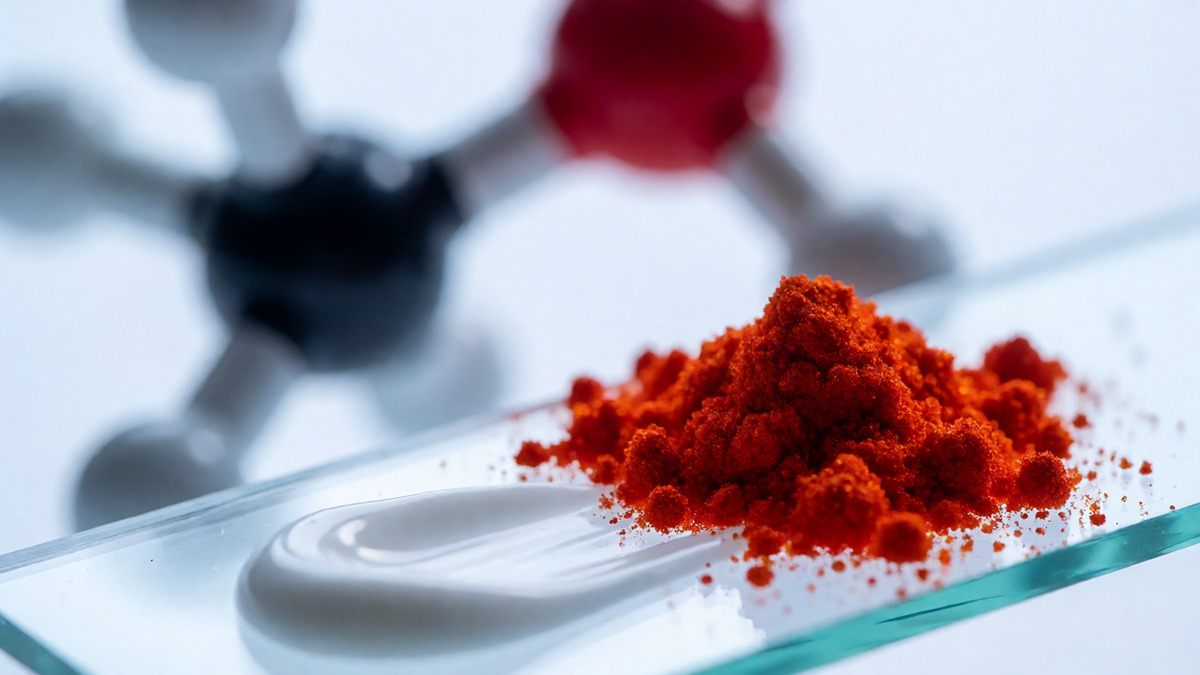
Lycopene is the pigment that makes tomatoes red, watermelon pink and guava blush — and in the past two years it has quietly migrated from the supplement aisle onto the brightening shelf. Unlike the tyrosinase inhibitors that dominate pigmentation formulation (thiamidol, 4-butylresorcinol, tranexamic acid), lycopene is not primarily an enzyme blocker. It is a singlet-oxygen quencher — a lipophilic carotenoid that accumulates in the epidermis and interrupts the oxidative cascade upstream of melanogenesis. Understanding that difference is the key to formulating with it, and to setting realistic expectations for the products now claiming a “tomato glow.”
What Lycopene Actually Is
Lycopene is an acyclic, 40-carbon carotenoid with 11 conjugated double bonds — the longest conjugated system of any common dietary carotenoid. That extended chromophore does two things: it absorbs light in the blue-green region (hence its red colour), and it makes lycopene the single most efficient biological quencher of singlet oxygen yet measured, roughly twice as efficient as β-carotene in vitro.
Crucially, lycopene is not a provitamin A. Unlike β-carotene, it is not cleaved to retinol, so it carries none of the retinoid signalling that complicates the pigmentation story. It is fat-soluble, which means it partitions into cell membranes and sebum, and it is stored in skin and adipose tissue — giving it a residency time that water-soluble antioxidants such as vitamin C cannot match.
The Mechanism: Upstream of Tyrosinase
Melanogenesis is triggered by more than direct tyrosinase activation. UV and visible light generate reactive oxygen species (ROS) — singlet oxygen, superoxide and lipid peroxides — in keratinocytes and melanocytes. These ROS feed the pro-inflammatory cascade (NF-κB, IL-6, TNF-α, PGE₂) that ultimately upregulates MITF and its downstream targets tyrosinase, TRP-1 and TRP-2. This is the same oxidative-inflammatory axis that makes post-inflammatory hyperpigmentation (PIH) so stubborn in melanin-rich skin.
Lycopene intervenes at the top of that cascade:
- Singlet-oxygen quenching. By dissipating excitation energy as heat, lycopene prevents the peroxidation of membrane lipids — the initiating event in UV-induced inflammation.
- NF-κB and cytokine suppression. Lycopene downregulates NF-κB and reduces IL-6 and TNF-α, blunting the inflammatory signal that drives MITF.
- MMP-1 inhibition. Lycopene suppresses UV-induced matrix metalloproteinase-1, protecting the dermal matrix that gives skin its light-reflecting density.
The net effect is a reduction in the oxidative “noise” that pushes melanocytes into overdrive — a complementary, not competitive, mechanism to direct tyrosinase inhibition.
The Clinical Evidence
The strongest human data for lycopene concerns photoprotection, which is directly relevant to pigmentation because UV is the primary driver of melasma and solar lentigines.
Erythema reduction (meta-analysed). A systematic review and meta-analysis of randomised placebo-controlled trials found that lycopene-rich products at 8–20 mg/day significantly reduced UV-induced erythema, with a mean difference of −2.35 units versus control (95% CI −3.65 to −1.05, I² = 0.0%). At the molecular level, lycopene inhibited UV-induced MMP-1, heme oxygenase-1 and ICAM-1.
The 40% erythema study. In a controlled human trial, participants consuming 40 g of tomato paste daily (≈16 mg lycopene) for 10 weeks showed roughly 40% less UV-induced redness than controls — a direct demonstration that oral lycopene accumulates in skin and raises the minimal erythema dose.
Topical lycopene and skin tone. A double-blind, placebo-controlled 12-week trial of a topical lycopene emulgel (33 participants) found significant reductions in both erythema and melanin content, alongside improved hydration and elasticity. An earlier vehicle-controlled study using 0.03% lycopene in an oil-in-water emulsion showed reduced UV erythema, with the effect potentiated by the addition of α-tocopherol palmitate and ascorbic acid.
Melasma specifically. Two double-blind randomised trials tested tomato extract in melasma. In the first, 30 mg oral lycopene as an adjuvant to sunscreen plus 4% hydroquinone produced significantly greater MASI reduction than hydroquinone alone, with higher serum superoxide dismutase. In the second, a cream containing 0.05% tomato lycopene and 3.45% wheat bran extract applied twice daily for three months significantly reduced MASI scores from week six onward versus placebo.
The Honest Caveats
Lycopene is a supportive active, not a monotherapy. Its tyrosinase inhibition is weak compared with thiamidol (IC₅₀ ~1 µM) or 4-butylresorcinol; its value lies in quenching the oxidative trigger upstream. It also does not screen UV — its photoprotective benefit is biochemical, not optical, so it never replaces sunscreen. And oral carotenoid supplementation at high doses produces a harmless orange tint (lycopenemia) that formulators should note when marketing “glow.”
Formulating with Lycopene in 2026
Lycopene is notoriously unstable: it is oxidised by light, heat, oxygen and metal ions, and it degrades rapidly in water-in-oil systems. The practical formulation playbook:
- Encapsulate or emulsify. Liposomal and nanoemulsion systems markedly improve penetration and stability; the 12-week emulgel trial used exactly this approach.
- Pair with the antioxidant network. Lycopene regenerates the tocopherol radical, which ascorbic acid then regenerates — so lycopene + vitamin E + vitamin C is a mechanistically rational trio, and the 0.03% topical study confirmed the potentiation.
- Add a chelator. EDTA or phytic acid limits metal-catalysed oxidation.
- Use opaque, airless packaging. Lycopene’s shelf life is measured in the dark.
Bottom Line
Lycopene earns its place in the brightening conversation not as a tyrosinase knockout but as an upstream oxidative-stress modulator with genuine RCT support for erythema and melanin reduction, and specific melasma evidence in both oral and topical arms. For melanin-rich skin prone to PIH — where inflammation, not just enzyme activity, drives pigmentation — that mechanism is arguably more relevant than another resorcinol. Formulate it encapsulated, pair it with the vitamin C/E network, and position it honestly: the tomato’s pigment works by protecting skin, not by bleaching it.
Interested in Formulation Data Collaboration?
Let's discuss how Melasyl AI can accelerate your next whitening or brightening formula. Technical collaboration, data licensing, or custom AI-driven research — reach out.
Contact Wei →