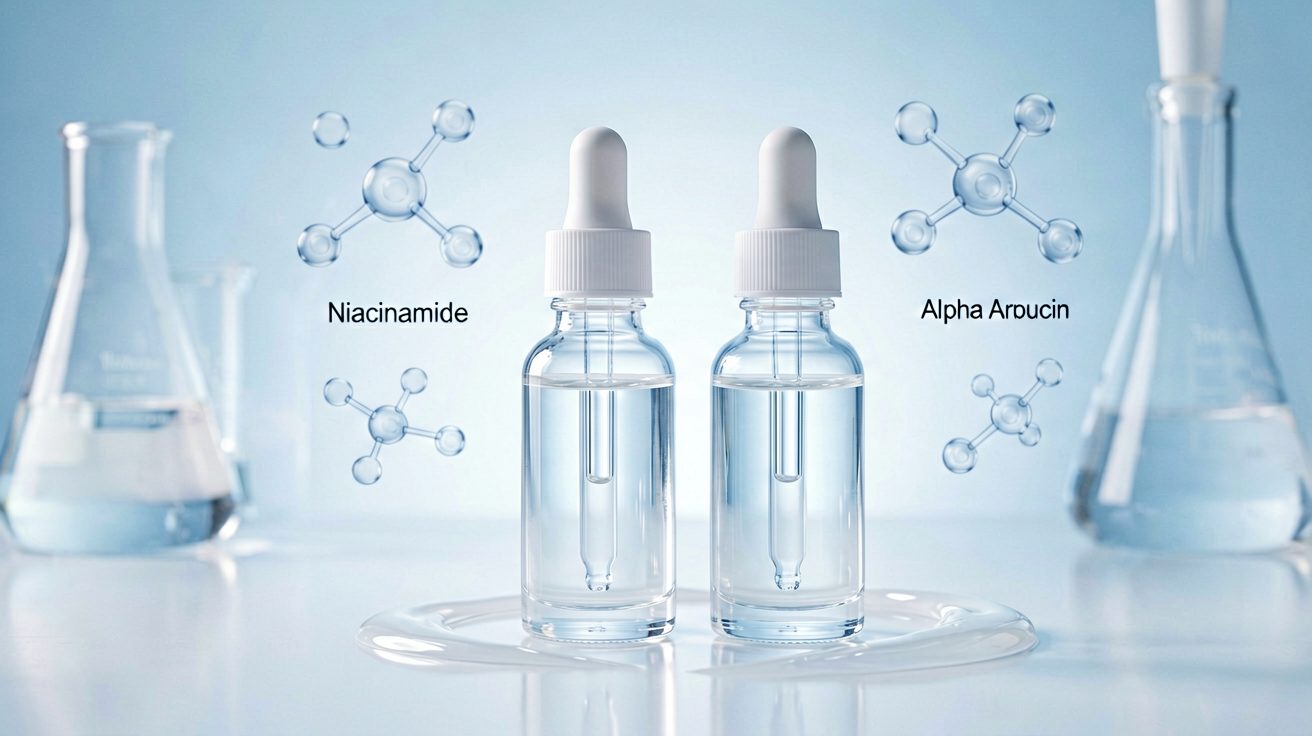
For formulators targeting Southeast Asian markets where hyperpigmentation ranks among the top consumer skin concerns, combining Niacinamide and Alpha Arbutin represents one of the most evidence-dense ingredient pairings available. Each compound operates through a distinct melanogenesis pathway — Niacinamide suppressing melanosome transfer, Alpha Arbutin inhibiting tyrosinase activity — making their combined use additive rather than redundant. This guide walks through the science, formulation protocol, and stabilization requirements for a stable, clinically dosed brightening serum.
The Science: How Each Active Works
Niacinamide (Vitamin B3, Nicotinamide)
Niacinamide interferes with melanin transfer from melanocytes to keratinocytes by reducing melanin content in cells by approximately 35–68% at concentrations between 2–5% — without affecting melanin synthesis itself. The proposed mechanism involves inhibition of the PAR-2 (protease-activated receptor-2) pathway, which regulates melanosome phagocytosis in keratinocytes. A landmark double-blind, placebo-controlled study of 18 Japanese women demonstrated a statistically significant reduction in hyperpigmented lesion area after 8 weeks of topical 5% Niacinamide application (Hakozaki et al., 2002, British Journal of Dermatology).
At 4%, Niacinamide is well tolerated across Fitzpatrick skin types I–VI, with minimal risk of the flushing response associated with Nicotinic Acid. It also supports barrier function by increasing ceramide and free fatty acid production in the stratum corneum — a meaningful co-benefit for consumers in humid Southeast Asian climates who may experience compromised barrier integrity from frequent cleansing.
Alpha Arbutin (4-Hydroxyphenyl α-D-glucopyranoside)
Alpha Arbutin is a β-D-glucopyranoside derivative of hydroquinone that acts as a reversible, competitive inhibitor of tyrosinase — the rate-limiting enzyme in melanin synthesis. Unlike hydroquinone, Alpha Arbutin does not cause ochronosis with prolonged use. At concentrations of 0.5–2%, it demonstrates measurable tyrosinase inhibition in ex vivo pigmentation models. A clinical study evaluating 0.5% Alpha Arbutin in a hydroalcoholic vehicle showed visible skin brightening at 12 weeks, with skin melanin index reductions correlating directly with application duration (Ali et al., 2018, Journal of Cosmetic Dermatology).
The key formulation advantage of combining these two actives: Niacinamide addresses the transfer step of the melanin pathway, while Alpha Arbutin targets synthesis. Hitting two distinct nodes maximizes brightening efficacy across a broader population with varying melanogenesis drivers.
Formulation Protocol: 4% Niacinamide + 1% Alpha Arbutin Brightening Serum
Target Product Specifications:
- Appearance: Clear to slightly hazy serum, pH 5.0–6.5
- Viscosity: 2,000–6,000 cPs (spindle RV, 10 rpm, 25°C)
- Skin feel: Lightweight, non-tacky, rapid absorption
- Preservatives: Phenoxyethanol + Ethylhexylglycerin (broad-spectrum, EWG 2–3)
- Target markets: Southeast Asia (Fitzpatrick III–V predominance)
Phase A — Water Phase (aqua to 100%):
| Ingredient | % w/w | Function |
|---|---|---|
| Deionized Water | qs to 100 | Vehicle |
| Niacinamide PC | 4.00 | Brightening active |
| Alpha Arbutin | 1.00 | Tyrosinase inhibitor |
| Butylene Glycol | 8.00 | Humectant, active solubilizer |
| Glycerin | 5.00 | Humectant |
| Panthenol (D-Panthenol) | 1.00 | Barrier support, soothing |
Phase B — Oil/Warm-Phase (heat to 70–75°C):
| Ingredient | % w/w | Function |
|---|---|---|
| PEG-40 Hydrogenated Castor Oil | 0.50 | Solubilizer for oil-phase actives |
| Caprylic/Capric Triglyceride | 2.00 | Emollient |
| C13-15 Alkane (Neossance Hemisqualane) | 3.00 | Lightweight emollient, sensory modifier |
Phase C — Cool-Down / Active Addition (≤40°C):
| Ingredient | % w/w | Function |
|---|---|---|
| Sodium Hyaluronate (1% solution) | 2.00 | Humectant, skin-plumping |
| Phenoxyethanol + Ethylhexylglycerin | 0.90 | Preservative system |
| Disodium EDTA | 0.05 | Chelating agent, stability |
| Citric Acid (10% soln) | qs | pH adjustment to 5.5–6.0 |
Protocol:
- Combine Phase A ingredients. Heat to 70–75°C with stirring until Niacinamide and Alpha Arbutin are fully dissolved (clarity check). Niacinamide dissolves readily in water; Alpha Arbutin may require 10–15 min stirring at temperature with butylene glycol pre-dissolution.
- Combine Phase B ingredients separately, heat to 70–75°C.
- Add Phase B to Phase A under rotor-stator homogenization (8,000 rpm, 3 min).
- Cool to ≤40°C with gentle stirring.
- Add Phase C ingredients sequentially with mixing. Adjust pH to 5.5–6.0 using citric acid solution. Final viscosity typically develops within 4–6 hours of standing at room temperature.
Critical Stabilization Notes
Alpha Arbutin pH stability
Alpha Arbutin undergoes hydrolysis above pH 6.5, reducing efficacy. Maintain formulation pH between 5.0 and 6.0 throughout shelf life. Include the citrate buffer system and EDTA chelator to prevent metal-catalyzed degradation.
Niacinamide and aldehyde preservatives
Avoid combining Niacinamide with formaldehyde-donor preservatives (e.g., DMDM Hydantoin, Imidazolidinyl Urea) in the same formula — trace formaldehyde can cause Niacinamide to convert to Nicotinic Acid, triggering vasodilation and flushing in sensitive users.
Packaging
Use airless pump or stabilized dropper bottles to minimize oxidation and maintain active potency over a 12-month shelf life. Clear or amber glass preferred; if PET or HDPE is used, confirm compatibility with the oil phase.
Application and Clinical Context
Apply 2–3 pumps (approximately 0.5–1.0 mL) to cleansed face and neck in the morning and/or evening, after water-based actives (pH-dependent serums) and before heavier occlusive layers. Onset of visible brightening effects is typically observed at 8–12 weeks with consistent twice-daily use, consistent with the clinical timelines reported for both individual actives.
A comparative assessment of dual-ingredient brightening protocols found that combining a tyrosinase inhibitor with a melanosome-transfer inhibitor produced greater reduction in visual hyperpigmentation scores than either class used alone — supporting the rationale for this specific pairing (Burnett et al., 2010, Dermatology Research and Practice).
For darker Fitzpatrick IV–VI skin types experiencing post-inflammatory hyperpigmentation (PIH), this formulation can serve as a maintenance protocol following professional treatments (chemical peels, laser) that reduce existing pigmentation — addressing residual pigment production at the formulation level while the barrier recovers.
Formulation Summary
The 4% Niacinamide + 1% Alpha Arbutin serum represents a pragmatic, evidence-backed approach to multi-pathway brightening. The combination covers both major nodes of the melanogenesis cascade — synthesis inhibition and transfer suppression — making it effective across a broader range of hyperpigmentation drivers than single-active protocols. Careful pH and preservative system design ensures both actives remain stable and effective through a standard 12-month shelf life.
For formulators targeting Southeast Asian consumers with documented hyperpigmentation concerns, this dual-mechanism approach delivers clinically validated efficacy with a favorable tolerability profile across diverse skin tones.
Interested in Formulation Data Collaboration?
Let's discuss how Melasyl AI can accelerate your next whitening or brightening formula. Technical collaboration, data licensing, or custom AI-driven research — reach out.
Contact Wei →