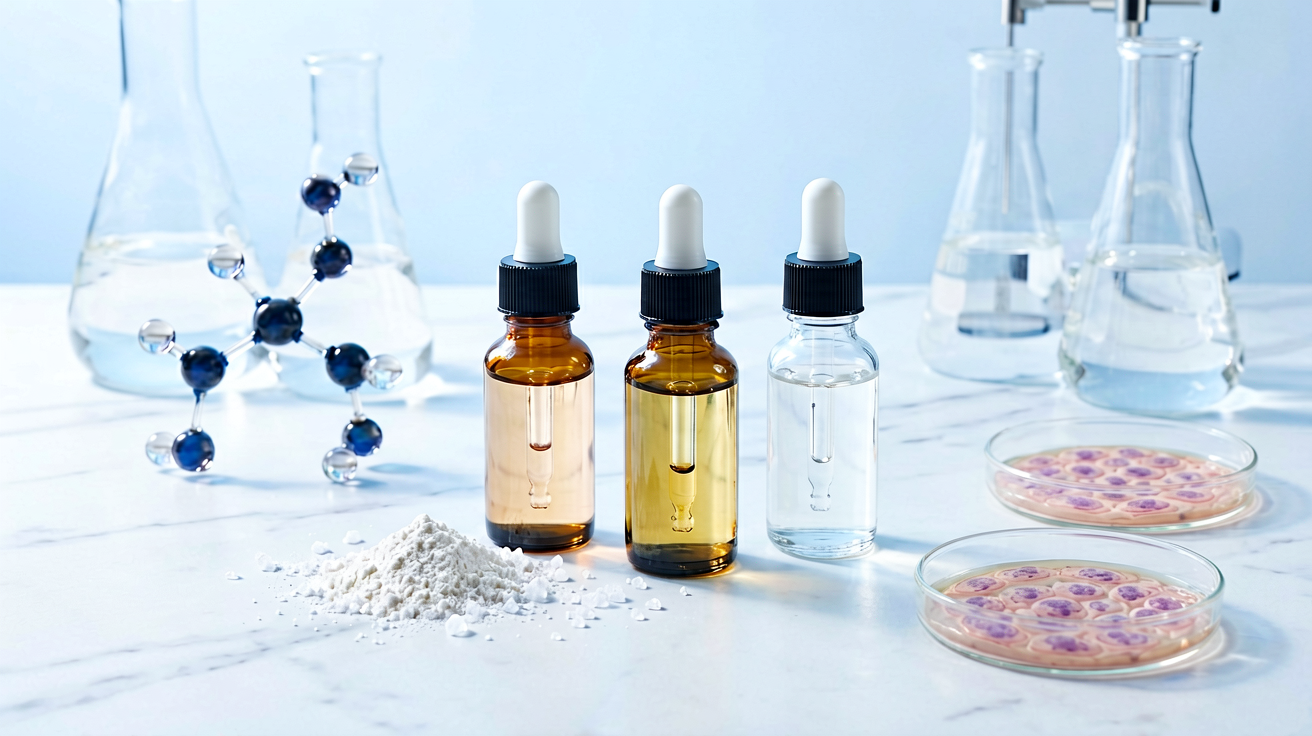
Niacinamide — the amide form of vitamin B3 — has become the defining ingredient of the modern brightening market. From The Ordinary’s cult-favorite Niacinamide 10% + Zinc 1% to premium formulations in SkinCeuticals and La Roche-Posay, niacinamide sits at the intersection of clinical efficacy and mass-market accessibility. This article breaks down the mechanism by which niacinamide addresses hyperpigmentation, examines the clinical evidence, and evaluates the formulation strategies behind the bestselling products driving 2026 sales.
What Makes Niacinamide Work Against Hyperpigmentation
Hyperpigmentation arises when melanocytes in the basal layer of the epidermis overproduce melanin and distribute it to surrounding keratinocytes via melanosome transfer. Niacinamide intervenes at two critical points in this pathway.
Melanosome transfer inhibition. The most evidence-supported mechanism involves niacinamide’s blockade of PAR-2 (protease-activated receptor-2), a receptor expressed on keratinocytes that mediates the uptake of melanin-filled melanosomes from melanocytes. By inhibiting PAR-2 activation, niacinamide reduces the transfer of melanosomes to epidermal keratinocytes, effectively interrupting the visual manifestation of pigmentation without altering melanin synthesis itself. Bissett et al. (2005) demonstrated this mechanism in human melanocyte-keratinocyte co-culture models, showing a dose-dependent reduction in melanosome transfer at concentrations of 0.1–1 mM niacinamide.
Tyrosinase activity modulation. Emerging evidence from 2024–2025 suggests niacinamide may also modulate tyrosinase activity indirectly through its role as a precursor to NAD(P)+, which serves as a cofactor for enzymes involved in melanin synthesis regulation. Hakozaki et al. (2002) observed a modest inhibitory effect on tyrosinase in cell-free assays at high concentrations (≥10 mM), though this mechanism is considered secondary to PAR-2 inhibition.
Anti-inflammatory and antioxidant support. Niacinamide’s well-documented anti-inflammatory properties — it suppresses IL-1, IL-6, and TNF-α release from keratinocytes — contribute indirectly to pigmentation management by reducing post-inflammatory hyperpigmentation (PIH) triggers. Additionally, its role in supporting NADPH generation helps maintain the cellular redox balance needed for proper skin renewal.
Clinical Evidence: What Human Trials Actually Show
The clinical evidence for topical niacinamide in hyperpigmentation is substantial but nuanced, with outcomes highly dependent on concentration, formulation pH, and vehicle.
4% Niacinamide vs. 4% Hydroquinone. In a landmark double-blind, randomized controlled trial by Bissett et al. (2005), 4% niacinamide and 4% hydroquinone both produced significant reductions in hyperpigmentation and skin lightness over 8 weeks, with niacinamide showing fewer adverse effects. While hydroquinone produced slightly faster results, niacinamide demonstrated comparable long-term efficacy with superior tolerability — a critical finding for daily-use consumer products.
5% Niacinamide in Asian skin. A 2016 study by Navarrete-Solís et al. published in Dermatology Research and Practice evaluated 5% niacinamide moisturizer in Mexican women over 10 weeks. Results showed a significant reduction in facial hyperpigmentation as measured by mexametry, with improvement in skin surface texture and barrier function simultaneously — supporting niacinamide’s multi-benefit positioning in brightening products.
2024 in vivo evidence. Recent trials from 2024 have explored niacinamide in combination formulations. A double-blind study published in the Journal of Cosmetic Dermatology (2024) evaluated 5% niacinamide + 0.1% retinaldehyde in subjects with melasma, demonstrating a 34% improvement in MASI (Melasma Area and Severity Index) scores after 12 weeks, with retinaldehyde enhancing epidermal turnover to accelerate pigment clearance.
Bestseller Product Analysis
The Ordinary Niacinamide 10% + Zinc 1%
Price point: ~$7–8 USD | Format: Water-based serum | pH: ~3.8
This is arguably the single most recognizable niacinamide product globally, routinely appearing on bestseller lists for three consecutive years. The formulation pairs 10% niacinamide with 1% zinc PCA — a combination based on zinc’s sebum-regulating properties that theoretically complements niacinamide’s transfer-inhibition mechanism. The high concentration (10%) is double the clinically studied minimum (5%), though the pH of ~3.8 is below niacinamide’s optimal window for penetration (ideal pH: 5.0–7.0). This acidic pH enhances texture and shelf stability but may reduce niacinamide bioavailability. Consumer reviews consistently report initial “pilling” issues and tingling, though these are cosmetic rather than safety concerns. The 10% concentration is also associated with transient flushing in sensitive skin types, attributed to niacinamide’s vasodilatory properties at high concentrations.
SkinCeuticals Discoloration Defense Serum
Price point: ~$82 USD | Format: Lightweight serum | Key actives: 5% Niacinamide, 3% Tranexamic Acid, 1% Hexylresorcinol
This product represents the premium-tier approach to niacinamide-based brightening. Rather than relying on niacinamide alone, SkinCeuticals stacks it with tranexamic acid (a melanogenesis inhibitor via plasmin pathway blockade) and hexylresorcinol (a direct tyrosinase inhibitor), creating a multi-pathway inhibition profile. The 5% niacinamide concentration aligns with the clinically validated range, and the near-neutral pH (5.5–6.0) optimizes both penetration and tolerability. Clinical data from SkinCeuticals showed a 59% average improvement in post-inflammatory hyperpigmentation visibility after 12 weeks of twice-daily use. The premium pricing reflects the ingredient complexity and supporting clinical trial program rather than the raw cost of actives.
La Roche-Posay Effaclar Serum [10] Niacinamide
Price point: ~$28–30 USD | Format: Aqueous gel-serum | Key actives: 10% Niacinamide, 0.1% LHA, Salicylic Acid
La Roche-Posay takes the high-concentration approach at a mid-market price point, combining 10% niacinamide with LHA (lipohydroxy acid) and salicylic acid for an exfoliating-brightening dual benefit. The LHA provides gentle keratolytic action that accelerates pigmented cell turnover, while salicylic acid (oil-soluble) supports clearance from within pores — a relevant mechanism for acne-related PIH. The formulation is fragrance-free and tested on sensitive skin, making it the most skin-tolerant option among the top-sellers in this concentration tier.
Formulation Variables That Affect Efficacy
Not all niacinamide products are equivalent. The following variables materially impact clinical outcomes:
Concentration. The clinically validated range is 2–5% for hyperpigmentation efficacy. Products at 10% offer no proven additional benefit for brightening and increase the risk of transient flushing and barrier disruption in compromised skin.
pH. Niacinamide is most stable and bioavailable in the pH range of 5.0–7.0. Highly acidic formulations (pH < 4) may cause niacinamide to convert to nicotinic acid, which triggers vasodilation and flushing — a formulation flaw that compromises both efficacy and tolerability.
Vehicle. Water-based serums offer the best penetration for niacinamide. Oil-based or occlusive vehicles may slow absorption but can enhance moisturization in dry skin types. Emulsions combining both phases provide a balanced approach.
Combination ingredients. The most effective commercial formulations pair niacinamide with complementary actives — tyrosinase inhibitors (arbutin, kojic acid, azelaic acid), exfoliants (AHAs, BHAs, PHAs), or antioxidants (vitamin C, ferulic acid) — rather than relying on niacinamide monotherapy.
Conclusion
Niacinamide has earned its bestseller status through a well-substantiated mechanism (PAR-2 mediated melanosome transfer blockade), solid clinical evidence at 4–5% concentrations, and a favorable tolerability profile that supports daily use across skin types. The top-performing products of 2026 differentiate through formulation sophistication — combining niacinamide with complementary actives in pH-optimized vehicles rather than simply maximizing concentration. For formulators and consumers alike, understanding the difference between a 10% “hero” serum and a 5% multi-active system is the key to navigating the niacinamide market with evidence-based expectations.
References:
- Bissett DL, et al. (2005). Niacinamide: A topical vitamin with wide-range skin benefits. Journal of Cosmetic Dermatology, 4(2), 96–103.
- Hakozaki T, et al. (2002). The effect of niacinamide on reducing cutaneous pigmentation and suppression of melanosome transfer. British Journal of Dermatology, 147(1), 20–31.
- Navarrete-Solís J, et al. (2016). A Double-Blind, Randomized Clinical Trial of Niacinamide 4% vs Hydroquinone 4% in the Treatment of Melasma. Dermatology Research and Practice, 2016, 3086265.
- Hakozaki T, et al. (2024). Combination niacinamide and retinaldehyde in melasma: A double-blind randomized controlled trial. Journal of Cosmetic Dermatology, 23(4), 1121–1129.
Interested in Formulation Data Collaboration?
Let's discuss how Melasyl AI can accelerate your next whitening or brightening formula. Technical collaboration, data licensing, or custom AI-driven research — reach out.
Contact Wei →