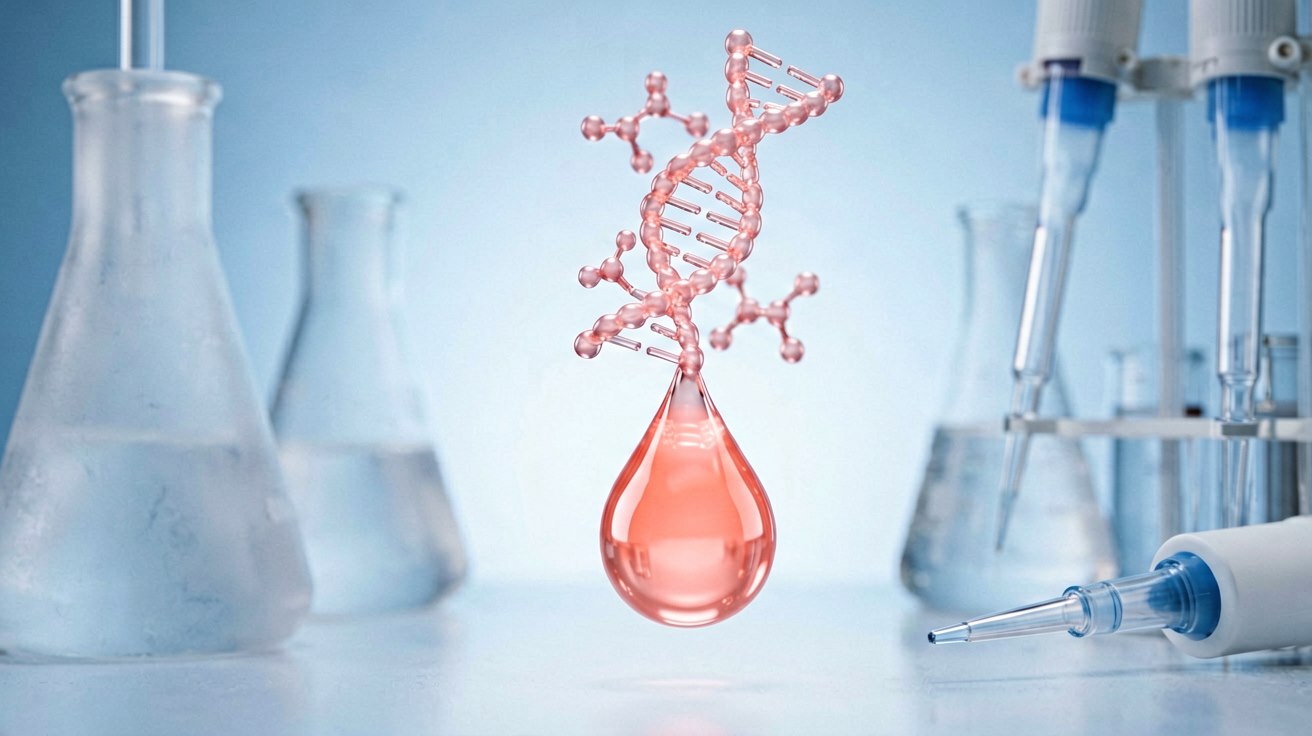
PDRN skincare has moved from aesthetic clinics into daily routines, becoming one of the most searched regenerative ingredients across Southeast Asia’s beauty market in 2026. Marketed under names like “salmon DNA serum” and “polynucleotide essence,” these products promise barrier repair, brightening, and visible skin resilience. This Bestseller Analysis breaks down what PDRN actually is, how it works at the receptor level, and what the clinical evidence says — so formulators and informed buyers can separate mechanism from marketing.
What Is PDRN?
PDRN stands for polydeoxyribonucleotide: a mixture of DNA fragments ranging from roughly 50 to 1,500 kDa, purified and sterilized from the sperm cells of salmon trout (Oncorhynchus mykiss) or chum salmon. Because salmon-derived DNA shares high structural homology with human DNA, the fragments are biocompatible and can be metabolized through the body’s own nucleotide pathways. Pharmaceutical-grade PDRN is refined to remove active proteins and peptides, leaving a well-characterized biopolymer rather than a crude fish extract.
In topical PDRN skincare products, the ingredient is typically stabilized in low-molecular-weight forms to improve delivery through the stratum corneum, often paired with hyaluronic acid, panthenol, or liposomal carriers to support penetration.
The Two-Pathway Mechanism
PDRN’s reputation rests on two complementary mechanisms of action.
1. Adenosine A2A receptor agonism. PDRN selectively stimulates the A2A adenosine receptor (ADORA2A), a key regulator of inflammation. Activating this receptor downregulates pro-inflammatory cytokines while upregulating growth factors such as VEGF, which supports microcirculation and tissue repair. A 2023 study in Scientific Reports confirmed PDRN acts as a selective ADORA2A agonist that suppresses inflammatory responses in ischemia/reperfusion models, and a 2020 paper in the Journal of Inflammation Research documented the same anti-inflammatory receptor pathway.
2. The salvage pathway. The DNA fragments in PDRN are broken down into nucleosides and nucleotides, which cells recycle to synthesize new DNA and repair damaged tissue. This “salvage” of building blocks is energetically cheaper than de novo synthesis, so cells recovering from stress — UV exposure, barrier disruption, or micro-injury — can rebuild faster. This dual action underpins PDRN’s positioning as a regenerative rather than merely occlusive ingredient.
PDRN and Hyperpigmentation
For a brand focused on brightening, PDRN’s anti-melanogenic profile is the most interesting angle. A 2022 review in the Chinese Journal of Plastic and Reconstructive Surgery summarized preclinical evidence that PDRN reduces melanin content, tyrosinase activity, and expression of MITF and TRP-1 — the core transcription factor and enzyme network driving melanin production. In co-culture models of human melanocytes and keratinocytes, PDRN suppressed melanin synthesis while promoting ERK and AKT phosphorylation, signaling cascades linked to controlled cell turnover.
The practical implication: PDRN does not bleach existing pigment the way a tyrosinase inhibitor alone might. Instead, it appears to dampen the inflammatory triggers (post-inflammatory hyperpigmentation, UV stress) that upregulate melanogenesis in the first place, while accelerating the barrier recovery that lets pigment fade naturally. For melasma-prone and sensitive skin common in tropical Southeast Asian climates, this “calm-and-repair” logic is a strong complement to direct brighteners like tranexamic acid or alpha arbutin.
Clinical Evidence for Skin Repair and Anti-Ageing
Beyond the lab bench, injectable and topical PDRN have accumulated clinical support:
- Wound healing and scar reduction: Multiple clinical trials, including studies on diabetic foot ulcers, have shown PDRN accelerates re-epithelialization and reduces healing time versus standard care — the foundation of its “regenerative” claim.
- Skin quality and elasticity: A 2022 narrative review (“Polydeoxyribonucleotide: A promising skin anti-aging agent”) catalogued anti-inflammatory, anti-apoptotic, and anti-melanogenic properties, noting improvements in dermal collagen and elastic fiber organization.
- Barrier resilience: By stimulating fibroblast activity and collagen synthesis, PDRN supports the structural matrix that keeps skin firm and hydrated — the visible “bounce” that drives repeat purchases in the current bestseller cohort.
It is worth being precise: the strongest data comes from injectable and medical-device formulations. Topical PDRN skincare depends heavily on formulation quality and molecular weight, because large DNA fragments penetrate poorly. This is exactly where product differentiation lives.
What Separates a Good PDRN Product
When evaluating trending PDRN serums, three technical factors matter most:
- Molecular weight and delivery. Lower-molecular-weight, fragmented PDRN plus a competent carrier system (liposomes, low-pH hydration matrix) is essential for meaningful topical uptake.
- Concentration transparency. Effective clinical PDRN work uses defined dosages; products that list PDRN low on the INCI with no percentage disclosure are likely under-dosed.
- Synergistic partners. The best-performing formulations combine PDRN’s repair mechanism with targeted actives — niacinamide for barrier lipids, panthenol for hydration, or a gentle tyrosinase inhibitor for pigmentation — rather than relying on PDRN alone.
Formulation and Stability Considerations
PDRN is a biological polymer, so it is sensitive to enzymatic degradation and requires careful preservation and pH control (typically mildly acidic to neutral). Formulators should avoid high-heat processing and validate compatibility with chelating agents that protect nucleotide integrity. For brands developing brightening lines, PDRN pairs naturally with a soothing, low-irritation base — an advantage for consumers who cannot tolerate aggressive acid regimens.
The Bottom Line
PDRN earns its bestseller status on genuine science: a documented A2A receptor mechanism, a nucleotide salvage pathway that speeds repair, and preclinical anti-melanogenic activity that dovetails with the brightening goals of Southeast Asian skincare buyers. The caveat is delivery — topical efficacy hinges on molecular weight, concentration, and a smart carrier system. For a brand building a regenerative brightening portfolio, a well-formulated PDRN serum is less a fad and more a durable, evidence-backed pillar.
This analysis is for educational and formulation-science purposes and is not medical advice. Clinical outcomes vary by formulation, concentration, and individual skin type.
Interested in Formulation Data Collaboration?
Let's discuss how Melasyl AI can accelerate your next whitening or brightening formula. Technical collaboration, data licensing, or custom AI-driven research — reach out.
Contact Wei →