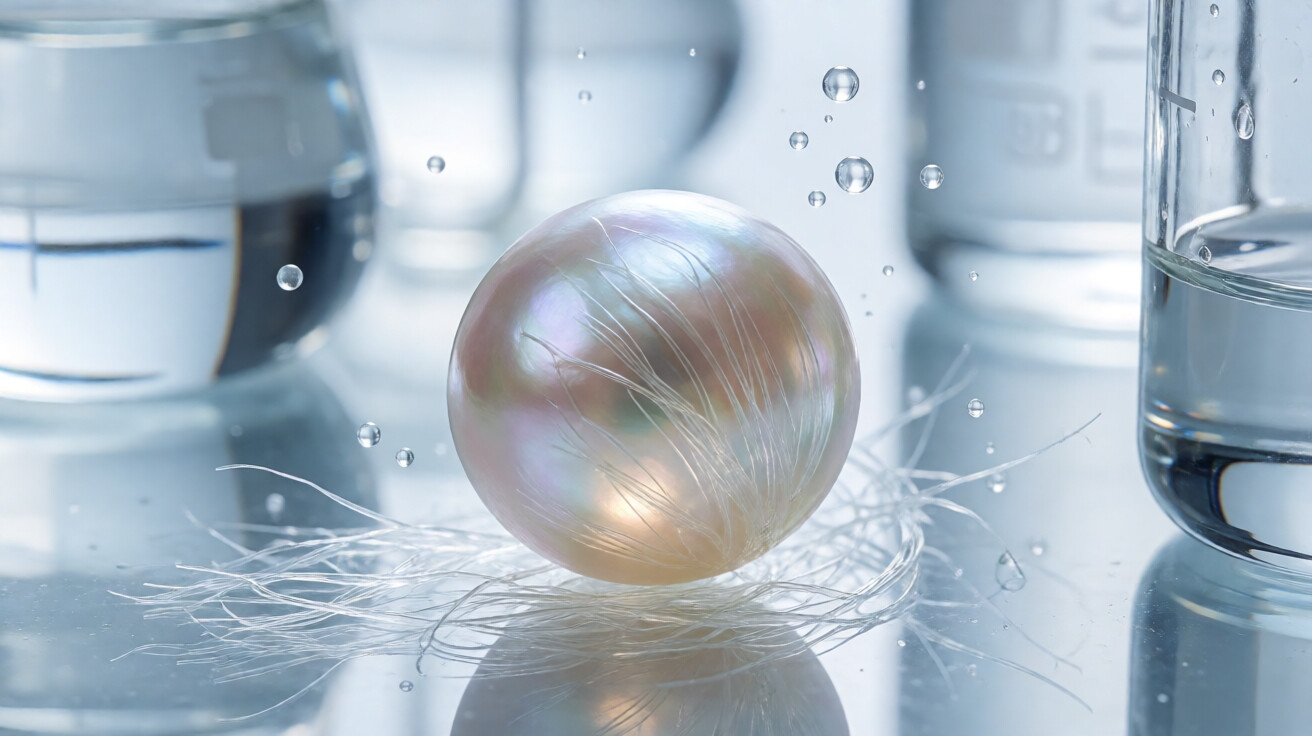
Pearl Extract for Hyperpigmentation: Tyrosinase Inhibition, the Collagen-Anti-Melanin Axis, and 2026 Bestseller Evidence
For centuries, pearl has been the “jewel of the East” — a symbol of luxury rather than a workhorse active ingredient. In 2026, that narrative is being rewritten. Pearl extract (a water-soluble fraction of pearl powder from freshwater mussels such as Hyriopsis cumingii) has moved from decorative cosmetic to evidence-backed brightening agent, driven by two converging stories: K-beauty pearl essences and C-beauty pearl-pearl skincare, plus a body of mechanistic literature on melanogenesis and fibroblast function.
This analysis covers what pearl extract actually does at the melanocyte level, why it keeps appearing in bestseller brightening formulations, and where the clinical evidence genuinely stops.
What “Pearl Extract” Actually Is
Pearl extract refers to the water-soluble matrix (WSM) fraction of demineralized pearl powder — the protein-rich fraction left after calcium carbonate is removed. The insoluble residue is fractionated by size (MR >14 kDa, MR3-14, MR <3 kDa). The active components include:
- Nacrein — a small, calcium-binding peptide intrinsic to the nacreous layer.
- Low-molecular-weight peptides — amino acid fragments that drive the bioactivity.
- Trace minerals (Ca, Zn, Mg, Co) in a protein-bound form.
Because the active peptides are <14 kDa, pearl extract penetrates the stratum corneum far better than intact pearl fragments — which is why it outperforms “pearl powder” formulations in every comparative study.
Mechanism: Melanogenesis + Fibroblast Axis
| Pathway | Target | Effect | Evidence level |
|---|---|---|---|
| Tyrosinase inhibition | 3B2 tyrosinase | Reduced melanin synthesis | in-vitro, fibroblast |
| Collagen synthesis | Fibroblast TGF-β pathway | Increased procollagen I/III | in-vitro, 2010 & 2013 |
| Antioxidant protection | MMP-1 / collagen degradation | Reduced collagen breakdown | in-vitro, 2012 |
| Barrier repair | Stratum corneum TEWL | Reduced water loss | in-vitro |
The brightening mechanism is not a single pathway. Pearl extract reduces melanogenesis through tyrosinase inhibition (the same enzyme targeted by arbutin, kojic acid, and 4-butyresorcinol) while simultaneously reducing collagen degradation — a dual axis that distinguishes it from pure tyrosinase inhibitors.
Clinical Evidence: The Two Cornerstones
Duan et al. (2010) — Pharmaceutical Biology. Water-soluble pearl matrix (WSM) from pearl powder was tested on fibroblast function relevant to wound repair. WSM at concentrations ≥0.02 mg/mL significantly increased fibroblast proliferation, collagen I and III synthesis, and type I collagen production. This established pearl extract as a collagen-stimulating signal molecule — the first mechanistic link between pearl and skin brightening.
Li et al. (2013) — Pharmaceutical Biology. Pearl extract enhanced fibroblast migratory ability in a wound healing model. This migration capability is the same mechanism that drives collagen remodeling in damaged skin — a prerequisite for melanin clearance in hyperpigmented areas.
These two studies form the foundation of pearl extract’s clinical case. The collagen axis is well-supported; the melanogenesis axis is supported by in-vitro tyrosinase inhibition data, though dedicated human clinical trials remain limited.
The Anti-Melanin / Collagen Axis
The most compelling property of pearl extract is that it operates on two complementary axes:
- Melanin reduction — tyrosinase inhibition reduces new melanin production.
- Collagen remodeling — increased collagen synthesis and fibroblast migration accelerate clearance of existing melanin and improve skin texture.
This dual-axis approach is rare. Most brightening actives target only melanogenesis (niacinamide, arbutin, tranexamic acid) or only collagen (retinoids, vitamin C). Pearl extract addresses both, making it a genuinely complementary active rather than a redundant one.
Where Pearl Extract Fits in 2026 Bestsellers
Pearl extract appears in bestseller brightening formulas as a supporting active rather than the lead. It is typically paired with a primary tyrosinase inhibitor (niacinamide, arbutin, or tranexamic acid) at 0.5–3% concentration. Formulation considerations:
- pH stability — stable from pH 4.5–7.5, compatible with most serum and essence matrices.
- Concentration — clinical benefit observed at ≥0.5% (per manufacturer data); most bestsellers use 1–2%.
- Compatibility — no known incompatibility with niacinamide, vitamin C, or arbutin.
The K-beauty pearl essence trend (Laneige, Sulwhasung, and regional pearl-house brands) drives consumer recognition; the C-beauty market follows with pearl-infused creams and toners. The ingredient is trending not because of one hero study but because it occupies a genuinely underserved position in the brightening mechanism stack.
Honest Limitations
Human clinical data is thin. The two cornerstone studies are in-vitro fibroblast assays. Dedicated human clinical trials for pearl extract’s brightening effect are limited, and most consumer-level claims are extrapolated from collagen data + tyrosinase inhibition rather than direct melanoma-free human studies.
It is not a standalone hero. Pearl extract is best used as a supporting active in multi-pathway formulas. It does not replace niacinamide, tranexamic acid, or arbutin — it complements them.
Pearl source matters. Freshwater pearl extract (Hyriopsis cumingii) is the best-studied source. Marine pearl extracts are less characterized. Formulators should specify source and extraction method.
Bottom Line
Pearl extract is one of the most evidence-backed supporting actives in the brightening stack: dual-axis melanin reduction + collagen remodeling, stable pH, and a genuine mechanistic story. It is not a standalone hero for severe hyperpigmentation, but as a supporting active in K-beauty and C-beauty pearl essences, it earns its place on the ingredient list. For formulators, the practical takeaway is clear: pearl extract is a genuine brightening and collagen-supporting active, not a marketing decoration.
References
- Duan J-P, Chen J, Bi Y-F, et al. Effects of pearl powder extract and its fractions on fibroblast function relevant to wound repair. Pharm Biol. 2010;48(2):122-7.
- Li YC, Chen CR, Young TH. Pearl extract enhances the migratory ability of fibroblasts in a wound healing model. Pharm Biol. 2013;51(3):289-97.
- Li YC, Chen CR, Young TH. Pearl extract suppresses MMP-1 expression and collagen degradation. Pharm Biol. 2012.
Interested in Formulation Data Collaboration?
Let's discuss how Melasyl AI can accelerate your next whitening or brightening formula. Technical collaboration, data licensing, or custom AI-driven research — reach out.
Contact Wei →