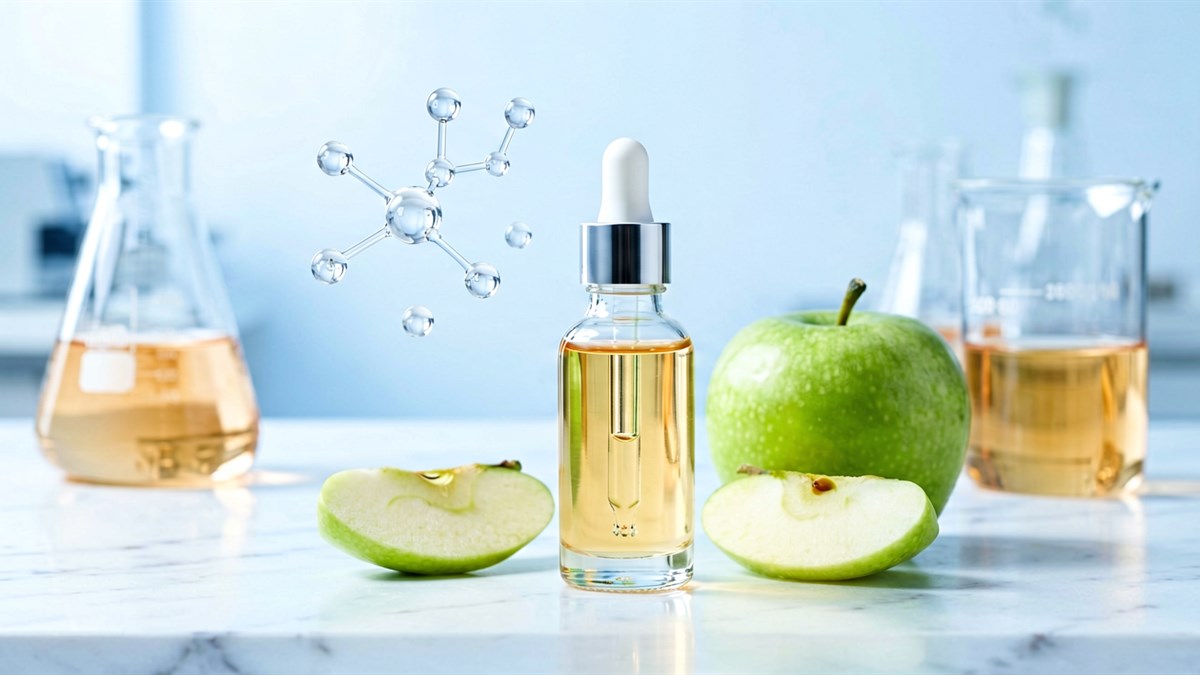
Phloretin rarely leads the ingredient conversation — and that is exactly why it deserves a closer look. This apple-derived flavonoid is the quiet engine behind one of the best-selling antioxidant serums of the past decade (the vitamin C + ferulic acid + phloretin archetype popularised by Phloretin CF), and it occupies a position no single tyrosinase inhibitor can: it defends skin against the UV and oxidative stress that create pigmentation in the first place. This review examines what the enzymology, the human photoprotection trial, and the 2026 formulation literature actually establish about phloretin for hyperpigmentation.
What Phloretin Actually Is
Phloretin is a dihydrochalcone flavonoid found in apple flesh and peel, where it occurs mainly as its glucoside, phloridzin. The aglycone form, phloretin, is the biologically active molecule used in skincare. It is a small, lipophilic polyphenol (logP ≈ 3.2) — a property that lets it partition into the stratum corneum and penetrate the skin, a prerequisite for any topically delivered antioxidant. That same lipophilicity makes it poorly water-soluble, a point that dominates formulation strategy later.
Structurally, phloretin belongs to the same plant-polyphenol family as ferulic acid and resveratrol: a redox-active molecule with multiple phenolic hydroxyls capable of donating hydrogen atoms to neutralise free radicals. Its dermatological interest spans four properties — antioxidant capacity, tyrosinase modulation, anti-inflammatory activity, and photoprotection.
Mechanism 1: Tyrosinase Inhibition — Real, But Modest
Phloretin inhibits tyrosinase, the rate-limiting enzyme of melanin synthesis, but the honest reading of the data places it in the “moderate” tier rather than the thiamidol tier. In human epidermal melanocytes, phloretin 100 µM reduced cellular tyrosinase activity by roughly 29% and melanin content by about 9% (Lin et al., 2007). Cell-free assays put the half-maximal inhibitory concentration between approximately 134 µM and 169 µM depending on substrate and enzyme source (Zhang et al., 2012; Chen et al., 2020). Molecular docking suggests phloretin competes with L-DOPA for the tyrosinase active site. Notably, phloretin’s reducing capacity measured higher than that of ascorbic acid in several assays — a hint of why it performs better as an antioxidant than as a stand-alone brightener.
Mechanism 2: Oxidative-Stress Blockade and UV Photoprotection
Melanogenesis is an oxidative cascade, and ultraviolet radiation is its most powerful trigger. Phloretin’s strongest pigment-relevant contribution is upstream of tyrosinase: neutralising the reactive oxygen species and DNA damage that activate MITF and drive new melanin production.
The definitive human data come from a randomised, vehicle-controlled study in ten healthy volunteers by Oresajo and colleagues (Journal of Cosmetic Dermatology, 2008). Applied for four days before solar-simulated UV exposure, a phloretin + vitamin C + ferulic acid solution significantly attenuated erythema and — critically for pigmentation — reduced sunburn-cell formation, thymine-dimer DNA damage, matrix metalloproteinase-9 expression, and p53 protein induction. It also blocked UV-induced suppression of CD1a-expressing Langerhans cells, an immunosuppressive event linked to photocarcinogenesis. Because these antioxidants do not absorb UVA/UVB directly, the protection is biological rather than a sunscreen effect: it complements, and does not compete with, SPF.
Mechanism 3: Anti-Inflammatory and Matrix Actions
Post-inflammatory hyperpigmentation is driven by inflammatory signalling, and phloretin interrupts it. Preclinical work shows suppression of NF-κB activation, COX-2 expression, PGE2 release, and IL-6/ICAM-1 production — the mediators that turn a healing blemish into a stubborn brown mark. Phloretin also inhibits elastase and matrix metalloproteinase-1, protecting collagen and elastin from the same UV-driven degradation that worsens photoaging (Casarini et al., European Journal of Pharmacology, 2020). For darker phototypes prone to PIH, that anti-inflammatory restraint is a meaningful safety advantage over aggressive exfoliating or irritant actives.
Mechanism 4: Synergy — Why Phloretin Is a Partner, Not a Soloist
Phloretin’s most commercially significant property is that it makes other actives work better. The original 2005 discovery by Lin and colleagues established that ferulic acid stabilises and increases the photoprotection of vitamins C and E; phloretin extends that logic, enhancing the skin availability of co-formulated L-ascorbic acid and ferulic acid while adding its own antioxidant and anti-inflammatory contributions. The combination is greater than the sum of its parts — the mechanistic basis for the best-selling antioxidant-serum archetype.
Emerging data point to synergy on the melanogenesis side as well. A 2024 study in Cosmetics found that apigenin and phloretin acted synergistically to reduce melanin production, modulating Wnt signalling, activating autophagy in melanocytes, and upregulating miR-675 — a microRNA that targets MITF and is reduced in melasma skin.
Clinical Evidence at a Glance
- Photoprotection RCT: phloretin + vitamin C + ferulic acid reduced sunburn cells, thymine dimers, MMP-9 and p53 versus vehicle in 10 volunteers (Oresajo et al., 2008; J Cosmet Dermatol 7(4):290–297).
- Melanocyte biology: 100 µM phloretin reduced tyrosinase activity ≈29% and melanin ≈9% (Lin et al., 2007).
- Enzymology: tyrosinase IC50 ≈ 134–169 µM, competitive with L-DOPA (Zhang et al., 2012; Chen et al., 2020).
- Delivery science: nicotinamide-stabilised phloretin nanocrystals cut tyrosinase activity to ≈63% and melanin to ≈37% in a zebrafish model, outperforming arbutin (Li et al., Pharmaceutics 2022).
- Review evidence: a dermatological review confirms depigmenting, anti-aging and anti-inflammatory actions, alongside documented photoinstability and low aqueous solubility (Casarini et al., 2020).
An honest limitation: there is no large, dedicated, vehicle-controlled clinical trial of phloretin monotherapy in melasma. The strongest human evidence is for phloretin within antioxidant combinations, and the strongest pigment-specific evidence is preclinical. That gap is a reason for measured claims, not for dismissal.
2026 Formulation Science
Phloretin’s two liabilities are poor water solubility and photoinstability — both addressable:
- Solvency: dissolve phloretin in propylene glycol, butylene glycol, or ethoxydiglycol (or ethanol) before adding to the water phase; typical use level 0.5–2%.
- Delivery: nanocrystal or lipid-nanoparticle encapsulation improves solubility, transdermal delivery and storage stability — the approach validated by the zebrafish study.
- pH environment: phloretin is most at home in acidic antioxidant systems (pH ≤ 3.5) alongside L-ascorbic acid; add during cool-down and protect from oxygen.
- Packaging: opaque, airless or ampoule formats to limit photodegradation and oxidation.
- Pairings: 10–15% L-ascorbic acid and 0.5% ferulic acid for the classic antioxidant stack; niacinamide or tranexamic acid in separate or buffered vehicles for a multi-pathway brightening strategy.
Tolerability and Positioning
Phloretin is generally well tolerated; the main irritation source in phloretin serums is the low pH needed for vitamin C, not phloretin itself. Critically, it carries no ochronosis risk and does not require the monitoring that hydroquinone demands — an increasingly important selling point in Southeast Asian markets, where pigmentary concerns skew toward PIH and melasma in skin of colour.
Positioned correctly, phloretin is not a hydroquinone replacement. It is the preventive, photoprotective layer of a brightening routine: the active that reduces the UV and inflammatory signals that generate pigment, while tyrosinase inhibitors handle existing melanin and retinoids accelerate turnover. That complementary role is precisely why the phloretin-containing antioxidant serum remains a bestseller — and why it belongs in any serious 2026 brightening portfolio.
References
- Oresajo C, Stephens T, Hino PD, et al. Protective effects of a topical antioxidant mixture containing vitamin C, ferulic acid, and phloretin against ultraviolet-induced photodamage in human skin. J Cosmet Dermatol. 2008;7(4):290–297. doi:10.1111/j.1473-2165.2008.00408.x.
- Lin FH, Lin JY, Gupta RD, et al. Ferulic acid stabilizes a solution of vitamins C and E and doubles its photoprotection of skin. J Invest Dermatol. 2005;125(4):826–832.
- Casarini TPA, Frank LA, Pohlmann AR, Guterres SS. Dermatological applications of the flavonoid phloretin. Eur J Pharmacol. 2020;889:173593. doi:10.1016/j.ejphar.2020.173593.
- Li Y, Xiang H, Xue X, et al. Dual antimelanogenic effect of nicotinamide-stabilized phloretin nanocrystals in larval zebrafish. Pharmaceutics. 2022;14(9):1825. doi:10.3390/pharmaceutics14091825.
- Apigenin and phloretin combination for skin aging and hyperpigmentation regulation. Cosmetics. 2024;11(4):128. doi:10.3390/cosmetics11040128.
- Chen et al. Tyrosinase inhibition, antioxidant capacity and molecular docking of phloretin (as reviewed in Casarini et al., 2020). 2020.
- Lin et al. Effect of phloretin on tyrosinase activity and melanin content in human epidermal melanocytes (as reviewed in Casarini et al., 2020). 2007.
Interested in Formulation Data Collaboration?
Let's discuss how Melasyl AI can accelerate your next whitening or brightening formula. Technical collaboration, data licensing, or custom AI-driven research — reach out.
Contact Wei →