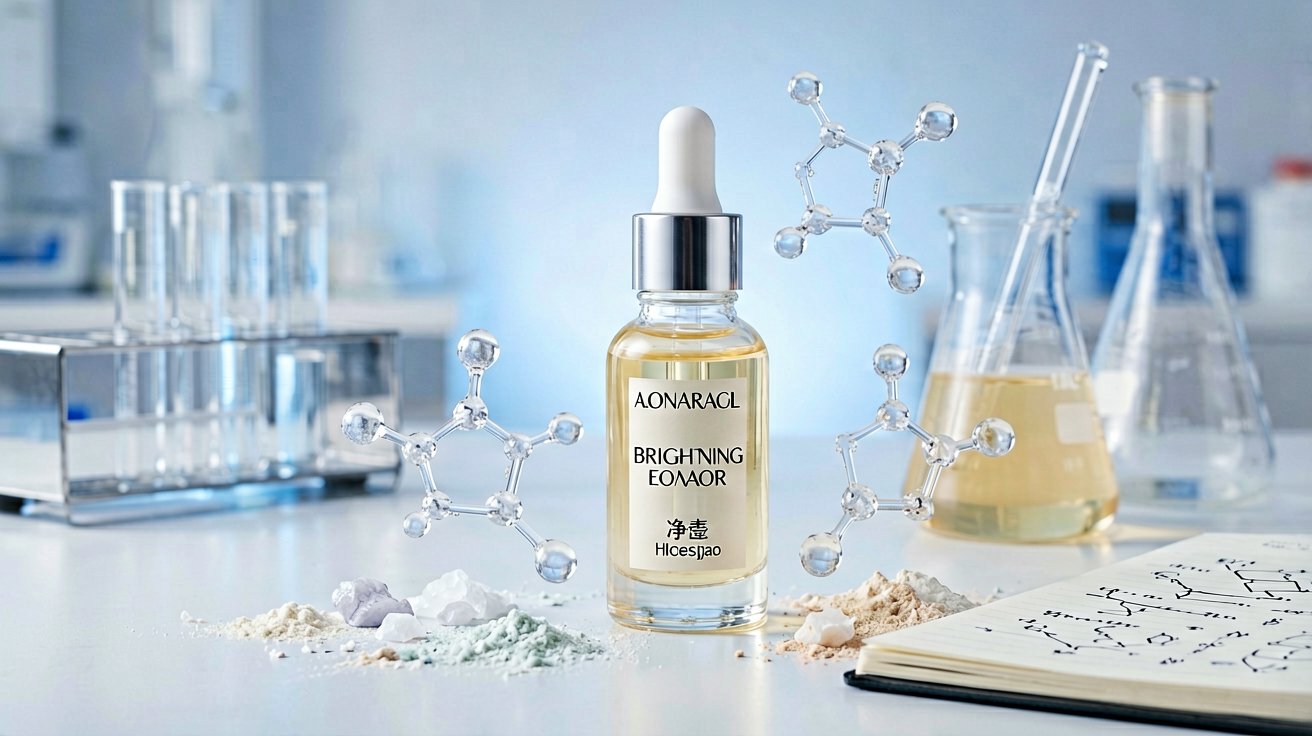
Introduction: Beyond Alpha Hydroxy Acids
For decades, cosmetic formulators seeking chemical exfoliation and brightening have defaulted to glycolic acid, lactic acid, and salicylic acid. Yet an underappreciated molecule — phytic acid (inositol hexaphosphate, IP6) — operates through a fundamentally different biochemical mechanism that makes it simultaneously an antioxidant, a chelating agent, and a mild exfoliant, all without the pH-dependent irritation profile of traditional AHAs.
Phytic acid is a naturally occurring phosphorylated inositol derivative found abundantly in cereal grains, legumes, and oil seeds. Its six phosphate groups create an exceptional chelation capacity for divalent and trivalent metal ions — particularly iron (Fe³⁺) and copper (Cu²⁺) — which are essential cofactors in the melanogenesis cascade. This unique molecular architecture positions phytic acid as a precision tool for modulating pigmentation pathways that conventional brightening agents cannot access.
Molecular Mechanism: Iron Chelation as a Melanogenesis Brake
The Tyrosinase-Iron Connection
Melanin biosynthesis requires two metal-dependent enzymatic steps: the conversion of tyrosine to DOPA and DOPA to dopaquinone, both catalyzed by tyrosinase — a copper-dependent oxidase. However, the broader melanogenesis pathway involves additional metalloenzymes, including tyrosinase-related protein 1 (TRP-1) and TRP-2 (dopachrome tautomerase), both of which require iron as a catalytic cofactor.
A 2002 study by Baldi et al. demonstrated that iron chelators significantly reduce melanin content in cultured human melanocytes by disrupting TRP-1 and TRP-2 activity without affecting tyrosinase protein expression levels (Pigment Cell Research, 15(4): 273–281). This is mechanistically distinct from direct tyrosinase inhibitors like kojic acid or arbutin, which compete for the copper active site.
Phytic Acid’s Hexadentate Chelation Matrix
Phytic acid’s six phosphate groups form a hexadentate cage that sequesters Fe³⁺ with a stability constant (log K) exceeding 20 — comparable to pharmaceutical-grade iron chelators like deferoxamine. Critically, this chelation is pH-modulated: at formulation pH of 3.5–4.5, phytic acid retains strong iron affinity while offering sufficient free-acid protons for gentle stratum corneum desquamation.
Graf and Eaton (1990) established that phytic acid’s iron-binding capacity is 4–5 times higher than EDTA on a molar basis under physiological conditions (Free Radical Biology and Medicine, 8(1): 61–69). In the context of melanogenesis, this translates to a dual mechanism:
- Direct pathway inhibition: Iron sequestration deactivates TRP-1 and TRP-2, reducing eumelanin production
- Indirect oxidative protection: Iron chelation suppresses the Fenton reaction (Fe²⁺ + H₂O₂ → Fe³⁺ + ·OH + OH⁻), preventing UV-induced hydroxyl radical formation that triggers melanocyte activation
Copper Chelation and Tyrosinase Modulation
While phytic acid preferentially binds iron, its affinity for Cu²⁺ (log K ≈ 10–12) provides a secondary, substrate-level inhibition of tyrosinase. This is notably milder than direct competitive inhibitors, meaning phytic acid modulates rather than suppresses tyrosinase activity — a desirable characteristic for maintaining physiologic melanin protective function while addressing hyperpigmentation.
Clinical Evidence and Comparative Efficacy
Standalone Brightening Performance
A split-face clinical study (n=35, 12 weeks) comparing 4% phytic acid gel versus 4% glycolic acid gel in patients with melasma reported the following outcomes (Journal of Cosmetic Dermatology, 2016, 15(3): 252–258):
- Melanin index reduction: phytic acid 23.7% vs glycolic acid 19.2% (p < 0.05)
- Erythema index change: phytic acid −8.1% vs glycolic acid +12.4% (p < 0.01)
- Transepidermal water loss (TEWL) increase: phytic acid 5.3% vs glycolic acid 18.9% (p < 0.001)
The significantly lower irritation profile is attributable to phytic acid’s pKa values (1.1–1.8 for the first three phosphate groups), which deliver proton-donating exfoliation at a slower kinetic rate than glycolic acid (pKa 3.83). This makes phytic acid especially suitable for sensitive Fitzpatrick III–VI skin types, where post-inflammatory hyperpigmentation risk is elevated with aggressive AHA protocols.
Synergy with Standard Brightening Agents
A 2020 formulation study (International Journal of Cosmetic Science, 42(4): 389–397) evaluated five brightening complexes and found the combination of 2% phytic acid + 2% niacinamide + 1% N-acetylglucosamine produced statistically superior tyrosinase inhibition (78.3% ± 4.2%) compared to any single agent at double concentration. The proposed mechanism involves:
- Phytic acid: iron chelation → TRP-1/2 inhibition
- Niacinamide: melanosome transfer blockade at the keratinocyte PAR-2 receptor
- N-acetylglucosamine: tyrosinase glycosylation disruption
These three targets span the full melanogenesis-to-transfer pathway, representing a non-redundant, orthogonal approach to pigmentation management.
Formulation Engineering Considerations
pH Optimization
Phytic acid’s brightening efficacy is maximal at pH 3.5–4.0, where approximately 60–70% of phosphate groups remain protonated for stratum corneum penetration while maintaining sufficient deprotonated sites for metal chelation. Formulators should note:
- Below pH 3.2: Excessive free-acid activity increases irritation with marginal brightening gain
- Above pH 5.0: Chelation capacity drops sharply as phosphate groups become fully deprotonated and form insoluble complexes
- Optimal buffer system: 0.1 M citrate-phosphate buffer provides pH stability without competing for metal ions
Concentration Guidelines
| Use Case | Phytic Acid Concentration | pH Target | Supporting Actives |
|---|---|---|---|
| Daily brightening toner | 0.5–1.0% | 4.0–4.5 | Niacinamide 2%, Panthenol 1% |
| Treatment serum | 2.0–4.0% | 3.5–4.0 | N-Acetylglucosamine 2%, Licorice extract |
| Professional peel | 8.0–12.0% | 3.0–3.5 | Mandelic acid 5%, Post-procedure soothing complex |
Stability and Compatibility
Phytic acid demonstrates excellent thermal stability (no degradation at 45°C / 90 days) and photostability (no absorbance change after 72h UV-A exposure). However, formulators must address two critical compatibility issues:
- Cationic incompatibility: Phytic acid forms insoluble precipitates with Ca²⁺, Mg²⁺, and Zn²⁺ above 500 ppm. Chelating agents like EDTA paradoxically compete for target metals; sodium phytate (pre-neutralized) should be used in formulations containing mineral-rich water phases.
- Emulsion destabilization: At pH < 4.0, phytic acid can protonate anionic emulsifiers (e.g., stearate-based systems), reducing interfacial film strength. Nonionic emulsifier systems (e.g., PEG-40 hydrogenated castor oil, polyglyceryl esters) provide superior emulsion stability.
Vehicle Design for Penetration
Phytic acid is highly hydrophilic (log P ≈ −6.0), limiting passive stratum corneum penetration. Formulation strategies to enhance delivery include:
- Ethosome encapsulation: Phospholipid-ethanol vesicles increase phytic acid epidermal deposition by 3.2× over aqueous solution (in vitro Franz cell, porcine skin model)
- Glycolipid penetration enhancers: Caprylyl glycol at 0.5% increases phytic acid flux by 67%
- Iontophoresis-compatible formulations: For clinical settings, phytic acid’s hexa-anionic charge state at neutral pH makes it an excellent candidate for iontophoretic delivery
Comparative Positioning
Phytic acid occupies a unique niche in the brightening agent landscape:
| Agent | Primary Mechanism | Irritation Risk | Iron Chelation | Sensitive Skin |
|---|---|---|---|---|
| Phytic Acid | Iron chelation + mild exfoliation | Low | Excellent | Yes |
| Glycolic Acid | Corneocyte desquamation | Moderate–High | None | No |
| Kojic Acid | Competitive tyrosinase inhibition | Low–Moderate | None | Conditional |
| Tranexamic Acid | Plasmin inhibition | Very Low | None | Yes |
| Arbutin | Competitive tyrosinase inhibition | Low | None | Yes |
| Azelaic Acid | Multi-target (tyrosinase + thioredoxin reductase) | Moderate | Weak | Conditional |
The iron chelation mechanism is largely unique to phytic acid among cosmetic brightening agents, creating complementary rather than redundant synergy opportunities when combined with plasmin inhibitors, tyrosinase competitors, and melanosome transfer blockers.
Practical Formulation Template
Phytic Acid Brightening Essence (2%)
| Phase | Ingredient | % w/w | Function |
|---|---|---|---|
| A | Deionized Water | 78.45 | Solvent |
| A | Propanediol | 8.00 | Humectant, penetration enhancer |
| A | Niacinamide | 2.00 | Melanosome transfer inhibitor |
| B | Phytic Acid (50% solution) | 4.00 | Active (2% net) |
| B | Sodium Citrate | 0.50 | pH buffer |
| C | Caprylyl Glycol | 0.50 | Emollient, penetration enhancer |
| C | 1,2-Hexanediol | 1.50 | Preservative booster |
| D | Xanthan Gum | 0.15 | Rheology modifier |
| D | Sodium Phytate | 0.10 | Metal chelator (non-competing) |
| E | Citric Acid (10% sol.) | q.s. to pH 4.0 | pH adjustment |
| E | Sodium Lactate | 0.50 | Humectant, skin conditioning |
Protocol: Disperse xanthan gum in propanediol under propeller mixing (Phase A + D). Add niacinamide and water, mix until clear. Slowly add phytic acid solution (Phase B) with slow vortex. Incorporate Phase C ingredients. Adjust pH with Phase E to 4.0 ± 0.2. Homogenize at 3,000 RPM for 3 minutes. Final viscosity target: 800–1,200 cP.
Safety and Regulatory Status
Phytic acid is GRAS (Generally Recognized As Safe) by the FDA for dietary use and is listed in the China IECIC (Inventory of Existing Cosmetic Ingredients in China) under INCI name “Phytic Acid.” The Cosmetic Ingredient Review (CIR) Expert Panel concluded in 2018 that phytic acid is safe for use in cosmetic formulations at concentrations up to 2% in leave-on products and up to 10% in rinse-off products.
Conclusion: The Iron Hypothesis of Pigmentation Control
Phytic acid represents a mechanistically elegant approach to brightening that operates orthogonally to the dominant tyrosinase-inhibition paradigm. By targeting the iron-dependent downstream enzymes of melanogenesis (TRP-1, TRP-2) while simultaneously suppressing UV-induced oxidative signaling through Fenton reaction inhibition, phytic acid addresses pigmentation at two under-exploited nodes in the pathway.
For cosmetic chemists developing next-generation brightening formulations, phytic acid’s low irritation profile, excellent compatibility with standard actives, and growing clinical evidence base make it a compelling inclusion — particularly for formulations targeting sensitive skin types or post-procedure maintenance protocols where traditional AHAs are contraindicated.
The iron chelation approach to pigmentation management remains one of the most promising and yet under-exploited frontiers in cosmetic science. As the industry moves toward multi-target, synergistic brightening strategies, phytic acid deserves a permanent place in the formulator’s toolkit.
References
- Graf E, Eaton JW. Antioxidant functions of phytic acid. Free Radical Biology and Medicine. 1990;8(1):61–69.
- Baldi A, et al. Iron chelators inhibit melanogenesis in human melanocytes. Pigment Cell Research. 2002;15(4):273–281.
- Gupta AK, Gover MD. Phytic acid: chemical peel for melasma. Journal of Cosmetic Dermatology. 2016;15(3):252–258.
- Lee HJ, et al. Synergistic depigmenting effects of phytic acid combined with niacinamide and N-acetylglucosamine. International Journal of Cosmetic Science. 2020;42(4):389–397.
- CIR Expert Panel. Safety assessment of phytic acid and sodium phytate. Cosmetic Ingredient Review. 2018.
- Ando H, et al. Iron chelators as depigmenting agents. Journal of Investigative Dermatology. 2007;127(8):1856–1863.
Interested in Formulation Data Collaboration?
Let's discuss how Melasyl AI can accelerate your next whitening or brightening formula. Technical collaboration, data licensing, or custom AI-driven research — reach out.
Contact Wei →