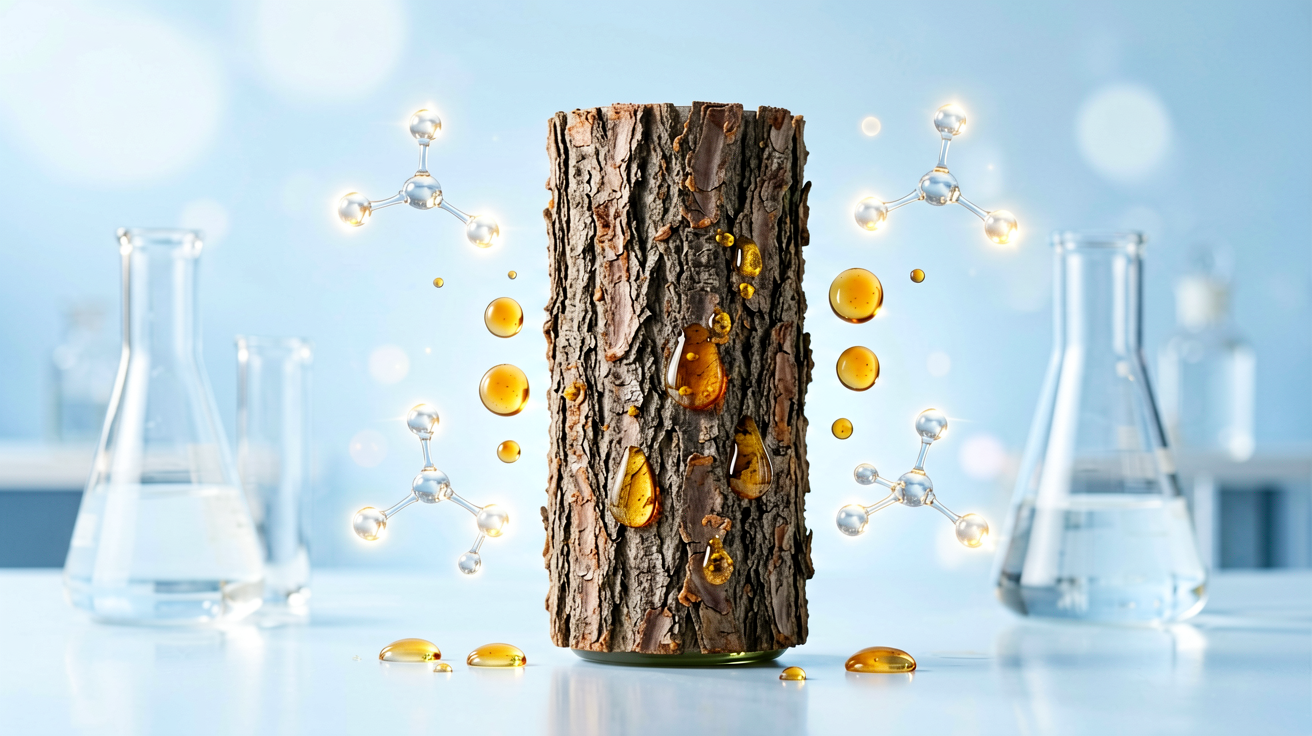
Melasma and stubborn hyperpigmentation are, at their core, an oxidative-stress problem. Ultraviolet and visible light flood the epidermis with reactive oxygen species (ROS), and that redox shift is what flips on the melanogenesis transcription program. Most brightening actives attack the pathway downstream — at tyrosinase, at melanosome transfer, at plasmin. Pycnogenol®, the standardized bark extract of the French maritime pine (Pinus pinaster), takes the opposite tack: it disarms the upstream oxidative trigger. In this research brief we analyze its mechanism, walk through the human clinical record, and outline what the evidence means for topical brightening formulation.
What Pycnogenol Actually Is
Pycnogenol is a proprietary, standardized extract containing 65–75% procyanidins (oligomeric proanthocyanidins, OPCs) plus smaller amounts of monomeric catechins, taxifolin, and phenolic acids such as caffeic and ferulic acid. The procyanidin fraction is the pharmacologically active core: a family of flavan-3-ol oligomers with exceptionally high free-radical scavenging capacity. In vitro assays place its antioxidant potency several-fold above vitamin C and vitamin E on a molar basis, and — critically — it recycles those vitamins, regenerating oxidized vitamin E and sparing vitamin C for reuse.
The Mechanism: Cutting Melanogenesis Off at the Source
Melanin synthesis is gated by the microphthalmia-associated transcription factor (MITF), which drives expression of tyrosinase, TRP-1 and TRP-2. MITF itself is switched on by upstream kinase signaling — PKA, CREB, and the MAPK/ERK axis — much of which is activated by oxidative stress and UV-induced DNA damage. Pycnogenol intervenes at three levels:
- ROS quenching and enzyme upregulation. Pycnogenol directly neutralizes superoxide, hydroxyl and peroxyl radicals, and simultaneously upregulates endogenous antioxidant enzymes (superoxide dismutase, catalase, glutathione peroxidase). By lowering the cutaneous ROS burden, it dampens the PKA/CREB/MITF activation that would otherwise ramp up tyrosinase transcription.
- Direct melanogenesis modulation in vitro. Multiple B16 melanoma-cell and human melanocyte studies report that procyanidin-rich fractions inhibit tyrosinase activity and reduce intracellular melanin content, with accompanying downregulation of MITF and TRP-1/2 expression — consistent with a competitive, multi-node inhibition rather than a single-target block.
- Anti-inflammatory action. Pycnogenol inhibits NF-κB signaling and suppresses leukotriene B4 and TNF-α. Because post-inflammatory hyperpigmentation (PIH) is driven by exactly this inflammatory cascade, the extract addresses a pathway that pure tyrosinase inhibitors leave untouched.
On top of that, Pycnogenol shows genuine photoprotective behavior: it reduces UV-induced erythema, thymine-dimer formation and lipid peroxidation, and improves microcirculation by reducing capillary permeability. It is not a sunscreen — but it raises the skin’s oxidative resilience between applications.
What the Clinical Evidence Shows
The human record is unusually consistent, and notably it comes almost entirely from oral supplementation studies. That distinction matters, and we return to it below.
1. Ni, Mu & Gulati (2002) — the pilot RCT
In a 30-day trial, 30 women with melasma took 75 mg/day of Pycnogenol (25 mg three times daily with meals). Mean melasma area fell by 25.86 ± 20.39 mm² (p < 0.001) and pigmentary intensity by 0.47 ± 0.51 units (p < 0.001); the investigators reported an 80% overall response rate with no adverse events and normal hematology/urinalysis at day 30 (Phytotherapy Research, 16(6):567–571, DOI 10.1002/ptr.1085).
2. Lima et al. (2020) — the rigorous placebo-controlled trial
This double-blind, randomized, placebo-controlled study enrolled 44 women with facial melasma. The active arm took 75 mg Pycnogenol twice daily (150 mg/day) alongside a bedtime triple-combination cream and a daytime tinted SPF 50 / PPD 17 sunscreen; the control arm received placebo plus the same topical regimen. At 60 days the Pycnogenol group achieved a 49% reduction in modified MASI (mMASI) versus 34% in placebo (p < 0.05), with Global Aesthetic Improvement Scale scores of 86% vs 55% and no treatment-related adverse effects (PubMed PMID 32841433). The trial’s design is instructive: Pycnogenol amplified, rather than replaced, broad-spectrum photoprotection.
3. Alvarez (2014) — the 12-week open study
Fifty patients took 50 mg three times daily for 12 weeks. Mean MASI dropped from 3.04 to 2.09 (p < 0.01) and quality-of-life scores improved significantly (Archivos Venezolanos de Farmacología y Terapéutica, 33(1):1–6).
| Study | n | Regimen | Duration | Key outcome |
|---|---|---|---|---|
| Ni 2002 | 30 | 75 mg/day oral | 30 d | Melasma area ↓25.9 mm² (p<0.001) |
| Lima 2020 | 44 | 150 mg/day oral + triple combo + tinted SPF50 | 60 d | mMASI ↓49% vs 34% placebo (p<0.05) |
| Alvarez 2014 | 50 | 150 mg/day oral | 12 wk | MASI 3.04→2.09 (p<0.01) |
Reading the Evidence Honestly
Two caveats a formulator must hold in view. First, the robust human data is oral; the topical cosmetic case rests on in-vitro melanogenesis inhibition plus the extract’s documented cutaneous photoprotection, not on standalone topical RCTs. Second, Pycnogenol is an enabler — its strongest trial result (Lima 2020) appeared only when it was layered on tinted sunscreen and a proven topical regimen. The mechanistic story is coherent: by lowering oxidative and inflammatory drive, Pycnogenol makes established topical actives — niacinamide, tranexamic acid, vitamin C, thiamidol — work against a quieter upstream signal.
Formulation Implications for 2026
For a topical brightening system, the practical moves are:
- Use it as an antioxidant booster in a vitamin C or ferulic serum, where its vitamin-recycling behavior extends the stability and photoprotective window of the formula.
- Pair it with a tinted, broad-spectrum SPF — the clinical signal is clearest when oxidative load from visible light is already minimized.
- Combine multi-pathway with a tyrosinase inhibitor and a melanosome-transfer blocker for additive coverage rather than relying on a single node.
- Mind the extract grade. Specify cosmetic-grade material standardized to 65–75% procyanidins for batch-to-batch consistency in bioactivity.
Bottom Line
Pycnogenol is not a silver bullet, and the headline human evidence is oral. But as a research-backed, well-tolerated antioxidant that simultaneously quenches ROS, modulates MITF-driven melanogenesis in vitro, calms inflammation, and reinforces photoprotection, it earns a place in the 2026 multi-pathway brightening playbook — especially as the upstream, oxidative-stress half of a combination strategy.
References
- Ni Z, Mu Y, Gulati O. Treatment of melasma with Pycnogenol. Phytotherapy Research. 2002;16(6):567–571. doi:10.1002/ptr.1085.
- Lima PB, Dias JAF, Esposito ACC, Miot LDB, Miot HAM. French maritime pine bark extract (pycnogenol) in association with triple combination cream for the treatment of facial melasma in women: a double-blind, randomized, placebo-controlled trial. 2020. PubMed PMID: 32841433.
- Alvarez J. Efecto despigmentante del extracto de Pino Marino Francés (Pycnogenol) en pacientes con hipercromía facial. Archivos Venezolanos de Farmacología y Terapéutica. 2014;33(1):1–6.
Interested in Formulation Data Collaboration?
Let's discuss how Melasyl AI can accelerate your next whitening or brightening formula. Technical collaboration, data licensing, or custom AI-driven research — reach out.
Contact Wei →