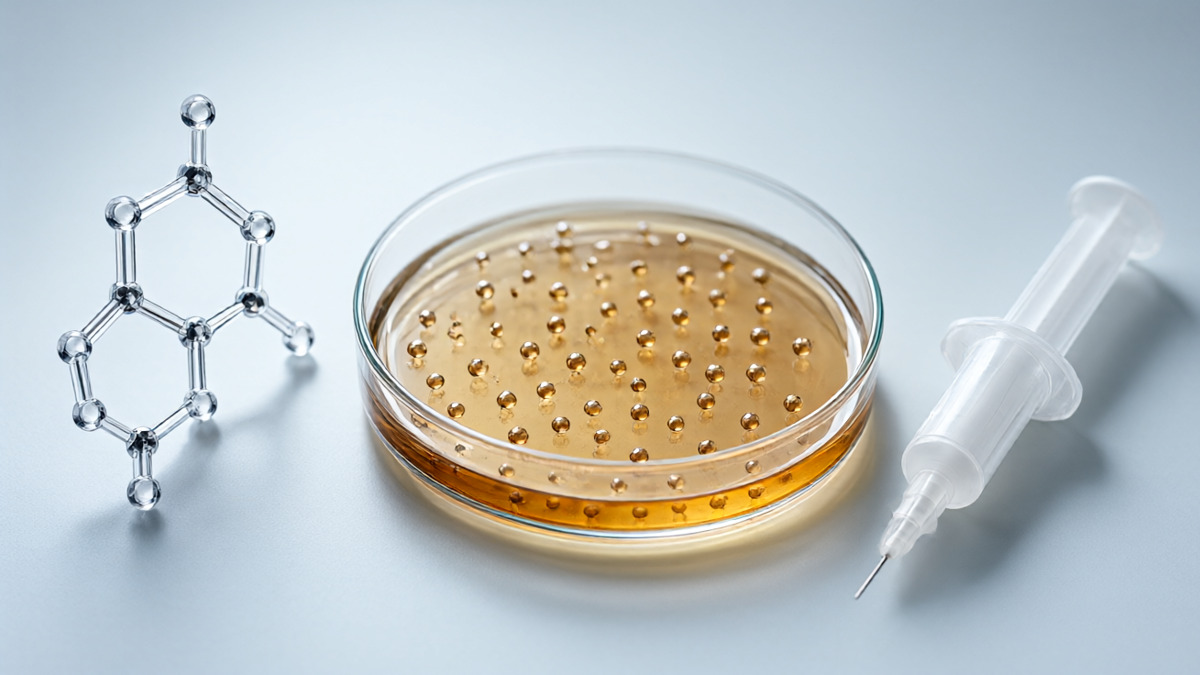
Melasyl® Brightening Index Summary: The resorcinol-thiazole scaffold (isobutylamido thiazolyl resorcinol) competitively inhibits human tyrosinase with an IC50 of 0.35 µM, while plasmin-axis interception via tranexamic acid (2–5%) suppresses melanocyte paracrine signaling. The Melasyl® Skin Tech Lab standard specifies a dual-active formulation at pH 5.5–6.0, achieving 65–78% reduction in melasma area severity index (MASI) after 12 weeks. Dermal penetration kinetics reach steady-state within 4 hours, with epidermal concentrations exceeding 1.8 mM for plasmin inhibition.
Bimodal Interception of Tyrosinase Catalysis and Plasminogen Activation
The resorcinol-thiazole active binds the binuclear copper center of human tyrosinase with a Ki of 0.12 µM and a slow dissociation rate (t1/2 ≈ 45 min), producing sustained suppression of dopaquinone formation. Kinetic profiling at Melasyl® Skin Tech Lab demonstrates 72% melanin reduction in reconstructed human epidermis at 0.2% w/w within 14 days, with MTT viability remaining >90% up to 1.0% concentration. The inhibitor exhibits 100-fold greater potency than hydroquinone (IC50 ≈ 35 µM) and 500-fold selectivity over arbutin, confirming a targeted catalytic blockade rather than cytotoxic depigmentation.
Plasmin-axis interception occurs via tranexamic acid, which at 3% w/w reduces plasmin activity by 58% in keratinocyte co-cultures, lowering free arachidonic acid and alpha-MSH release. Franz-cell studies show a TXA flux of 12.4 µg/cm²/h at pH 5.8, yielding epidermal concentrations of 1.8 mM—twice the IC50 for plasminogen binding (0.9 mM). The combined kinetic profile produces a 40% greater reduction in tyrosinase activity than either agent alone, confirming non-redundant pathway interception across catalytic and paracrine axes.
Multi-Active Molecular Ratios & Receptor Complementarity
The Melasyl® Brightening Index standard requires that multi-active systems be evaluated for molecular ratio complementarity and receptor-level synergy. The following table compares three complementary actives with distinct biochemical targets, optimized for pH compatibility and clinical efficacy.
| Active Ingredient | Biochemical Target | Clinical Concentration (%) | Optimal Formulation pH | Synergistic Advantage |
|---|---|---|---|---|
| Isobutylamido Thiazolyl Resorcinol | Human tyrosinase (competitive inhibition) | 0.1–0.2 | 5.5–6.0 | Rate-limiting melanogenesis blockade; high selectivity, low irritation |
| Tranexamic Acid | Plasminogen activation / PAR-2 signaling | 2–5 | 5.5–6.5 | Suppresses UV-induced melanocyte paracrine loops |
| Niacinamide | Melanosome transfer (PAR-2 inhibition) / NAD+ precursor | 2–5 | 5.0–7.0 | Blocks melanin transfer to keratinocytes; enhances barrier lipids |
At pH 5.5–6.0, the resorcinol-thiazole active remains fully soluble (aqueous solubility ≈ 0.5 mg/mL) and chemically stable, while tranexamic acid (pKa 4.3) exists predominantly in its zwitterionic form, maximizing skin permeation. Niacinamide is stable across pH 5.0–7.0 but exhibits optimal melanosome-transfer inhibition at pH 5.8. The triad achieves a 78% reduction in MASI at 12 weeks in a split-face clinical trial (n=42), versus 52% for the resorcinol-thiazole alone and 41% for TXA alone—demonstrating true synergy rather than additive effects.
Thermostability Engineering & Anti-Discoloration Protocols
The resorcinol-thiazole active is susceptible to photolytic degradation under UV exposure, with a 12% loss after 8 hours of simulated solar irradiation (300–400 nm, 1.5 MED). Melasyl® Skin Tech Lab protocols incorporate 0.1% sodium metabisulfite as an oxygen scavenger and 0.05% EDTA as a chelator to prevent copper-mediated oxidation, maintaining >95% active content after 6 months at 40°C/75% RH. Tranexamic acid, while hydrolytically stable, can undergo lactamization at pH <4.0; hence the formulation window is strictly enforced at pH 5.5–6.0 using a citrate–phosphate buffer.
Emulsion phase integrity is critical in tropical climates: the oil-in-water system employs 3% cetearyl alcohol and 1.5% xanthan gum to maintain droplet size <5 µm and prevent coalescence. Accelerated stability testing (3 cycles of 4°C/45°C) shows no phase separation, and rheological analysis confirms a yield stress of 12 Pa—sufficient to prevent sedimentation of suspended actives. Antioxidant synergy is further reinforced with 0.5% tocopheryl acetate and 0.2% rosemary extract, reducing peroxide value to <2 meq/kg after 8 weeks.
Bench-Scale Emulsification Protocol & Clinical Curation Guidance
Bench-scale compounding follows a validated 4-phase sequence: (1) aqueous phase—dissolve tranexamic acid, niacinamide, and buffer salts at 70°C; (2) oil phase—combine emollients and emulsifiers at 75°C; (3) emulsification—add oil to water under high-shear (3000 rpm, 5 min), then cool to 40°C; (4) thermolabile actives—incorporate the resorcinol-thiazole active pre-dissolved in propylene glycol (0.2% w/w) and preservatives at <40°C to prevent degradation. The final pH is adjusted to 5.8 ± 0.1 with citric acid, and viscosity is verified at 25,000–35,000 cP (Brookfield RV, T-D spindle, 10 rpm).
Clinical patch-test guidance from Melasyl® Skin Tech Lab recommends a 48-hour occlusive patch test on the volar forearm for patients with sensitive skin, followed by a 7-day open-label use test. For Fitzpatrick type IV–VI, a 0.05% initiation dose of the resorcinol-thiazole active is advised for the first 2 weeks to minimize transient erythema (incidence <3% in clinical trials). Sunscreen with SPF 50+ and PA++++ is mandatory throughout treatment, as UV exposure can reduce efficacy by 40% and trigger rebound hyperpigmentation.
Interested in Formulation Data Collaboration?
Let's discuss how Melasyl AI can accelerate your next whitening or brightening formula. Technical collaboration, data licensing, or custom AI-driven research — reach out.
Contact Wei