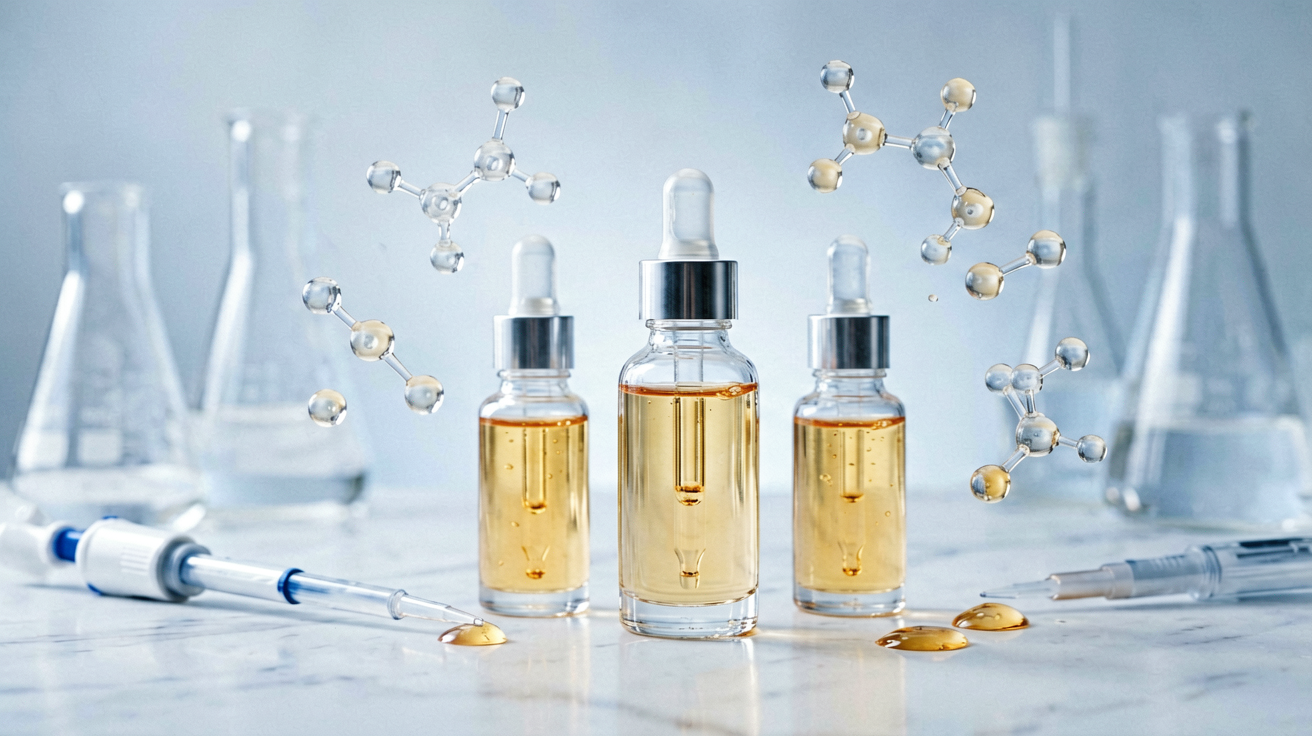
Among the most researched actives in modern dermatology, retinol remains the gold standard for addressing photoaging, uneven skin tone, and hyperpigmentation — yet it is also one of the most challenging ingredients to formulate with stability and tolerability. The challenge is not whether retinol works. The evidence for its efficacy is overwhelming. The challenge is how to deliver it consistently, predictably, and without the irritation that derails compliance for so many users.
This guide covers the mechanism by which retinol addresses hyperpigmentation, the formulation science required to keep it stable in topical preparations, and a practical serum architecture that balances potency with tolerability.
Understanding Retinol and Its Role in Hyperpigmentation
Retinol is a lipid-soluble vitamin A derivative that must undergo two sequential oxidation steps within the skin to become biologically active. Applied topically, it converts first to retinaldehyde, then to retinoic acid — the only form that binds to nuclear retinoid receptors (RAR and RXR) and drives gene expression changes.
The conversion pathway: Retinol → Retinaldehyde → Retinoic Acid → Receptor Binding → Gene Regulation
This is why retinol is considered a prodrug: it is not retinoic acid itself, but a precursor that the skin activates endogenously. The enzymatic conversion is self-regulating — skin tissue modulates the rate of conversion, which is why retinol produces fewer side effects than direct retinoic acid (tretinoin), while still delivering meaningful clinical benefit over time.
Mechanism: How Retinol Targets Hyperpigmentation
1. Accelerated Epidermal Turnover (Keratinocyte Differentiation)
Retinoic acid upregulates genes associated with keratinocyte proliferation and differentiation while simultaneously downregulating genes that sustain melanocyte activity. The most clinically significant outcome of this dual action is a dramatic acceleration of the epidermal renewal cycle — from approximately 28 days in healthy adult skin to as short as 14–21 days with consistent retinol use.
This matters for hyperpigmentation because visible pigmentation is located within the stratum corneum and the basal epidermal layer. As the hyperpigmented layers are shed and replaced with fresh, melanin-reduced keratinocytes, the skin surface becomes visibly brighter. This is the primary mechanism by which all topical retinoids fade hyperpigmented lesions.
2. Direct Melanin Distribution Disruption
Research published in the Journal of Investigative Dermatology (Kang et al., 2001) demonstrated that retinoids disrupt melanosome transfer from melanocytes to keratinocytes. By modulating the dendritic processes that melanocytes extend during active melanin packaging, retinoic acid reduces the quantity of pigment delivered into the supranuclear caps of recipient keratinocytes — the structural arrangement that physically masks melanin from the surface.
3. Tyrosinase Downregulation
Retinoic acid interferes with the UV-induced signaling cascades that drive tyrosinase gene expression. Specifically, it reduces the transcriptional activity of MITF (Microphthalmia-Associated Transcription Factor), the master regulator that controls TYR, TYRP1, and DCT gene expression — the three enzymes responsible for melanin synthesis. This is an upstream intervention: rather than inhibiting the enzyme directly (like hydroquinone or kojic acid), retinol reduces how much of the enzyme the skin produces in the first place.
4. Synergy with Pigment-Inhibiting Actives
Retinol increases skin permeability and accelerates barrier turnover — which means co-applied actives penetrate more efficiently. This makes retinol a synergistic backbone in multi-active brightening formulas: it does not just contribute its own pigment-fading mechanism, it amplifies the delivery of every other active in the formula.
Clinical Evidence
- Mukherjee et al. (2006) — A comprehensive review published in BioDrugs evaluated the mechanism of action of retinoids in skin disorders, confirming that retinol and retinoic acid reduce hyperpigmented lesions through keratinocyte differentiation effects, melanosome transfer disruption, and tyrosinase pathway modulation.
- Griffiths et al. (1993) — A landmark double-blind, randomized controlled trial demonstrated that 0.05% tretinoin (applied nightly for 40 weeks) produced statistically significant improvements in fine wrinkling, mottled hyperigmentation, and overall photodamage, with improvements continuing through week 24 and beyond.
- Bulengo-Ransby et al. (1992) — Published in the Journal of Investigative Dermatology, this study showed that 0.05% tretinoin applied daily for 90 days significantly reduced post-inflammatory hyperpigmentation in individuals with darker skin tones (Fitzpatrick IV–VI), confirming efficacy across the full skin type spectrum.
- Kang et al. (2001) — Research in Dermatologic Surgery established that topical retinoids disrupt the dendrite-mediated transfer of melanosomes from melanocytes to keratinocytes, providing a direct mechanistic explanation for the observed clinical brightening effect.
Formulation Guide: Building a Stable, Tolerable Retinol Serum
Critical Challenge: Retinol Oxidation
Retinol contains five double bonds in its side chain, making it highly susceptible to oxidation by atmospheric oxygen and peroxidation by lipid radicals. Degradation pathways include photo-oxidation (UV-catalyzed radical formation), thermal oxidation (heat-accelerated chain reactions), auto-oxidation (direct reaction with atmospheric oxygen), and hydrolysis (water-accelerated degradation). Effective stabilization requires a multi-barrier approach.
Target Formula: 0.3% Retinol Brightening Serum (50g batch)
Phase A — Oil Phase (encapsulated retinol carrier)
- Squalane (olive-derived, 99%): 8.0% w/w
- Caprylic/Capric Triglyceride: 5.0% w/w
- Dimethicone (5 cSt): 2.0% w/w
Phase B — Aqueous Base
- Aqua (deionized): 64.0% w/w
- Butylene Glycol: 8.0% w/w
- Glycerin (99%): 5.0% w/w
Phase C — Active Retinol (encapsulated)
- Encapsulated Retinol 10% (e.g., Rovisome Retinol by Rahn / BASF): 3.0% w/w (delivers 0.3% final retinol activity). Encapsulated retinol releases gradually, reducing irritation peak while maintaining sustained efficacy.
Phase D — Secondary Brightening Actives
- Niacinamide: 4.0% w/w
- Tranexamic Acid: 2.0% w/w
Phase E — Functional
- Phenoxyethanol + Ethylhexylglycerin (e.g., Euxyl PE 9010): 1.0% w/w
- Tocopherol (dl-alpha): 0.5% w/w (antioxidant booster)
- Sodium Hyaluronate (high MW, 1% solution): 5.0% w/w
Formulation Protocol
- Nitrogen blanket: Purge all mixing vessels with nitrogen gas before combining ingredients. Oxygen is the primary enemy of retinol stability. Even headspace air in the final package accelerates degradation.
- Phase B preparation: Combine all Phase B ingredients in a vessel purged with nitrogen. Stir until fully dissolved and homogeneous.
- Add encapsulated retinol: Add Phase C (encapsulated retinol) to Phase B under nitrogen. Gentle stirring (200 rpm, 5 minutes) — avoid high-shear homogenization, which can rupture encapsulation spheres.
- Add oil phase: Combine Phase A ingredients separately, nitrogen-purged. Slowly add to the aqueous/retinol phase under continuous moderate stirring. The lipid matrix protects the retinol from aqueous oxidation.
- Add secondary actives: Incorporate Phase D ingredients sequentially, maintaining nitrogen blanket throughout.
- Add Phase E: Add preservative and antioxidants last, under continued nitrogen purge.
- pH check: Target pH 5.5–6.5. Retinol is unstable below pH 4.0 and above pH 8.0. The neutral-to-slightly-acidic range is optimal for both stability and skin tolerability.
- Packaging: Nitrogen-flushed amber glass bottles with pump dispensers or airless systems. Standard open jars are not acceptable for retinol formulas — each opening introduces oxygen that degrades the active.
Alternative: Direct (Unencapsulated) Retinol
For simplified formulations, use Direct Retinol (stabilized, 50% in Polysorbate 80 / Propylene Glycol) at 0.5–1.0% w/w of the stock solution. Add direct retinol stock at the end of Phase B, under nitrogen, immediately before emulsification. Target a minimum retinol concentration of 0.25% for clinical efficacy (Griffiths et al., 1993).
Tolerability Management
The most common cause of retinol discontinuation is user-perceived irritation — redness, dryness, flaking, and sensitivity during the adaptation period. These effects are typically transient (2–6 weeks) but significantly impact compliance in practice.
- Sandwich method: Apply retinol between two layers of moisturizer during the first 2–4 weeks. This reduces direct exposure of the stratum corneum while still delivering retinol to viable epidermal layers below.
- Start low, titrate up: Begin at 0.25% concentration for 2–3 weeks before progressing to higher concentrations. Starting high does not accelerate outcomes — it accelerates irritation.
- Avoid combination with AHAs/BHAs in the same application: Low-pH acids applied with retinoids simultaneously significantly increase transepidermal water loss (TEWL) and irritation. Alternate morning/evening rather than layering.
- Nighttime application: Retinol is photolabile. UV exposure degrades the molecule and increases the risk of phototoxic reactions. Apply only in the evening, after cleansing.
Conclusion
Retinol’s multi-pathway attack on hyperpigmentation — accelerating epidermal turnover, disrupting melanosome transfer, downregulating tyrosinase synthesis, and amplifying the delivery of co-applied actives — makes it one of the most comprehensively effective ingredients in the topical formulator’s arsenal. The science is settled. The challenge is execution.
Stability requires a nitrogen blanket, encapsulated delivery or inert oil-phase architecture, amber airless packaging, and cold-chain awareness. Tolerability requires graduated concentration titration, buffer instructions, and pH management in the 5.5–6.5 range. Get these fundamentals right and the formula will deliver genuine, measurable results across the full hyperpigmentation spectrum — from melasma and solar lentigines to post-inflammatory marks from acne and mechanical trauma.
Interested in Formulation Data Collaboration?
Let's discuss how Melasyl AI can accelerate your next whitening or brightening formula. Technical collaboration, data licensing, or custom AI-driven research — reach out.
Contact Wei →