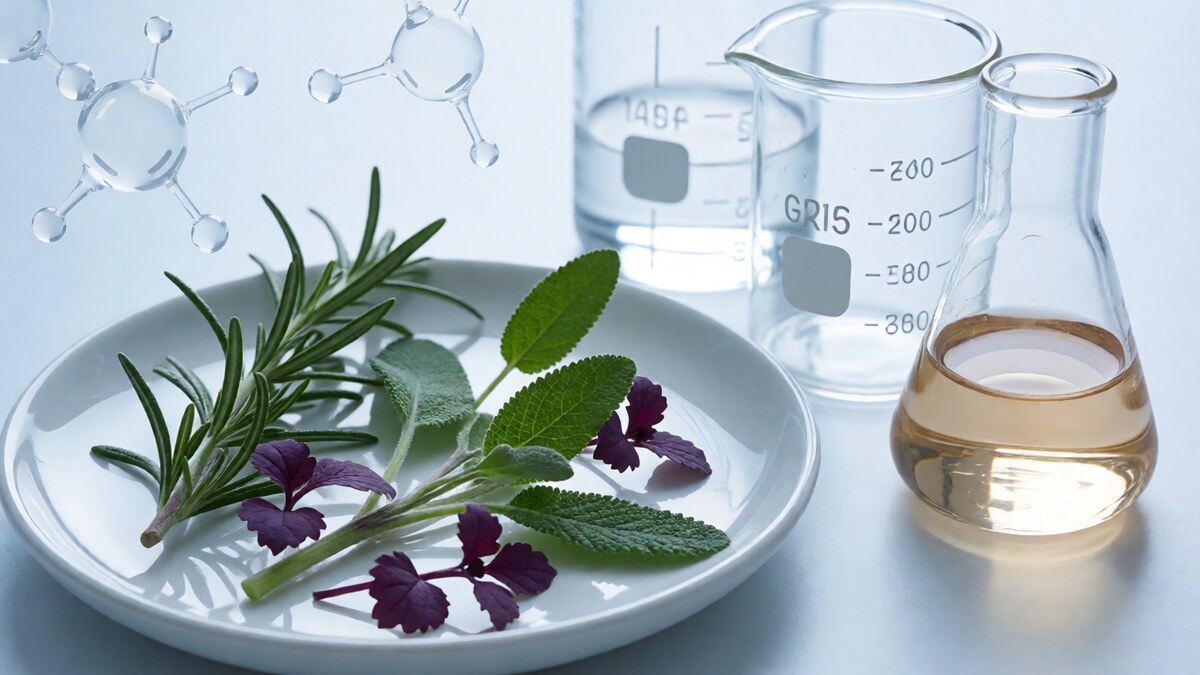
Rosmarinic acid is the rare brightening candidate whose own literature disagrees with itself — and that disagreement is exactly why it deserves a closer look. This caffeic acid ester, the signature polyphenol of rosemary, sage, lemon balm and perilla, has been reported both to stimulate and to suppress melanin synthesis depending on concentration and model. In 2026 that is no longer a contradiction to be embarrassed about; it is a dose-dependent switch that formulators can learn to steer. This article examines the chemistry, the biphasic mechanism, the tyrosinase and MITF data, and how to position rosmarinic acid in a pigmentation platform.
1. What Rosmarinic Acid Actually Is
Rosmarinic acid (RA, C18H16O8, MW 360.31) is an ester of caffeic acid and 3,4-dihydroxyphenyllactic acid. Structurally it is a caffeoyl ester — effectively two catechol-bearing phenolic arms joined by an ester bridge. That dual-catechol architecture underpins three behaviours that matter for skin: broad free-radical scavenging, iron/copper coordination, and the ability to engage the dinuclear copper active site of tyrosinase.
It is water-soluble and reasonably pH-stable across the cosmetic range (roughly pH 3–8), which makes it far easier to formulate than lipophilic actives such as bakuchiol or piceatannol. Commercial material is supplied as purified rosmarinic acid (commonly 50% or 98% HPLC) or as standardized Melissa officinalis / Rosmarinus officinalis extracts. Always specify by rosmarinic acid content, not by plant ratio.
2. The Biphasic Melanogenesis Story
The confusion in the older literature is real and worth understanding, because it dictates use level.
2.1 Low concentration: pro-melanogenic
In the landmark 2007 study by Lee and colleagues (Biochemical Pharmacology, PMID 17651699), rosmarinic acid increased melanin content and tyrosinase protein in B16 melanoma cells in a concentration-dependent manner. The mechanism was traced to PKA/CREB signalling: RA phosphorylated CREB and activated the cAMP response element without raising cAMP itself, meaning it acted downstream of cAMP production to upregulate MITF and its tyrosinase target. A parallel Brazilian study (Revista Brasileira de Farmacognosia, 2013) confirmed the same dual behaviour — RA raised melanin biosynthesis at low concentrations (around 10 µM) and lowered it at higher levels.
2.2 High concentration: anti-melanogenic
At higher concentrations the balance flips. Direct enzyme inhibition and antioxidant pressure dominate, and net melanin output falls. This biphasic curve is the single most important formulation fact about rosmarinic acid: there is a threshold below which it may do the opposite of what a brightening brief intends.
3. Mechanism: Enzyme, Transcription and Barrier
3.1 Direct human tyrosinase inhibition
A 2025 structure-based repurposing study screened FDA-approved drugs and active agents against tyrosinase and found rosmarinic acid among the most potent hits, inhibiting human tyrosinase with an IC50 of 7.8 ± 0.4 µM (ferulic acid: 9.3 ± 0.5 µM). Enzyme kinetics indicated competitive inhibition, and molecular dynamics simulations showed a stable binding mode with persistent coordination inside the enzyme’s dicopper active site. Cellular anti-melanogenic effects in α-MSH-stimulated B16F10 cells followed at higher cellular IC50 values (37.8–108.1 µM), a useful reminder that cell penetration, not enzyme affinity, often limits real-world potency.
3.2 Downstream gene suppression
Work on rosmarinic-acid-rich extracts has repeatedly shown suppression of the full melanogenic cassette. In a 2024 study in the International Journal of Molecular Sciences, rosmarinic acid docked to tyrosinase (PDB 2Y9X) at residues HIS263, VAL283, SER282 and MET280 with the strongest binding energy of the panel, and treatment reduced mRNA for MITF, TYR, TRP-1 and DCT to levels comparable with arbutin and kojic acid. So RA acts at two nodes: it competes at the enzyme and it dials down the transcription factor that builds the enzyme in the first place.
3.3 Barrier acidification and photoprotection
A 2022 study identified a second, non-pigment mechanism: rosmarinic acid activates the sodium–proton exchanger NHE1, acidifying the stratum corneum interface and supporting ceramide processing and barrier cohesion. In 3D skin models, creams containing 0.05% and 0.1% RA upregulated NHE1 in a concentration- and time-dependent way. Separately, UVB studies in HaCaT keratinocytes show RA reduces intracellular ROS and engages the AKT/ERK–Nrf2–GSH antioxidant axis. For melasma — where a compromised barrier and chronic oxidative stress both drive relapse — this is a genuine adjunct benefit.
4. Clinical Evidence
Honest summary: rosmarinic acid has strong mechanistic and in-vitro data, moderate human data, and no large pigmentation-specific RCT yet.
- Human anti-inflammatory trial: a topical 0.3% rosmarinic acid emulsion applied twice daily for 8 weeks significantly reduced erythema, SCORAD, pruritus and transepidermal water loss in atopic dermatitis patients, with no adverse patch-test reactions. This is the most robust human dataset and directly supports the barrier/anti-inflammatory positioning.
- Reconstructed skin: published work confirms antioxidant and tyrosinase-inhibitory activity with good biocompatibility in reconstructed skin models.
- Keratinocyte protection: RA protects human keratinocytes from particulate-matter-induced apoptosis, relevant to pollution-driven PIH in urban Southeast Asian markets.
The evidence gap is a controlled melasma or PIH trial with a pigment endpoint. Until that exists, RA is best framed as a multi-target supportive active, not a standalone hydroquinone substitute.
5. Formulation Science
- Respect the threshold: formulate at or above the concentration where anti-melanogenic behaviour dominates. In practice this means 0.2–1% purified rosmarinic acid in a brightening serum, or 0.3%+ for barrier/anti-inflammatory positioning. Do not use trace levels and expect depigmentation.
- Water phase, cool down: RA is water-soluble and heat-sensitive. Add below 40°C. It needs no solubiliser, so it suits toners, essences and aqueous serums.
- pH and chelation: stable pH 3–8; keep the finished formula mildly acidic (pH 4.5–6) and include 0.02–0.05% disodium EDTA to prevent metal-catalysed oxidation.
- Antioxidant pairing: combine with tocopherol, ferulic acid or a small ascorbate fraction. RA also helps stabilise other labile actives in the same formula.
- Packaging: light- and oxygen-sensitive — use opaque or airless packaging and add an inert headspace where possible.
- Compatibility: excellent with niacinamide, tranexamic acid, alpha-arbutin, azelaic acid and panthenol. Avoid strongly alkaline systems and unchelated transition metals.
6. Where It Fits
Rosmarinic acid is not the strongest single-target tyrosinase inhibitor in the toolbox — that crown belongs to resorcinol derivatives and thiamidol. Its value is breadth and tolerability: a competitive human-tyrosinase inhibitor that also suppresses MITF-driven enzyme transcription, calms oxidative and inflammatory signalling, and repairs barrier pH. For a Southeast Asian brightening platform where barrier compromise and post-inflammatory pigmentation are the dominant clinical picture, that combination is unusually well matched. The catch is dose discipline: below threshold, this molecule can push pigment the wrong way. Above it, it is a credible, water-soluble, gentle multi-pathway partner.
References
- Lee J, Kim YS, Park D. “Rosmarinic acid induces melanogenesis through protein kinase A activation signaling.” Biochemical Pharmacology. 2007;74(7):960–968. PMID 17651699.
- Oliveira KB, et al. “Influence of rosmarinic acid and Salvia officinalis extracts on melanogenesis of B16F10 cells.” Revista Brasileira de Farmacognosia. 2013;23(2):249–258.
- Drug repurposing for skin pigmentation disorders: discovery of novel tyrosinase inhibitors. Structure-based screening; human tyrosinase IC50 for rosmarinic acid 7.8 ± 0.4 µM. 2025.
- Valorization of Hom Thong banana peel as an anti-melanogenic agent: rosmarinic acid docking and MITF/TYR/TRP-1/DCT suppression. International Journal of Molecular Sciences. 2024;25(23):13202.
- Rosmarinic acid activates NHE1 to acidify the stratum corneum and improve barrier function. International Journal of Molecular Sciences. 2022.
- Rosmarinic acid protects human keratinocytes from UVB-induced oxidative stress via AKT/ERK–Nrf2–GSH signalling. Biomolecules & Therapeutics. 2024.
- Topical 0.3% rosmarinic acid emulsion in atopic dermatitis: 8-week human clinical study (erythema, SCORAD, pruritus, TEWL).
- Rosmarinic acid protects skin keratinocytes from particulate matter 2.5-induced apoptosis.
Interested in Formulation Data Collaboration?
Let's discuss how Melasyl AI can accelerate your next whitening or brightening formula. Technical collaboration, data licensing, or custom AI-driven research — reach out.
Contact Wei →