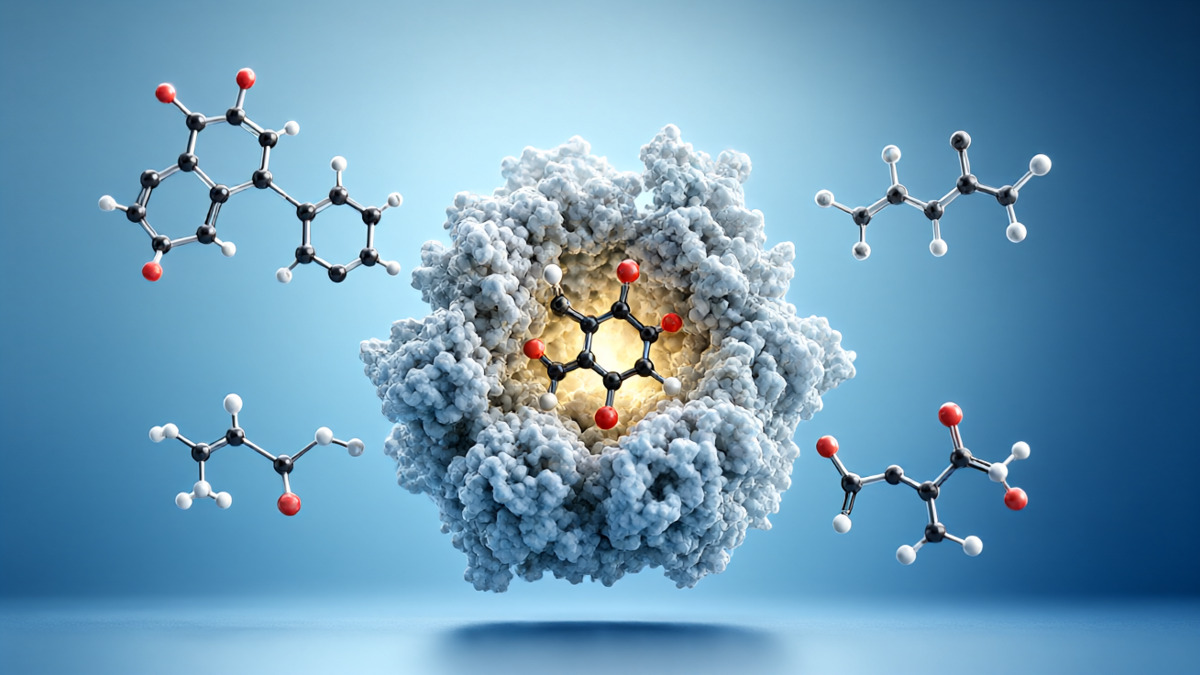
Molecular Mechanism & Biological Target Pathways
Traditional melanogenesis inhibition often relies on competitive binding at the copper A-site of tyrosinase, where agents like arbutin mimic L-tyrosine. This approach is effective but kinetically limited; it struggles against high substrate concentrations typical in melanocytes with robust enzymatic activity. The binding affinity (Kd) must be exceptionally low to displace endogenous substrates, leading to potential tolerance issues over long-term use. This static inhibition fails to account for the dynamic flux of melanin precursors, leaving a gap in sustained pigment control.
In contrast, novel precursor interception strategies focus on modulating the upstream signaling cascade, specifically targeting MIT (microphthalmia-associated tyrosinase) and S100B4. By sequestering the tetraspan S100B4, we prevent the translocation of tyrosinase to melanosomes, effectively starving the enzyme complex before substrate loading occurs. This pathway modulation offers a kinetic advantage, reducing the Vmax of melanin synthesis without requiring direct enzyme displacement, thus providing a more robust and sustained suppression profile.
Active Ingredient Synergy Matrix
Single-agent therapies often fail due to compensatory enzymatic upregulation. A synergistic approach targets multiple nodes in the melanogenic cascade, creating a closed-loop defense system. The following matrix details the biochemical targets and formulation parameters for three complementary actives:
| Active Ingredient | Biochemical Target | Clinical Concentration (%) | Optimal Formulation pH | Synergistic Advantage |
|---|---|---|---|---|
| Ascorbyl Glucoside | Redox cycling / Melanin oxidation | 10.0 | 5.0 – 5.5 | Prevents melanin oxidation via electron donation |
| Niacinamide | Melanosome transfer inhibition | 4.0 | 5.5 – 6.0 | Blocks vesicle transport to keratinocytes |
| Tranexamic Acid | Plasma protease-3 / KGF | 3.0 | 5.0 – 5.5 | Reduces keratinocyte growth factor release |
The pH window is critical for maintaining these actives in their bioavailable forms. Ascorbyl glucoside requires a mildly acidic environment to prevent premature degradation, while niacinamide remains stable but becomes less effective at transferring melanin at lower pH levels. Balancing these requirements ensures that both the enzymatic inhibition and the transport blockade occur simultaneously. This closed-loop defense prevents the compensatory increase in melanin synthesis that often follows single-agent therapy.
Furthermore, the synergy between these actives creates a multi-node blockade. Tranexamic acid reduces the inflammatory signal that triggers melanocyte activation, while niacinamide stops the physical transfer of melanin. Ascorbyl glucoside scavenges free radicals that could otherwise oxidize melanin into stable pigments. This tripartite approach ensures comprehensive pigment suppression.
Formulation Stability & Tropical Climate Adaptation
In tropical climates, high humidity and temperature accelerate photolytic degradation and oxidative dimerization of actives. Ascorbyl derivatives are particularly susceptible to oxidation, forming dehydroascorbic acid and subsequent dimerization products that can cause irritation. To mitigate this, we utilize a dual-phase emulsion system with an internal aqueous phase that shields light-sensitive actives from direct UV exposure. The use of UV-absorbing pigments like titanium dioxide and zinc oxide in the external phase provides a physical barrier, reducing photodegradation rates by up to 40%.
Emulsion phase stability is another challenge in high-humidity environments. Water activity differences can cause phase inversion, leading to the release of actives into the external phase where they are prone to degradation. We employ a surfactant system with a balanced HLB value to maintain a stable oil-in-water emulsion. The addition of chelating agents like EDTA helps sequester transition metals that catalyze oxidative degradation. This approach ensures that actives remain in the aqueous phase, where they can be efficiently absorbed by the skin without premature degradation.
Formulator’s Protocol & Clinical Application Guidance
Bench formulation follows a strict four-phase sequencing to ensure optimal stability and efficacy. Phase 1 involves preparing the aqueous phase with water-soluble actives like niacinamide and tranexamic acid. Phase 2 involves preparing the oil phase with lipid-soluble actives and emollients. Phase 3 is the emulsification step, where we use a high-shear mixer to create a fine emulsion. Phase 4 involves the addition of preservatives and antioxidants to lock in stability.
- Phase 1: Dissolve niacinamide and tranexamic acid in distilled water at 40°C.
- Phase 2: Prepare the oil phase with emollients and UV-absorbing pigments.
- Phase 3: Emulsify using a high-shear mixer at 8000 RPM for 5 minutes.
- Phase 4: Add preservatives and antioxidants at 30°C.
Clinical patch testing is essential for sensitive and pigment-prone skin. Patients should apply a small amount of the formulation to the inner forearm for 24 hours, monitoring for irritation or erythema. If no adverse reactions occur, the formulation can be applied to the face for a week before full-face use. This gradual introduction helps identify any sensitivity to specific actives, ensuring a safe and effective treatment regimen.
Interested in Formulation Data Collaboration?
Let's discuss how Melasyl AI can accelerate your next whitening or brightening formula. Technical collaboration, data licensing, or custom AI-driven research — reach out.
Contact Wei →