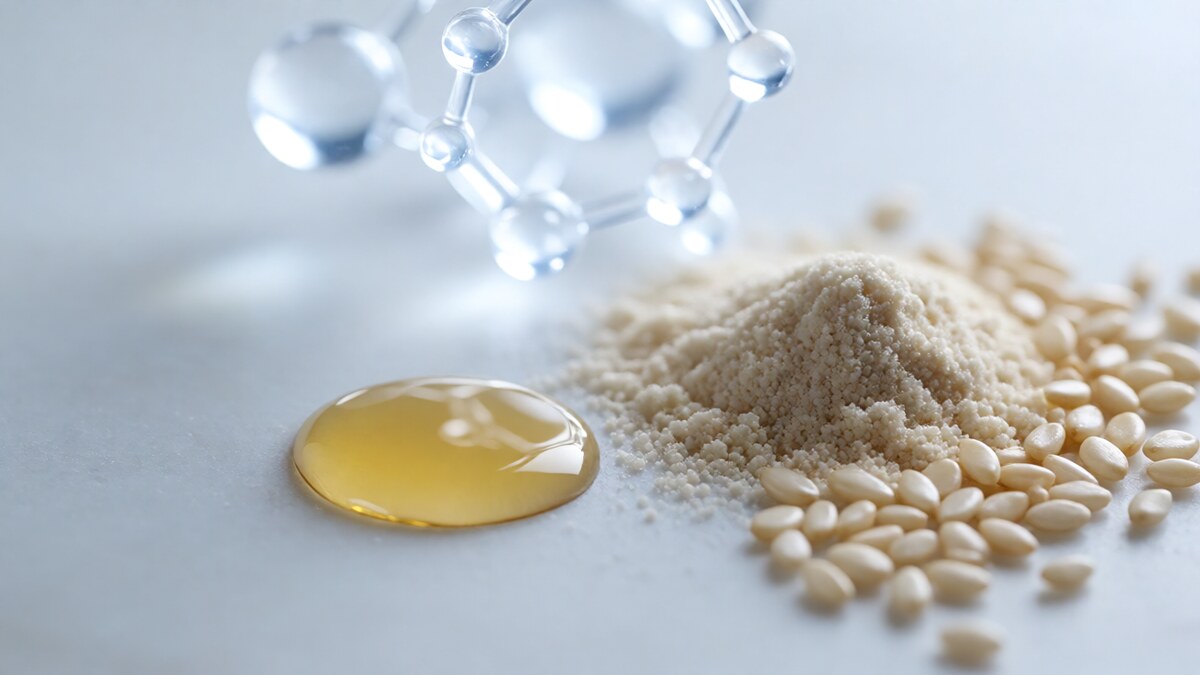
Why a Sesame-Seed Antioxidant Is Being Re-Examined as a Brightening Active
Sesamol (3,4-methylenedioxyphenol, C7H6O3, MW 138.12) is the phenolic fragment that forms when sesame lignans such as sesamin and sesamolin degrade during oil extraction and heating. It is best known as the reason sesame oil resists rancidity, and it sits on permitted cosmetic-ingredient lists as a natural antioxidant. What has changed the conversation is a run of studies showing that the same molecule is a genuinely potent tyrosinase inhibitor — in some assays an order of magnitude stronger than the reference standards the industry still benchmarks against. For formulators building brightening lines for melanin-rich skin in Southeast Asia, that combination — antioxidant and antimelanogenic activity in one small, inexpensive molecule — is worth a careful look.
The Direct Mechanism: Two-Stage Tyrosinase Inhibition
Melanin synthesis begins with the copper-dependent enzyme tyrosinase, which hydroxylates L-tyrosine to L-DOPA (monophenolase activity) and then oxidises L-DOPA to dopaquinone (diphenolase activity). Sesamol interferes with both steps, and the kinetics are unusual: it behaves as a competitive inhibitor of the monophenolase step and a non-competitive inhibitor of the diphenolase step — a two-stage blockade rather than the single-point inhibition typical of kojic acid.
The potency numbers are the headline. In a mushroom-tyrosinase assay reported by Srisayam and colleagues, sesamol returned an IC50 of 1.6 µM — roughly 42-fold more potent than kojic acid (IC50 67.6 µM), while β-arbutin showed no meaningful inhibition even at 1000 µg/mL. Baek and Lee, working in melan-a melanocytes, measured a tyrosinase IC50 of 6.7 µM against arbutin’s 416.6 µM, and a cellular tyrosinase IC50 of 97 µM. Crucially, sesamol is not a copper chelator; it inhibits the enzyme through its phenolic chemistry rather than by stripping the active-site copper, which distinguishes it mechanistically from kojic acid and arbutin.
The Transcriptional Mechanism: MITF, cAMP and the MAPK Brake
Direct enzyme inhibition is only half the story. In α-MSH-stimulated B16F10 cells, sesamol suppressed the entire melanogenic programme: MC1R, MITF, tyrosinase and TRP-1 protein levels all fell (Wu et al., 2018). The upstream explanation is that sesamol lowers intracellular cAMP, blunting the cAMP/PKA signal that normally drives MITF transcription, while simultaneously increasing phosphorylation of ERK, Akt and GSK3β — the kinases that mark MITF for degradation. Baek and Lee reported the same p38 and JNK activation in melan-a cells, with sesamol at 50 µM suppressing tyrosinase, TRP-1 and TRP-2 protein expression by 65.8%, 56.4% and 75.7% respectively. In plain terms: sesamol turns down the master switch, not just the downstream enzyme.
What the In Vivo Data Show
The strongest animal evidence comes from You et al. (2019). Topical sesamol applied to C57BL/6 mouse skin for four weeks significantly reduced UVB-induced hyperpigmentation, lowered the melanin index and melanin content, and raised skin brightness (L* value). Histology showed reduced epidermal hyperplasia and less collagen degradation in the dermis — meaning sesamol acted as both a depigmenting and a photoprotective agent in the same model. An earlier mouse study (Sharma & Kaur, 2006) had already reported that a topical sesamol formulation prevented chronic UV photodamage. Sesamol’s UVB absorbance around 290 nm adds a modest sunscreen-function argument to the brightening case.
| Parameter | Sesamol | Kojic acid | β-Arbutin |
|---|---|---|---|
| Mushroom tyrosinase IC50 | 1.6 µM | 67.6 µM | No inhibition ≤3673 µM |
| Inhibition type | Competitive + non-competitive (two-stage) | Competitive (copper chelation) | Intracellular conversion |
| MITF / transcription | Down-regulates MITF, MC1R | Minimal | Minimal |
| In-vivo hyperpigmentation | Reduced (mouse, 4 wk) | Limited | Limited |
| Primary limitation | Fast skin flux; photosensitive | Cytotoxicity; stability | Weak direct potency |
The Formulation Catch: Fast Flux, Short Residence
Sesamol’s weakness is the flip side of its chemistry. At MW 138 with a water solubility of roughly 38.8 mg/mL and a log P of 1.29, it partitions easily into the stratum corneum — and just as easily out the other side into systemic circulation. Geetha et al. documented significant flux across mouse skin, which caps how much active stays where the melanocytes actually sit, in the basal epidermis. The established fix is lipid encapsulation: sesamol-loaded solid lipid nanoparticles (127.9 nm, 88.2% entrapment efficiency) applied in a cream base showed markedly higher skin retention and minimal systemic flux. A 2016 nanostructured lipid-carrier study in excised human skin and a 2024 design-of-experiments study in Cosmetics reached the same conclusion — encapsulation slows permeation and keeps sesamol in the skin, which is exactly what a cosmetic wants.
Practical formulation notes: sesamol is photosensitive and prone to oxidative reddening, so it belongs in opaque, airless packaging with a chelator and ideally a co-antioxidant (vitamin C or E). It is stable and effective at pH 4–6.5 and degrades quickly above pH 7, so keep it in acidic systems. Cosmetic use ranges from about 0.02% to 1%, with roughly 0.1% a sensible efficacy target; the CIR panel has assessed it safe up to 1% in skincare.
Honest Caveats
Almost all of the mechanistic evidence is in vitro or animal. Human randomised trials with sesamol as a single brightening active remain scarce, and the ingredient is far better studied as a food antioxidant than as a cosmetic one. Sensitisation risk is moderate, and its photosensitivity means patch testing and careful packaging are non-negotiable. Positioned as a supporting active alongside better-validated actives — not as a standalone hero — sesamol is a rational, low-cost addition to a brightening formula.
The Bottom Line
Sesamol is a rare case of a cheap, food-grade antioxidant that also does real work on melanogenesis: inhibiting tyrosinase at both stages, suppressing MITF transcription, and reducing UVB-induced pigmentation in vivo. Its limitation is delivery, not potency, and lipid-nanoparticle encapsulation resolves it. For brightening formulations targeting Southeast Asian skin, it is a credible multi-pathway ingredient that pairs naturally with niacinamide, tranexamic acid or vitamin C.
Key References
- Baek SH, Lee SH. Sesamol decreases melanin biosynthesis in melanocyte cells and zebrafish: possible involvement of MITF via the intracellular cAMP and p38/JNK signalling pathways. Exp Dermatol. 2015;24(10):761–766. doi:10.1111/exd.12765.
- Srisayam M, Weerapreeyakul N, Kanokmedhakul K. Antioxidant, antimelanogenic, and skin-protective effect of sesamol. J Cosmet Sci. 2014;65(2):69–79.
- Srisayam M, et al. Inhibition of two stages of melanin synthesis by sesamol, sesamin and sesamolin. Asian Pac J Trop Biomed. 2017;7(10):886–895. doi:10.1016/j.apjtb.2017.09.013.
- Wu PY, et al. Sesamol inhibited melanogenesis by regulating melanin-related signal transduction in B16F10 cells. Int J Mol Sci. 2018;19(4):1108. doi:10.3390/ijms19041108.
- You YJ, et al. Sesamol inhibited ultraviolet radiation-induced hyperpigmentation and damage in C57BL/6 mouse skin. Antioxidants (Basel). 2019;8(7):207. doi:10.3390/antiox8070207.
- Geetha T, et al. Sesamol-loaded solid lipid nanoparticles for treatment of skin cancer. J Drug Target. 2015;23(2):159–169. doi:10.3109/1061186X.2014.965717.
- Puglia C, et al. Nanostructured lipid carriers as vehicles for topical administration of sesamol: in vitro percutaneous absorption. Drug Res (Stuttg). 2016. doi:10.1055/s-0042-105293.
- Optimization of solid lipid nanoparticle formulation for cosmetic application (Part II): physical characterization and in vitro skin permeation for sesamol. Cosmetics. 2024;11(4):120. doi:10.3390/cosmetics11040120.
Interested in Formulation Data Collaboration?
Let's discuss how Melasyl AI can accelerate your next whitening or brightening formula. Technical collaboration, data licensing, or custom AI-driven research — reach out.
Contact Wei →