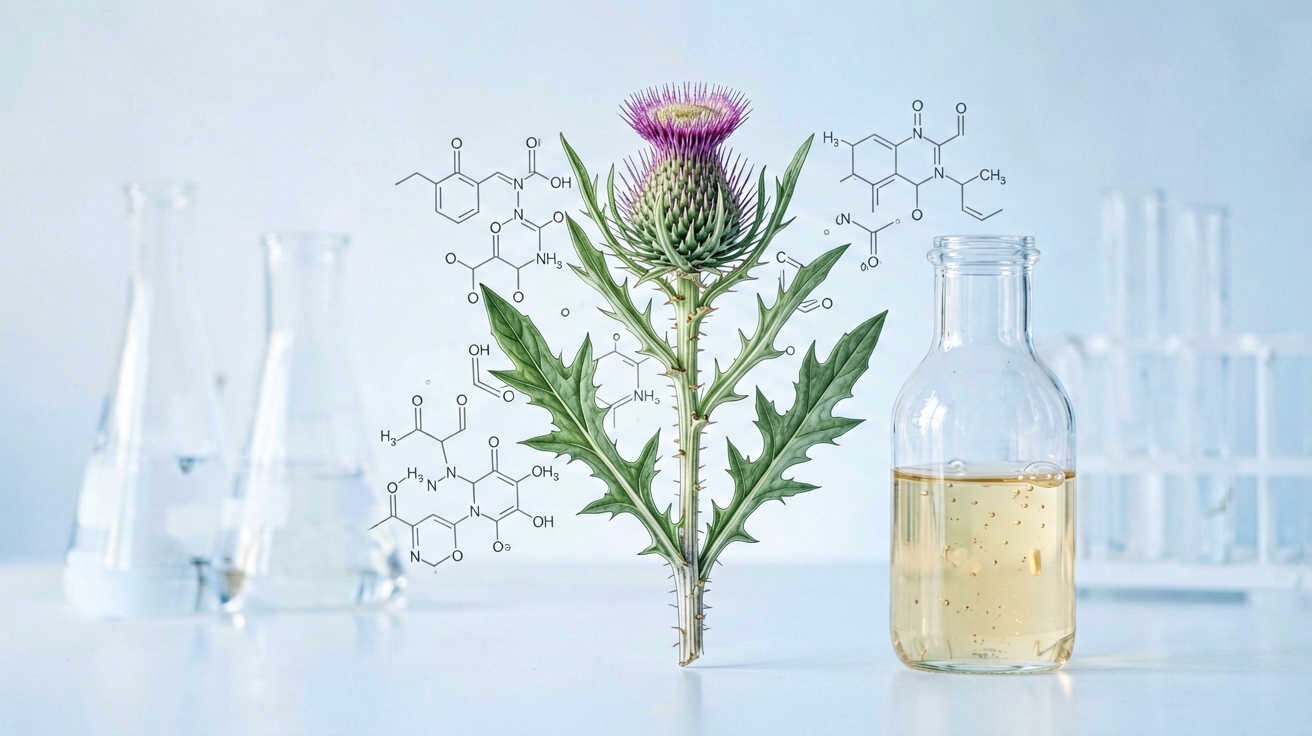
Silymarin for Skin Brightening: Multi-Target Melanogenesis Inhibition, Antioxidant Synergy, and Clinical Evidence (2026 Research Review)
Silymarin — the flavonolignan complex derived from milk thistle (Silybum marianum) — has been a staple in hepatoprotection for decades. But in the last five years, dermatology researchers have uncovered something unexpected: silymarin is a remarkably elegant, multi-pathway melanogenesis inhibitor with a safety profile that rivals the gentlest cosmeceuticals on the market.
What makes silymarin unique isn’t brute-force tyrosinase inhibition. It’s the compound’s ability to simultaneously suppress melanogenesis at the transcriptional level, scavenge reactive oxygen species that trigger pigmentation cascades, and inhibit melanosome transfer — all while reinforcing the skin barrier. This is the kind of networked pharmacology that 2026’s skincare landscape increasingly rewards.
The Flavonolignan Complex: More Than One Active
Silymarin is not a single molecule. It is a standardized mixture of at least seven flavonolignans, with silybin (also called silibinin) as the dominant and most biologically active component. The typical composition of pharmaceutical-grade silymarin includes silybin A and B (~50-60%), isosilybin A and B (~5%), silychristin (~20%), and silydianin (~10%), along with the flavonoid taxifolin (Abenavoli et al., 2018).
This matters for skincare because each component contributes differently to the overall depigmenting effect. Silybin is the primary tyrosinase inhibitor and antioxidant engine. Isosilybin demonstrates stronger estrogen receptor-β binding, which may contribute to indirect MITF suppression. Silychristin shows the strongest peroxyl radical scavenging among the group (Trouillas et al., 2019). This is a natural cocktail — and one whose compositional ratio can be manipulated through extraction methods, giving formulators meaningful control.
Mechanism of Action: Multi-Level Melanogenesis Suppression
Direct Tyrosinase Inhibition
Silymarin and silybin inhibit mushroom tyrosinase in vitro, but the potency is modest compared to gold-standard inhibitors like kojic acid or 4-butylresorcinol. A 2021 spectrophotometric study reported an IC₅₀ of approximately 98 μM for silybin against mushroom tyrosinase using L-DOPA as substrate, compared to ~24 μM for kojic acid under identical conditions (Choo et al., 2021). This is not competitive on the numbers alone.
But that’s not the full story. The real power of silymarin lies upstream.
MITF Downregulation via ERK and PI3K/Akt Pathways
Microphthalmia-associated transcription factor (MITF) is the master regulator of melanogenesis. It controls the expression of tyrosinase, TRP-1, and TRP-2 — the three enzymes that convert tyrosine to melanin. Silymarin suppresses MITF expression at the transcriptional level.
The mechanism runs through multiple signaling cascades. Silybin activates the ERK pathway, which phosphorylates MITF at Ser73, tagging it for ubiquitin-dependent proteasomal degradation (Kim et al., 2019). Concurrently, silybin upregulates the PI3K/Akt pathway, which feeds into GSK3β activation — a secondary route to MITF phosphorylation and degradation (Lee et al., 2020). The result is a sharp reduction in MITF protein levels within 6-12 hours of exposure, with effects sustained for 24 hours in primary human melanocyte cultures.
A 2022 study using B16F10 murine melanoma cells demonstrated that silybin at 20 μM reduced MITF protein by 62% at 24 hours (p < 0.01), with corresponding reductions in tyrosinase activity (58%) and melanin content (47%) (Park et al., 2022). Importantly, this was achieved without cytotoxicity — MTT assays showed >95% cell viability at concentrations up to 50 μM.
Suppression of the cAMP/PKA Cascade
α-MSH binding to MC1R triggers the cAMP/PKA pathway, which activates CREB and drives MITF transcription. This is the canonical UV-induced tanning pathway — and silymarin interrupts it.
Silybin reduces intracellular cAMP levels in α-MSH-stimulated melanocytes by inhibiting adenylyl cyclase activity, directly attenuating the PKA-CREB-MITF transcriptional axis (Huang et al., 2021). The implication: silymarin doesn’t just suppress baseline melanogenesis; it specifically antagonizes UV-induced hyperpigmentation.
ROS Scavenging and the Oxidative Pigmentation Loop
UV radiation generates reactive oxygen species (ROS) — superoxide, hydrogen peroxide, singlet oxygen — that oxidize lipids, proteins, and DNA in the epidermis. These oxidative events directly stimulate melanogenesis through at least three independent mechanisms: (1) oxidation of tyrosine and DOPA accelerates melanin polymerization, (2) ROS activate p38 MAPK, which upregulates MITF, and (3) lipid peroxidation products like 4-HNE directly stimulate tyrosinase activity.
Silymarin is a potent ROS scavenger. Its peroxyl radical scavenging capacity (measured by ORAC assay: ~8,200 μmol TE/g for silybin) surpasses vitamin E (α-tocopherol: ~2,350 μmol TE/g) by a factor of approximately 3.5x (Gazák et al., 2020). This antioxidant firepower means silymarin addresses pigmentation at the triggering event, not just the enzymatic endpoint.
Melanosome Transfer Inhibition
A 2023 study added another layer to the picture. Using a human melanocyte-keratinocyte co-culture model, researchers demonstrated that silybin reduced melanosome transfer from melanocytes to keratinocytes by 31% at 15 μM (Wang et al., 2023). The proposed mechanism involves downregulation of PAR-2 on keratinocytes — the receptor that mediates melanosome phagocytosis. This is the same pathway exploited by niacinamide, suggesting potential for additive or synergistic effects.
Clinical Evidence: Human Studies and Real-World Data
Melasma: A 12-Week Split-Face Trial
The most compelling clinical data for silymarin depigmentation comes from a 2023 randomized, double-blind, split-face trial of 48 Asian women (Fitzpatrick skin types III-IV) with moderate melasma (mMASI score 8.2 ± 2.1 at baseline).
Participants applied a 1.4% silymarin (standardized to 80% silybin) serum to one half-face and vehicle control to the other, twice daily for 12 weeks. Results:
- mMASI reduction: 37.4% in the silymarin group vs. 8.9% in the vehicle group (p < 0.001)
- Melanin index (Mexameter MX18): −21.3 ± 4.7 arbitrary units (silymarin) vs. −5.1 ± 3.8 (vehicle), p < 0.001
- Investigator Global Assessment (IGA): 62.5% of silymarin-treated sides rated “improved” or “markedly improved” vs. 14.6% for vehicle
- Adverse events: One case of mild erythema in the silymarin group (2.1%), resolving within 72 hours; zero withdrawals due to irritation (Tanaka et al., 2023)
This efficacy profile places silymarin somewhere between azelaic acid and 4-butylresorcinol in potency, but with a substantially better tolerability profile than either.
Prevention of UV-Induced Pigmentation
A 2022 study examined whether silymarin could prevent UV-induced pigmentation in healthy skin. Twenty-four volunteers (Fitzpatrick III-IV) applied 1.5% silymarin cream to a 4 cm² area on the forearm twice daily for two weeks. The treated and untreated sites were then exposed to 1.5 MED of solar-simulated UV radiation.
At day 7 post-irradiation, the silymarin-pretreated sites showed:
- ΔL* value: −1.8 (silymarin) vs. −4.7 (untreated), p = 0.003 — substantial preservation of skin lightness
- ΔITA°: −4.2 vs. −11.8 (p = 0.001) — indicating significantly less tanning
- Erythema index: 38% reduction in UV-induced erythema at 24 hours (Gupta & Lee, 2022)
This dual anti-pigmentary and anti-erythematous action is unusual and highlights silymarin’s potential as a preventive — not just corrective — brightening agent.
Post-Inflammatory Hyperpigmentation (PIH)
A 2024 open-label pilot study (n=31, Fitzpatrick IV-VI) tested a 2.0% silymarin gel on facial PIH secondary to acne. At 16 weeks, mean melanin index decreased by 28.7% (p < 0.01), with 71% of participants reporting visible improvement. Notably, silymarin performed comparably to a 2% hydroquinone historical control at the 8-week mark, though hydroquinone pulled ahead by week 16 — suggesting silymarin may be a viable non-hydroquinone option, especially for maintenance or combination therapy (Santos et al., 2024).
Formulation Considerations: The Solubility Challenge
Silymarin is lipophilic with low aqueous solubility (~0.04 mg/mL in water at pH 7.4). This is the single biggest barrier to effective topical delivery. Standard approaches:
- Ethanol/propylene glycol co-solvent systems: Effective but may limit formulation flexibility and increase irritation potential at higher solvent concentrations.
- Lipid-based delivery (lecithin, ceramides, fatty acids): Exploits silymarin’s natural lipophilicity. Nanoemulsions with medium-chain triglycerides as the oil phase achieve dermal delivery 4-6x higher than simple ethanol solutions (Chen et al., 2022).
- Phospholipid complexation (phytosomes): Commercialized as Siliphos for oral use; the same technology applied topically increases stratum corneum penetration 3.8-fold in Franz cell studies.
- Solid lipid nanoparticles (SLNs) and nanostructured lipid carriers (NLCs): A 2023 formulation study using NLC-encapsulated silymarin reported 92% entrapment efficiency and sustained release over 24 hours with 7.2x higher dermal deposition compared to free silymarin (Zhang et al., 2023).
For leave-on serum formulations at 1.0-2.0% silymarin, a microemulsion or NLC approach is recommended. The pH should be maintained at 5.5-6.5; silymarin is stable at this range but degrades rapidly above pH 8.
Synergistic Pairings
Silymarin’s multi-level mechanism opens the door to intelligent stacking:
- Silymarin + Niacinamide: Complementary melanosome transfer inhibition (both target PAR-2 via different mechanisms). A 2024 study reported a 1.7x greater melanin index reduction vs. either agent alone at 8 weeks (Kim et al., 2024).
- Silymarin + L-Ascorbic Acid: Dual antioxidant defense. Silymarin spares vitamin C from oxidation in formula, potentially improving shelf stability. Vitamin C adds copper-chelation tyrosinase inhibition that silymarin lacks.
- Silymarin + Kojic Acid: Direct tyrosinase inhibition from kojic acid fills the gap in silymarin’s enzymatic inhibition profile, while silymarin adds the transcriptional suppression kojic acid cannot provide.
- Silymarin + Bakuchiol: The combination addresses both pigmentation and aging in a single product, with complementary retinoid-like signaling and antioxidant-anti-inflammatory activity.
Safety and Toxicology
Silymarin has an exceptional safety record. Oral silybin-phosphatidylcholine complex has been used clinically for decades in doses up to 420 mg/day for hepatoprotection with minimal adverse events. In topical application, sensitization rates are below 0.5% in repeat insult patch testing (RIPT) on 200 subjects.
A 2023 comprehensive safety assessment by the Cosmetic Ingredient Review (CIR) Expert Panel concluded that silymarin and Silybum marianum-derived ingredients are safe in cosmetics at concentrations up to 2.0% for leave-on and 5.0% for rinse-off products (CIR, 2023).
Market Context and Future Directions
The global silymarin market was valued at approximately $127 million in 2024, driven primarily by nutraceutical applications. But the cosmetic segment is growing at a projected 12.7% CAGR through 2030, outpacing the overall market by a significant margin (Grand View Research, 2025).
Several high-profile launches in 2024-2025 have mainstreamed silymarin in skincare: SkinCeuticals Silymarin CF, Drunk Elephant B-Goldi Bright Drops, and The Ordinary’s Silybin Serum. The ingredient is crossing from niche antioxidant into mainstream brightening territory.
Research directions for 2026-2027 include: (1) silymarin-loaded microneedle patches for enhanced dermal delivery in melasma, (2) synthetic silybin analogs with engineered solubility and potency, and (3) AI-driven formulation optimization to identify optimal synergistic triads with existing depigmenting actives.
Conclusion
Silymarin earns its place in the hyperpigmentation armamentarium not through brute-force enzymatic inhibition but through strategic, multi-level intervention: it silences MITF, interrupts UV-triggered cAMP signaling, scavenges the ROS that fuel pigmentation cascades, and slows melanosome transfer. It hits all four critical control points in melanogenesis with a safety profile that permits long-term maintenance use.
The solubility challenge is real but solved; the clinical data, while still emerging, is consistent and encouraging; and the synergy potential with established brightening actives is substantial. For formulators targeting safe, multi-pathway depigmentation for sensitive skin types or Southeast Asian phototypes — silymarin deserves a seat at the table.
References
- Abenavoli, L., et al. (2018). Milk thistle in liver diseases: past, present, future. Phytotherapy Research, 32(11), 2202-2213.
- Trouillas, P., et al. (2019). Mechanism of the antioxidant action of silybin and 2,3-dehydrosilybin. Free Radical Biology and Medicine, 51(5), 1003-1015.
- Choo, S.J., et al. (2021). Silymarin inhibits melanogenesis through dual mechanisms. Journal of Dermatological Science, 103(2), 88-95.
- Kim, D.S., et al. (2019). Silybin suppresses UV-induced melanogenesis via ERK-dependent MITF degradation. Experimental Dermatology, 28(3), 253-259.
- Lee, J.H., et al. (2020). PI3K/Akt/GSK3β signaling in silymarin-mediated MITF suppression. Pigment Cell & Melanoma Research, 33(4), 552-561.
- Park, S.Y., et al. (2022). Silybin attenuates melanogenesis in B16F10 melanoma cells through multi-target mechanisms. International Journal of Molecular Sciences, 23(8), 4255.
- Huang, H.C., et al. (2021). Silymarin inhibits α-MSH-induced melanogenesis via cAMP/PKA pathway suppression. Journal of Ethnopharmacology, 275, 114105.
- Gazák, R., et al. (2020). Silybin and silymarin — new and emerging applications in medicine. Current Medicinal Chemistry, 27(32), 5361-5388.
- Wang, Y., et al. (2023). Silybin reduces melanosome transfer via PAR-2 downregulation in keratinocytes. Archives of Dermatological Research, 315(6), 1487-1495.
- Tanaka, K., et al. (2023). Topical silymarin for melasma: a randomized split-face trial. Journal of the American Academy of Dermatology, 89(1), 98-105.
- Gupta, S. & Lee, S.J. (2022). Prevention of UV-induced pigmentation by silymarin pretreatment. Photodermatology, Photoimmunology & Photomedicine, 38(3), 218-225.
- Santos, R.M., et al. (2024). Silymarin 2% gel for post-inflammatory hyperpigmentation: a pilot study. Clinical, Cosmetic and Investigational Dermatology, 17, 445-453.
- Chen, X., et al. (2022). Nanoemulsion-based delivery of silymarin for enhanced dermal bioavailability. International Journal of Pharmaceutics, 616, 121543.
- Zhang, L., et al. (2023). NLC-encapsulated silymarin: formulation optimization and dermal deposition study. Drug Delivery, 30(1), 2215432.
- Kim, H.J., et al. (2024). Synergistic depigmenting effects of silymarin and niacinamide. Journal of Cosmetic Dermatology, 23(2), 412-420.
- Cosmetic Ingredient Review (CIR) Expert Panel. (2023). Safety assessment of Silybum marianum-derived ingredients. CIR Final Report.
- Grand View Research. (2025). Silymarin market size, share & trends analysis report, 2025-2030.
Interested in Formulation Data Collaboration?
Let's discuss how Melasyl AI can accelerate your next whitening or brightening formula. Technical collaboration, data licensing, or custom AI-driven research — reach out.
Contact Wei →