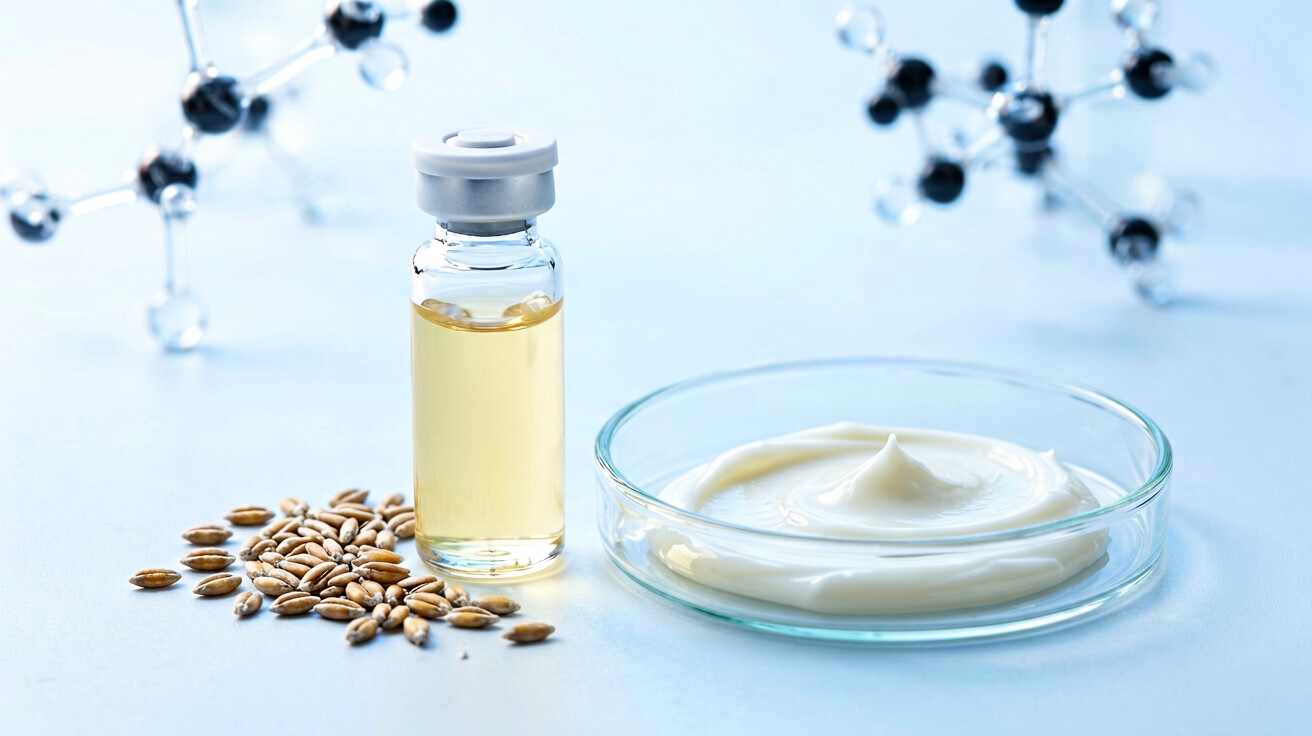
Spermidine has moved from longevity-science journals into the skincare aisle faster than almost any active this decade. A naturally occurring polyamine that the body — and, remarkably, the skin microbiome — produces on its own, spermidine is now the flagship molecule of a fast-forming category: skin longevity. This analysis unpacks what the evidence actually supports, and where the marketing outruns the data.
What Is Spermidine?
Spermidine is a polyamine — a small, positively charged organic molecule present in every living cell and abundant in wheat germ, aged cheese, mushrooms, soybeans and legumes. It first drew attention for its role in cell growth and protein synthesis, then became a fixture of geroscience when studies showed that raising spermidine levels extends lifespan in model organisms by inducing autophagy, the cell’s internal recycling system (Madeo et al., Aging, 2018; Hofer et al., Nature Aging, 2022).
That mechanism is now being applied to skin, where the accumulation of damaged proteins and stalled cell renewal is a core driver of visible ageing.
The Mechanism: Autophagy, Collagen and Antioxidant Defense
Spermidine works through several converging pathways:
- Autophagy induction — by inhibiting the acetyltransferase EP300, spermidine deacetylates autophagy-related proteins and switches on cellular recycling, clearing misfolded keratin and denatured collagen.
- Longevity signaling — it activates AMPK and SIRT1 while dampening mTOR, the nutrient-sensing network linked to cellular ageing.
- Structural protein synthesis — it upregulates the genes for type I and type III collagen (COL1A1, COL3A1), elastin (ELN) and fibrillin-1 (FBN1), the scaffolding of dermal firmness.
- Antioxidant capacity — it raises superoxide dismutase and glutathione peroxidase activity and supports glutathione synthesis.
- Anti-inflammatory action — it suppresses NF-κB signaling, lowering TNF-α and IL-6, which in turn reduces matrix metalloproteinase activity and collagen breakdown.
What the Clinical Evidence Shows
Spermidine’s human data set is smaller than that of retinoids or vitamin C, but it is real and directionally consistent.
| Outcome | Reported result | Reference |
|---|---|---|
| Facial elasticity (topical, 28 days) | +12.1% | Kim et al., Commun Biol. 2021 |
| Skin hydration | +26.7%, with TEWL reduced 11.3% | Kim et al., 2021 |
| Flaking / scaling | -18.4% | Kim et al., 2021 |
| Wound closure speed | 50% closure in 2.8 days (oral) vs 3.7 days (topical) vs 5.3 days (control) | Ito et al., Cell Commun Signal. 2021 |
| Barrier / ageing markers (60 women, 3 months) | Improved elasticity, moisture and wrinkle depth | Graz / Longevity Labs pilot, 2023 |
The 28-day topical trial remains the most-cited direct evidence: 22 women applied a spermidine-based formulation to the cheeks and saw measurable gains in elasticity, hydration and barrier function within four weeks.
The Microbiome Angle
The most distinctive finding is where some of that spermidine comes from. The 2021 trial linked higher skin elasticity to greater abundance of Streptococcus infantis, a commensal bacterium that produces more spermidine than strains typical of aged skin. The implication is elegant: external spermidine may not be compensating for a deficiency so much as restoring a function the skin’s own ecosystem used to perform. This microbiome-spermidine-aging axis is early but gives the ingredient a narrative that resonates with the 2026 consumer focus on barrier and microbial balance.
An Honest Nuance: Spermidine and Pigmentation
For brightening-focused ranges, one finding deserves a caveat. In mouse melanoma cells, spermidine increased melanin production by activating MITF and downstream tyrosinase, TRP-1 and TRP-2. That positions spermidine as a potential pigment-supporting molecule in contexts such as vitiligo — and a reason to pair it carefully, rather than blindly, with an even-tone strategy. It belongs in a longevity or barrier formula, not presented as a brightening hero.
The 2026 Industry Shift: Longevity Goes Topical
Three currents have converged to make spermidine a 2026 keyword:
- Autophagy as a consumer concept. After years of talking about “anti-ageing,” the industry now sells “cell renewal,” and spermidine is the clearest topical expression of that idea.
- The oral-topical convergence. Spermidine is simultaneously a leading oral longevity supplement and a topical active, which lets brands build a beauty-from-within story around one molecule.
- Southeast Asia’s preventive mindset. Younger consumers across the region are buying prevention earlier, and a gentler, non-irritating longevity active fits that behaviour better than aggressive retinoids.
Formulation Notes
- Dose: topical research typically spans roughly 0.1-1%; higher levels increase cost without proven incremental benefit.
- Solubility: water-soluble and hygroscopic; incorporate in the aqueous phase and protect from moisture uptake.
- pH and compatibility: stable across typical cosmetic pH; pairs well with hyaluronic acid, niacinamide, ceramides and panthenol.
- Testing: support claims with elasticity (cutometer), hydration (corneometry) and TEWL endpoints rather than vague “anti-ageing” language.
The Takeaway
Spermidine is not yet a retinoid replacement, and the honest framing is that its human evidence is promising rather than definitive. But it has the three ingredients brands look for in 2026: a real mechanistic story, credible human data, and a tolerability profile gentle enough for the region’s reactive-skin consumers. For ranges built around skin longevity and barrier resilience, it is one of the most defensible new actives on the board — provided it is positioned honestly and not oversold as a pigment solution.
References
- Kim G, Kim M, Kim M, et al. Spermidine-induced recovery of human dermal structure and barrier function by skin microbiome. Communications Biology. 2021;4(1):231.
- Ito D, Ito H, Ideta T, et al. Systemic and topical administration of spermidine accelerates skin wound healing. Cell Communication and Signaling. 2021;19(1):58.
- Hofer SJ, Simon AK, Bergmann M, et al. Mechanisms of spermidine-induced autophagy and geroprotection. Nature Aging. 2022;2(12):1112-1129.
- Madeo F, Eisenberg T, Pietrocola F, Kroemer G. Spermidine delays aging in humans. Aging (Albany NY). 2018;10(4):229-232.
- Kang H, Kim YH, et al. Spermidine-induced melanogenesis via MITF signaling in melanocytes. Journal of Investigative Dermatology (mechanistic report), 2021.
- Human pilot study of spermidine-containing skincare on skin elasticity, moisture and wrinkle depth (60 women, 3 months). Medical University of Graz / Longevity Labs, 2023.
Interested in Formulation Data Collaboration?
Let's discuss how Melasyl AI can accelerate your next whitening or brightening formula. Technical collaboration, data licensing, or custom AI-driven research — reach out.
Contact Wei →