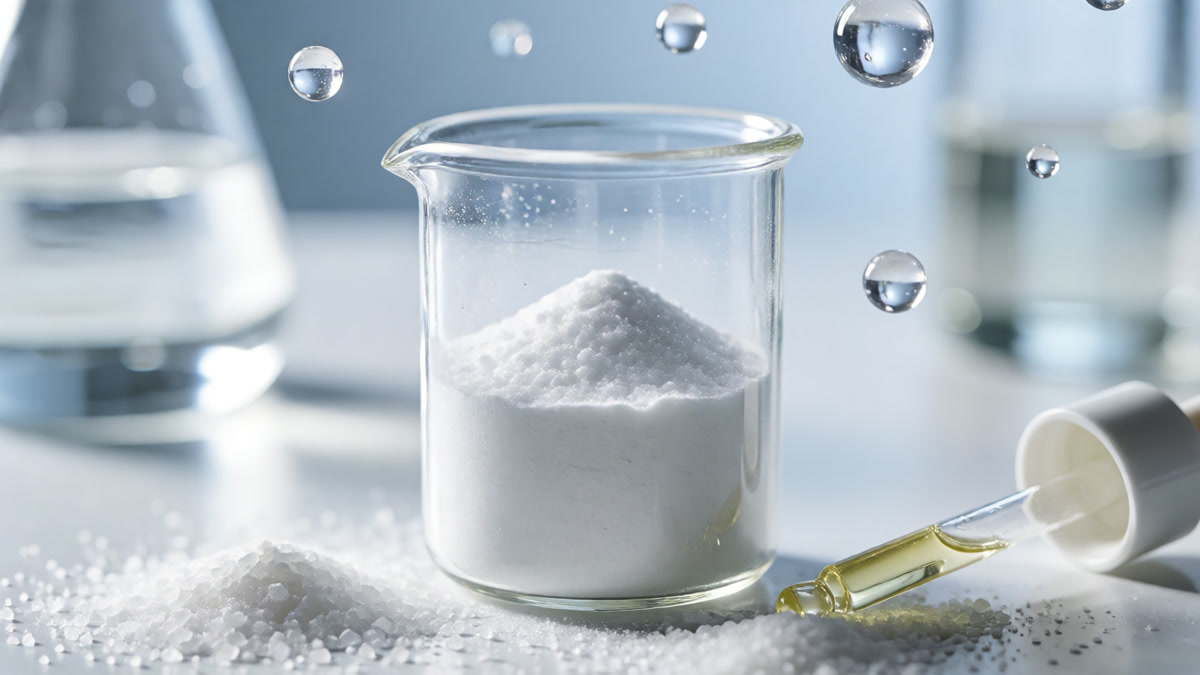
The ingredient dermatologists have been quietly stacking for decades
Ask ten formulators which keratolytic is the safest for hyperpigmented, barrier-compromised skin and most will answer before you finish asking: urea. It is not a new molecule, it is not a press-ready name, and it will rarely headline a launch deck. Yet in the two years since the “barrier-first” thesis took hold, urea has quietly become one of the most-relied-upon enablers in brightening formulation. This is an industry analysis of why, what the clinical record actually supports, and where the evidence stops.
A humectant below 10%, a keratolytic above
Urea behaves as a concentration-dependent ingredient, which is precisely why it has become so useful. Below roughly 10% it functions mainly as a humectant, drawing water into the stratum corneum and supporting the natural moisturising factor (NMF) the skin already produces. Above 10% it crosses into keratolytic territory, loosing corneocyte cohesion and accelerating the shedding of pigmented surface cells. That dual identity is rare. Most actives pick one role; urea does both, which is why it sits in both barrier formulas and brightening formulas without being redundant in either.
The clinical record, in plain numbers
The evidence base is unusual in depth for a “simple” ingredient. An evidence library aggregating eighty-plus studies, including forty-three randomised controlled trials, rates urea as moderate-confidence with a studied range of roughly 4% to 40% and a consensus optimal general concentration around 10%. That is more RCTs than most named actives in the aisle can claim.
- Hydration: corneometry studies show 20% urea formulations increasing stratum corneum water content by approximately 40-50% within the first 14 days.
- Hyperkeratosis: in localized hyperkeratotic conditions, 40% urea cream reduced measurable plaque thickness by 50-60% over three to four weeks of twice-daily use.
- Hyperpigmentation: in acanthosis nigritans, an eight-week randomised trial reported 20% urea reducing melanin levels meaningfully more than 10%, with improvements of roughly 22.5% versus 10.7%. A separate comparison of 10% urea against 10% salicylic acid found them comparable, at 12.5% versus 14.6%, a difference not statistically significant.
- Penetration: as a preparatory step, high-dose urea has been reported to increase the absorption of secondary topicals by roughly 30-40% by removing the dead-cell barrier.
Fresh data keeps arriving. A 2026 randomised study of 10% urea lotion in adults with moderate-to-severe dry skin reported clinically meaningful improvements in xerosis scores, reduced transepidermal water loss, and strengthened barrier function over four weeks, with high tolerability. That is the pattern that matters: a molecule with an old name still producing new, citable endpoints.
Why it fits the 2026 formulation thesis
The defining trend in brightening formulation is not a new melanin-inhibiting hero but subtraction and compatibility. Skin that is inflamed re-pigments; skin with a compromised barrier tolerates less active. Urea addresses the precondition rather than the target, which is why it keeps appearing as the stabilising layer in multi-active routines. It hydrates the skin while the brightening active does its work, and because its keratolytic effect is gentler than that of the stronger acids, it is the default choice where a glycolic or salicylic exfoliation would over-tolerate the very barrier the formula is trying to protect.
The pairing logic is also why urea keeps reappearing alongside retinoid and acid programs. During retinoid adaptation, a 5-10% urea moisturiser supports the barrier precisely while the retinoid temporarily weakens it, replenishing NMF components that the adaptation period depletes. The benefit is not that urea turns a retinoid into something stronger, but that it makes the retinoid tolerable long enough to compound its benefit. That is an enabler role, and it is the role the market is increasingly paying for.
The honest limits
Urea does not block melanin synthesis the way a tyrosinase inhibitor does. It is a complementary ingredient, and the evidence is concentrated in hyperkeratosis, xerosis, and specific pigmented conditions like acanthosis nigritans rather than melasma or post-inflammatory hyperpigmentation in isolation. Concentration heterogeneity across studies is the biggest evidentiary weakness, and several positive findings come from combination products where the urea contribution cannot always be isolated. The practical takeaway is consistent, though: start low for broad use, reserve the higher strengths for thick, rough, or localised areas, and introduce it gradually on sensitive skin.
What this means for the category
For the region, where hyperpigmentation is among the top consumer skin concerns and the barrier-first thesis is reshaping product logic, urea is one of the few actives that simultaneously strengthens the barrier, hydrates, and clears pigment-laden surface cells without the irritation burden of the stronger acids. It is the unglamorous answer to a very common formulation problem, and in 2026 that is exactly the kind of answer the market rewards. Expect it to move from the foot-cream aisle into brightening serums and multi-active routines faster, with the clinical record finally doing most of the marketing for it.
References: Celleno L. Topical urea in skincare: a review. Dermatologic Therapy. 2018;31:e12690. Lee Seifert C et al. Effects and patient benefits of a 10% urea-based moisturising lotion on xerosis in aging skin. Skin Pharmacol Physiol. 2026;39(1). McCormick E et al. Evaluation of a moisturising cream with 20% urea for keratosis pilaris. J Drugs Dermatol. 2024;23(1). Randomised eight-week urea vs urea pigmentation trials, J Cosmet Dermatol. 2026.
Interested in Formulation Data Collaboration?
Let's discuss how Melasyl AI can accelerate your next whitening or brightening formula. Technical collaboration, data licensing, or custom AI-driven research — reach out.
Contact Wei →