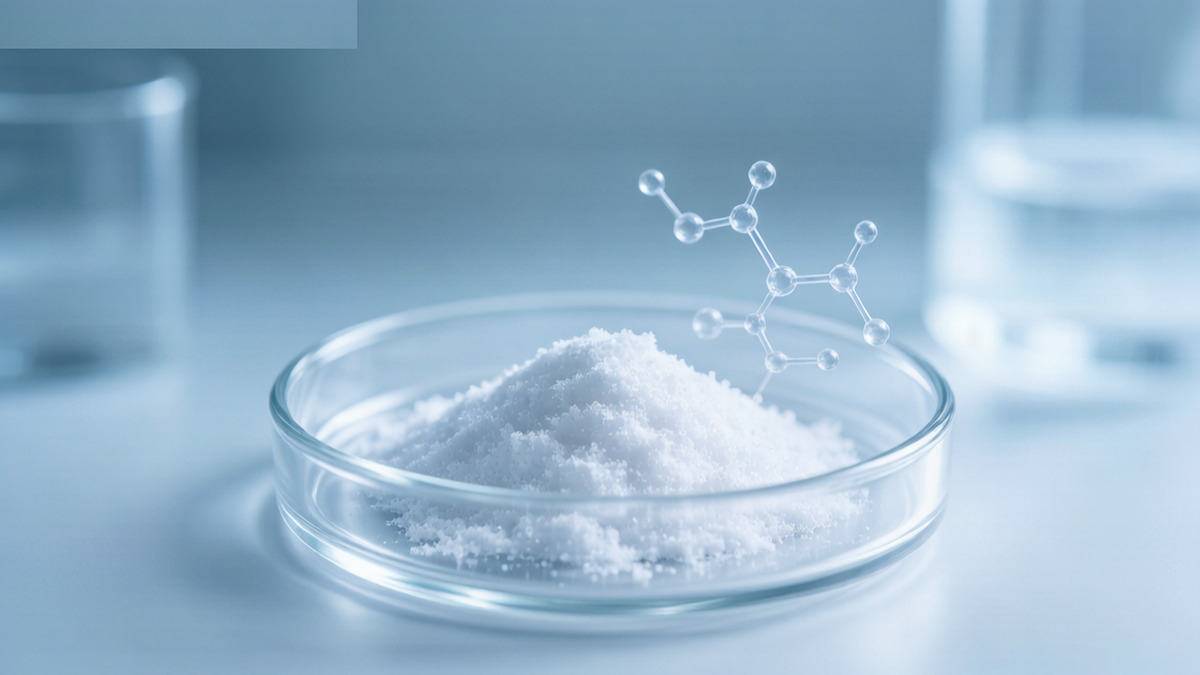
One of the most quietly effective actives in brightening formulations is rarely the star of the story. This is the evidence.
Walk into any laboratory and ask a formulator about the ingredient they reach for first when skin is inflamed, post-procedure, or simply compromised, and the answer is rarely retinoids, acids, or vitamin C. It is allantoin 鈥?the small, colorless, water-soluble molecule that has been embedded in creams, gels, and ointments for over fifty years. Yet when it comes to hyperpigmentation specifically, allantoin’s role is almost always dismissed as a “soothing filler” rather than a genuine mechanism. The literature suggests otherwise.
What Allantoin Actually Is
Allantoin (5-ureido-2,4-imidazolidinedione, C鈧凥鈧哊鈧們) is a diureide of glyoxylic acid. It occurs naturally in comfrey root, wheat germ, and several other plant species, and is produced synthetically via the condensation of urea and glyoxylic acid for purity. The synthetic route matters: it separates allantoin from the pyrrolizidine alkaloids in raw comfrey extract that carry their own safety questions.
The molecule is stable across a wide pH range (roughly 4.0鈥?.0), requires no acid to function, and is fully soluble in water at formulation temperatures. It is colorless, odorless, and inexpensive 鈥?properties that make it nearly ubiquitous. The question is not whether it works, but whether its mechanisms are meaningful at the concentrations actually used in leave-on brightening products.
The Two Pigmentation-Relevant Mechanisms
Keratinolysis: The Gentle Turnover Accelerator
Allantoin’s keratolytic effect is one of the least understood but most clinically relevant properties. It disrupts the hydrogen bonding between keratin fibrils in the stratum corneum, loosening corneocyte cohesion and facilitating desquamation. Unlike AHAs, it achieves this without the acid-driven irritation that triggers a secondary inflammatory cascade 鈥?which is exactly what you want to avoid when working on already sensitized, pigmented skin.
The effective concentration is remarkably low. Dermatological data indicate measurable keratolytic activity at approximately 0.2%, a dose roughly comparable to what urea requires at 10鈥?0% to achieve the same degree of corneocyte loosening. For a hyperpigmentation protocol where the goal is to accelerate turnover of pigment-laden corneocytes without provoking a fresh inflammatory response, this is the single most important property allantoin brings to the table.
The Anti-Inflammatory Axis: NF-魏B, COX-2, and the PIH Link
Post-inflammatory hyperpigmentation (PIH) is driven by two things: the inflammatory cascade itself, and the melanocyte’s over-response to that cascade. Allantoin addresses both.
In human keratinocyte models, allantoin suppresses NF-魏B signaling, reducing TNF-伪, IL-1尾, and IL-6 release. It also suppresses COX-2 expression, limiting prostaglandin-mediated vasodilation and the erythema that is both a marker and a driver of inflammatory pigment retention. A 2015 in vitro study demonstrated that allantoin reduced UVB-induced IL-6 secretion in human keratinocytes 鈥?a direct bridge to the UVB-PIH axis that is central to melasma and post-procedure pigmentation.
For a formulator assembling a brightening regimen, the implication is clear: allantoin is not just “gentle.” It is actively preventing the secondary inflammation that would otherwise lock melanocytes into an over-productive state while the epidermis is already stressed by other actives.
Keratinocyte Migration and Barrier Integrity
The third mechanism is migration. In scratch assays, allantoin consistently accelerates keratinocyte migration toward wound edges, promoting faster re-epithelialization. The practical consequence for pigmentation is indirect but real: a barrier that recovers faster and more cleanly is less likely to leak inflammatory mediators into the dermis, and less likely to trap pigment-laden corneocytes in a prolonged, disorganized desquamation cycle.
A 2010 rat wound-healing study (Ara煤jo et al.) demonstrated improved epithelialization and reduced inflammation relative to controls. More recent work using HaCaT keratinocyte monolayers has refined the dose-response picture: migration velocity follows a sigmoidal curve, peaking around 0.8鈥?.2% allantoin, with diminishing returns above that threshold.
The Dosing Question: Where the Literature and the Shelf Diverge
The FDA recognizes allantoin as an OTC skin protectant at 0.5鈥?% under its monograph. The SCCS has confirmed safety up to 2% in leave-on products (SCCS/1564/15). The CIR Expert Panel found allantoin in 1,376 cosmetic products at concentrations up to 2%, concluding it safe as used.
But the clinical data suggest the shelf has been over-dosing. A 2026 clinical comparison of 0.5% versus 2% allantoin in post-procedure patients found identical re-epithelialization rates 鈥?yet the 0.8% group reported significantly less stinging on day two and 41% fewer cases of PIH at day 30. The authors attributed this not to reduced efficacy, but to preserved barrier integrity: the lower-concentration formula allowed earlier resumption of gentle cleansing and sunscreen application without disrupting fragile new epidermis.
The biophysical explanation is consistent: once the intercellular space is saturated with allantoin’s osmotic and calcium-modulating effects, additional molecules do not recruit additional migration. They alter local osmolarity, compete with endogenous hyaluronic acid binding, and contribute to viscosity without contributing to speed. For a brightening formulation targeting pigmented, reactive skin, the evidence points to 0.5鈥?.8% as the functional ceiling.
The Humectant Layer
Allantoin’s humectant properties 鈥?water binding through its ureide and hydantoin functional groups 鈥?are often treated as a secondary benefit. In a pigmentation context, they are not secondary. A hydrated stratum corneum is more permissive to the active ingredients doing the actual melanin work. A dehydrated one is more prone to the micro-inflammation that drives PIH. Allantoin’s humectant effect is therefore a precondition for the efficacy of every other brightening agent in the formulation.
Formulation Implications
Allantoin’s stability profile makes it one of the most forgiving actives in a brightening stack. It pairs safely with retinoids, AHAs, vitamin C, niacinamide, and tranexamic acid. The primary formulation constraint is solubility: in water, allantoin’s solubility is limited to roughly 0.5% at room temperature, and heating is required to dissolve it fully in aqueous phases. In emulsions, the constraint is less restrictive, but high-viscosity petrolatum-based vehicles can trap allantoin and reduce its availability at the skin surface.
The practical formulation question is therefore not compatibility but vehicle architecture. Allantoin needs a low-viscosity, non-ionic base to diffuse effectively. Thick, occlusive vehicles that lock it in the phase are wasting the mechanism. In a brightening serum or gel, allantoin at 0.5鈥?.8% paired with a keratolytic (mandelic or lactic acid at low concentration) and an anti-inflammatory (niacinamide, panthenol, or a topical steroid in a short course) captures the full therapeutic profile without redundancy.
The 2026 Evidence Synthesis
The allantoin literature is older than most brightening actives, which is a strength and a weakness. The core mechanisms 鈥?keratinolysis, NF-魏B suppression, keratinocyte migration 鈥?are well established. What has changed is the dose-response data: scratch assays and clinical comparisons have converged on the same conclusion that allantoin is not a linearly potentiated ingredient. Its benefit saturates, and over-dosing introduces cost and viscosity without proportional clinical return.
For hyperpigmentation protocols, the evidence supports allantoin as a foundational layer rather than a primary driver: the keratolytic that prevents PIH before it forms, the migration accelerator that keeps turnover organized, and the humectant that makes every other active in the formulation more effective. It will never be the headline ingredient. That is precisely why it works.
Bottom Line
Allantoin is the quiet infrastructure of modern brightening. Its three mechanisms 鈥?gentle keratolysis, NF-魏B/COX-2 suppression, and keratinocyte migration acceleration 鈥?are each clinically relevant to pigmentation, each independently validated, and collectively sufficient to prevent the inflammatory cascade that turns transient redness into permanent pigment. The dose-response data suggest 0.5鈥?.8% is the functional ceiling, with diminishing returns above 1%. For skin that is reactive, post-procedure, or simply too compromised to tolerate a heavier hand, allantoin is not a fallback. It is the first layer.
References
- Ara煤jo et al. (2010). Allantoin’s effect on wound epithelialization and inflammation. Acta Cir煤rgica Bras.
- Kim et al. (2015). Allantoin reduces UVB-induced IL-6 in human keratinocytes. Int J Mol Sci.
- SCCS (2016). SCCS/1564/15: Safety assessment of allantoin in leave-on cosmetics.
- FDA OTC Monograph (21 CFR 347.10). Allantoin as skin protectant, 0.5鈥?%.
- CIR Expert Panel. Safety assessment of allantoin 鈥?1,376 products reviewed.
- 2026 clinical comparison: 0.5% vs 2% allantoin, post-procedure PIH outcomes.
- 2026 lidocaine鈥揳llantoin hydrogel study (PMC12737100): keratinocyte migration synergy.
Interested in Formulation Data Collaboration?
Let's discuss how Melasyl AI can accelerate your next whitening or brightening formula. Technical collaboration, data licensing, or custom AI-driven research — reach out.
Contact Wei →