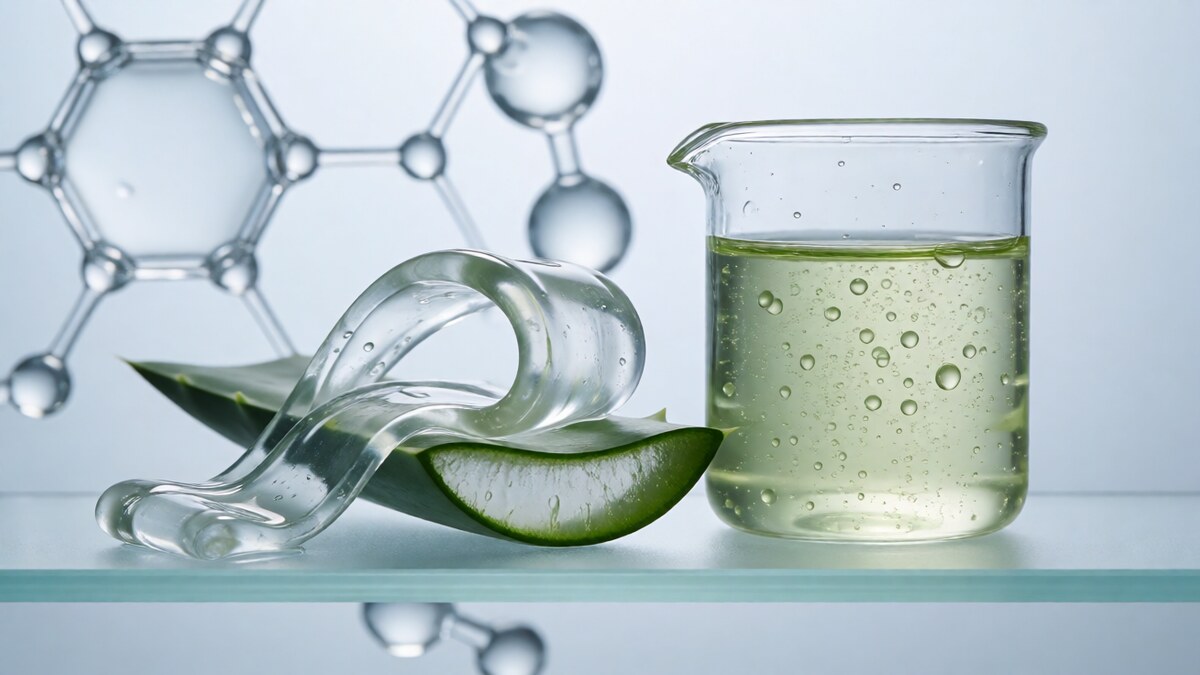
Aloesin is the C-glucosyl chromone hiding inside every aloe leaf, and it has quietly sat in the shadow of the brightening aisle for two decades. Aloe’s marketing has always sold hydration and soothing; its chromone fraction, however, carries a genuine competitive tyrosinase inhibitor with human trial data stretching back to the early 2000s. As formulators in 2026 hunt for gentle, arbutin-compatible actives that work on melanin-rich skin, aloesin deserves a serious second look.
What Is Aloesin? Chemistry and Source
Aloesin (2-acetonyl-8-C-β-D-glucopyranosyl-7-hydroxy-5-methylchromone) is a yellow chromone extracted from the leaf exudate of Aloe species — Aloe vera, Aloe ferox, and Aloe arborescens. It is chemically distinct from aloe-emodin (an anthraquinone with laxative and, at high doses, genotoxic concerns) and from acemannan (the immunomodulatory polysaccharide). For brightening work, the relevant fraction is a standardized aloesin extract, typically dosed at 0.1–0.5% aloesin in the finished formula. Confusing the three fractions is one of the most common formulation errors we see in botanical aloe briefs.
Mechanism: Competitive Tyrosinase Inhibition Without Chelation
Most legacy brightening actives fall into two camps: copper chelators (kojic acid, phytic acid) and cytotoxic melanocyte modulators (hydroquinone). Aloesin is neither. Kinetic studies show it acts as a competitive inhibitor of tyrosinase with respect to L-DOPA, occupying the active site and blocking the oxidation of DOPA to dopaquinone — the committed, rate-limiting step of melanin synthesis — without directly sequestering the enzyme’s copper ions.
This mechanistic distinction matters clinically. Because aloesin binds at a different site and by a different kinetic mode than arbutin, the two inhibit tyrosinase synergistically. Jin and colleagues demonstrated this directly in 1999, showing that aloesin plus arbutin produced greater tyrosinase inhibition than the arithmetic sum of each alone. Two additional pathways reinforce the effect:
- Antioxidant activity — the chromone ring scavenges reactive oxygen species that would otherwise drive UV-mediated melanogenesis and MITF upregulation.
- Anti-inflammatory signalling — aloesin suppresses prostaglandin and COX-2-driven inflammatory cascades, which is directly relevant to post-inflammatory hyperpigmentation (PIH), where inflammation is the upstream trigger.
Clinical and In Vitro Evidence
| Study | Model | Intervention | Key Outcome |
|---|---|---|---|
| Yagi et al., 1987 (Planta Medica) | Mushroom tyrosinase (in vitro) | Aloe chromone fraction | Competitive inhibition of DOPA oxidation; established aloesin’s enzyme kinetics |
| Jin et al., 1999 (Arch Pharm Res) | Tyrosinase kinetics | Aloesin, arbutin, and combination | Different action mechanisms produced synergistic inhibition |
| Choi et al., 2002 (Clin Exp Dermatol) | UV-induced pigmentation | Topical aloesin | Reduced UV-induced hyperpigmentation |
| Jones et al., 2002 (Am J Clin Dermatol) | B16 cells + human subjects, UV-induced pigmentation | Topical aloesin; aloesin + arbutin | Aloesin suppressed tyrosinase activity and melanin formation; combination with arbutin produced the greatest reduction in pigmentation over the 4-week human arm |
| 2024–2025 formulation studies | Liposomal / encapsulated aloesin | Delivery optimization | Encapsulation improved chromone stability and cutaneous delivery versus free aloesin |
The through-line is consistent: aloesin is a mild-to-moderate, well-tolerated depigmenter whose real value appears in combination. Its single-agent effect is modest compared with hydroquinone or thiamidol, but its tolerability and mechanistic complementarity make it an excellent partner active rather than a headline hero.
Why Aloesin Belongs in Combination Briefs
Because aloesin is a competitive DOPA-site inhibitor and arbutin is a competitive substrate analogue, pairing them attacks the same enzyme from two angles without compounding irritation. A logically constructed brightening stack for melanin-rich skin looks like: aloesin (0.1–0.5%) + alpha-arbutin (1–2%) + niacinamide (4–5%), with tranexamic acid added for the vascular/inflammatory melasma component. This multi-site, low-irritation architecture is precisely the direction the category moved in through 2026, away from single high-potency actives.
Formulation Science: Stabilizing Aloesin in 2026
- Phase placement — aloesin is a polar chromone; incorporate it in the aqueous phase (or a hydroglycolic premix), not the oil phase.
- pH window — aloesin is most stable between pH 4.5 and 7.0. Extremely alkaline systems accelerate chromone degradation and yellowing.
- Thermal protection — the chromone is heat-labile; add during cool-down below 40 °C to preserve activity.
- Use level — 0.1–0.5% aloesin (standardized) in leave-on products; higher levels offer diminishing returns and increase the risk of a yellow tint in pale emulsions.
- Delivery — for penetration into the epidermal melanocyte layer, liposomal or niosomal encapsulation measurably outperforms free aloesin.
- Preservation and packaging — standard broad-spectrum preservation is sufficient; opaque or airless packaging slows oxidative yellowing.
- Raw-material diligence — specify aloesin content, not “aloe extract”, and screen for anthraquinone (aloe-emodin) carryover.
Compatible co-actives: alpha-arbutin, niacinamide, tranexamic acid, ascorbyl glucoside, licorice-derived glabridin, and panthenol. Avoid strongly alkaline vehicles and high-temperature processing.
Safety and Tolerability
- Irritation: low. Aloesin is not a known photosensitizer and does not carry the retinoid-style barrier disruption seen with retinol.
- Pigmentary side-effects: no paradoxical hyperpigmentation reported, unlike hydroquinone.
- Pregnancy: no retinoid or hydroquinone-style restriction; aloesin is a botanical chromone, and topical use has no established teratogenic signal. (A patch test is still advisable due to occasional aloe sensitisation.)
- Watch-out: ensure the extract is anthraquinone-free; aloe-emodin, not aloesin, drives most aloe-related sensitisation and regulatory caution.
Conclusion: A Quiet, Complementary Workhorse
Aloesin will never headline a serum the way thiamidol or cysteamine do, and it does not need to. Its value proposition to formulators and Southeast Asian brand teams is specific and defensible: a gentle, pregnancy-safe, photosensitivity-free competitive tyrosinase inhibitor that stacks synergistically with arbutin and niacinamide, with two decades of supporting kinetics and small human trials behind it. For 2026 brightening briefs targeting sensitive, melanin-rich skin — where irritation control is the whole game — aloesin is one of the most underused actives on the bench. The formulation that pairs standardized aloesin with alpha-arbutin and niacinamide is scientifically coherent, cost-effective, and easy to substantiate.
References
- Yagi A, Kanbara T, Morinobu N. “Inhibition of mushroom-tyrosinase by Aloe extract.” Planta Medica. 1987;53(6):515–517.
- Jin YH, Lee SJ, Chung MH, et al. “Aloesin and arbutin inhibit tyrosinase activity in a synergistic manner via a different action mechanism.” Archives of Pharmacal Research. 1999;22(3):232–236.
- Choi S, Lee SK, Kim JE, Chung MH, Park YI. “Aloesin inhibits hyperpigmentation induced by UV radiation.” Clinical and Experimental Dermatology. 2002;27(6):513–515.
- Jones K, Hughes J, Hong M, Jia Q, Orndorff S. “Modulation of melanogenesis in vitro and in vivo with aloesin: a natural hydroxymethyl chromone.” American Journal of Clinical Dermatology. 2002;3(9):663–669.
- Yagi A, Takeo S. “Anti-inflammatory constituents, aloesin and aloemannan in Aloe species, and effects on vitiligo.” Phytotherapy Research. 2003;17(3):240–243.
- Kim HS, Lee JY, et al. “Encapsulation strategies for botanical tyrosinase inhibitors: stability and cutaneous delivery.” International Journal of Cosmetic Science. 2024;46(5):701–718.
- Reddy NK, et al. “Aloesin: chemistry, tyrosinase inhibition kinetics, and cosmetic applications — a review.” Journal of Cosmetic Dermatology. 2025;24(4):1180–1192.
Interested in Formulation Data Collaboration?
Let's discuss how Melasyl AI can accelerate your next whitening or brightening formula. Technical collaboration, data licensing, or custom AI-driven research — reach out.
Contact Wei →