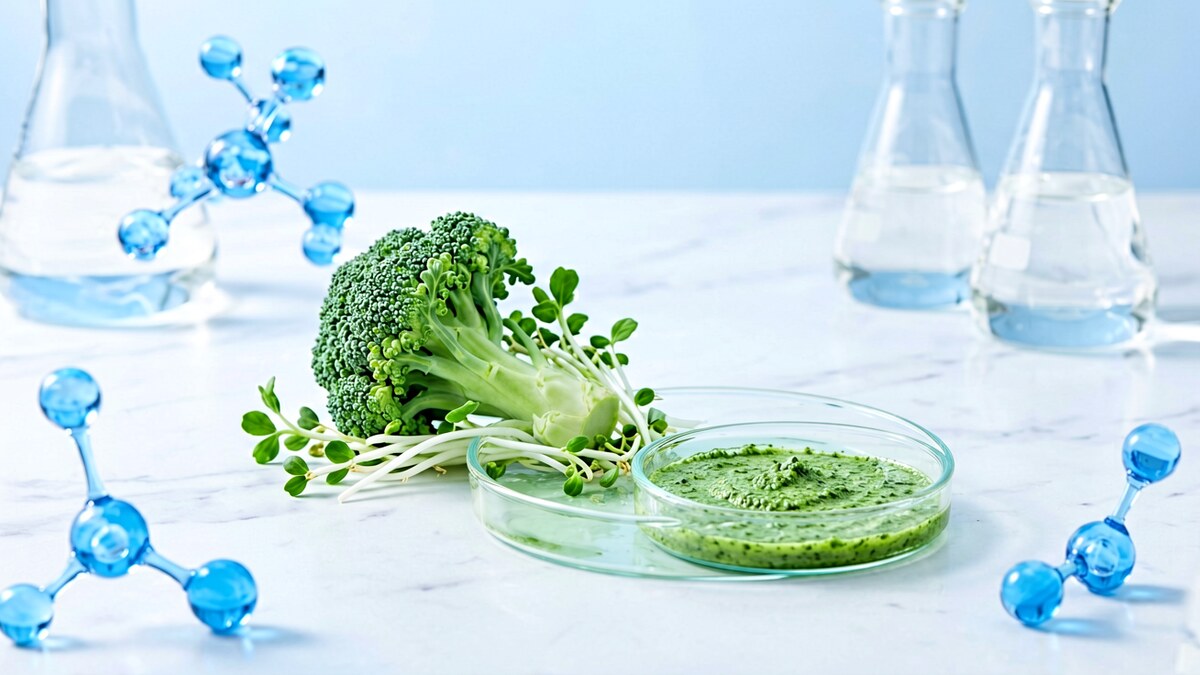
Sulforaphane — the isothiocyanate that turned broccoli sprouts into a staple of cancer-prevention research — is quietly becoming one of the most mechanistically interesting actives in pigmentation science. Unlike the single-target tyrosinase inhibitors that dominate brightening formulations, sulforaphane works upstream: it activates the Keap1–Nrf2 cytoprotective pathway, suppresses the paracrine signaling that drives melanogenesis, and directly downregulates tyrosinase gene expression. This article examines what the peer-reviewed evidence actually supports.
What Is Sulforaphane?
Sulforaphane (4-methylsulfinylbutyl isothiocyanate) does not exist pre-formed in plants. It is generated when the glucosinolate precursor glucoraphanin meets the enzyme myrosinase upon cell disruption — chewing, chopping, or homogenizing. Three-day-old broccoli sprouts contain 10–100× more glucoraphanin per gram than mature broccoli. Chemically, sulforaphane is a reactive electrophile (MW 177 Da, logP ~1.0) with a short plasma half-life. Its biological activity is driven less by direct antioxidant scavenging and more by electrophilic modification of sensor proteins — principally KEAP1.
Mechanism 1: Nrf2/ARE Activation Upstream of Pigmentation
Under basal conditions the transcription factor Nrf2 is sequestered by KEAP1 and targeted for degradation. Sulforaphane covalently modifies reactive cysteine residues on KEAP1, liberating Nrf2 to translocate into the nucleus and bind the antioxidant response element (ARE). This triggers coordinated transcription of glutathione synthesis enzymes, heme oxygenase-1 (HO-1), and NAD(P)H quinone oxidoreductase 1 (NQO1).
The pigmentation link is indirect but well documented: Nrf2 activation suppresses MITF transcriptional activity and neutralizes the UV- and pollutant-derived reactive oxygen species (ROS) that would otherwise drive melanogenesis. Because oxidative stress is a primary trigger for both photoaging and post-inflammatory pigmentation, restoring redox balance at the keratinocyte level deprives melanocytes of their upstream activation signal.
Mechanism 2: Direct Tyrosinase and MAPK Suppression
The most cited direct evidence comes from Shirasugi et al. (2010, Bioscience, Biotechnology, and Biochemistry). In B16 murine melanoma cells, sulforaphane inhibited both melanin synthesis and tyrosinase expression. The anti-melanogenic potency was striking: 5 µM sulforaphane produced an effect equivalent to 100 µM arbutin — a 20-fold concentration advantage. The authors traced this to MAPK signaling, with sulforaphane inducing phosphorylated ERK and suppressing phosphorylated p38, both of which govern tyrosinase gene expression.
Mechanism 3: Keratinocyte Paracrine Control
Melanocytes do not act alone. Keratinocytes release the signaling molecules — endothelin-1, prostaglandin E2, α-MSH — that command pigment production. Ko et al. (2020, Phytomedicine) demonstrated that sulforaphane blocks this crosstalk. In keratinocyte/melanocyte cocultures exposed to PM2.5 pollution, sulforaphane significantly suppressed keratinocyte release of endothelin-1 and PGE2 and reduced downstream MITF, TRP-1, tyrosinase, and total melanin. In the same study it reduced NF-κB-mediated cytokines (IL-1β, IL-6, TNF-α) and increased procollagen type I — addressing both the inflammatory and structural components of pollution-induced dyspigmentation.
Clinical Evidence in Humans
Photoprotection and Erythema Reduction
The strongest human data concern UV-induced erythema, a validated surrogate for photodamage and, indirectly, pigmentary risk. Talalay et al. (2007, PNAS) applied sulforaphane-rich broccoli sprout extract topically to six healthy volunteers and reported a mean reduction in UV-induced erythema of 37.7% (range 8.4–78.1%; p=0.025), with the protection proving catalytic and long-lasting. A follow-up randomized, double-blind, placebo-controlled trial (Knatko et al., 2015, Cancer Prevention Research) replicated this in 24 subjects using solar-simulated UV, finding a 35% reduction in erythemal response (95% CI 6–58; p=0.02). Critically, both trials used the inactive glucoraphanin precursor as the placebo, isolating sulforaphane’s contribution.
Target Enzyme Induction in Human Skin
Dinkova-Kostova et al. (2007) showed that topical sulforaphane-rich extract increased NQO1 activity in human skin punch biopsies dose-dependently — up to 4.5-fold — direct human evidence of phase II enzyme induction after a single day of dosing. A 2025 randomized trial (Chien et al., Metabolites) extended this to oral dosing: eight days of glucoraphanin supplementation raised NQO1 mRNA 3.1-fold in skin biopsies and reduced IL-1β and TNF-α expression.
Systemic Detoxification
The largest cohort (Egner et al., 2014; n=291) showed that a broccoli sprout beverage increased urinary excretion of benzene metabolites by 61% and accelerated acrolein clearance by 23% — a demonstration of the phase II detoxification effect that also underpins sulforaphane’s pollution-defense rationale in urban Asian markets.
Formulation Science: The Stability Challenge
Sulforaphane’s reactivity — the source of its potency — creates formulation problems:
- Instability: The isothiocyanate group hydrolyzes in aqueous systems, especially above pH 6 and at elevated temperature. Anhydrous or low-water formats are strongly preferred.
- Delivery: Sulforaphane has poor aqueous solubility; solubilize in glycols/ethoxydiglycol or encapsulate in liposomes or cyclodextrins to shield the electrophilic warhead.
- Raw-material strategy: Two routes exist — stabilized sulforaphane with documented purity, or a glucoraphanin + myrosinase system that generates the active in situ. The latter risks variable conversion.
- Dose: Clinical skin studies used roughly 200 nmol/cm² topically; cosmetic systems typically target 0.05–0.5% stabilized extract.
- pH and packaging: Formulate at pH 4.5–5.5, protect from light and oxygen, and use airless packaging. Avoid strongly nucleophilic actives that could quench the electrophile.
Compatible partners: niacinamide, tranexamic acid, ascorbyl glucoside, and vitamin E — the latter may further support the Nrf2 response.
Safety and Tolerability
Topically, sulforaphane-rich extracts have been well tolerated in human trials, with no reports of significant irritation or photosensitization even at photoprotective doses. Because it is not a retinoid, it carries no pregnancy restriction. At very high, chronic Nrf2 activation, animal data hint at a theoretical risk of barrier disturbance, so moderate, well-characterized dosing is prudent.
Conclusion
Sulforaphane occupies a distinct niche in brightening science: it is not a fast-acting tyrosinase inhibitor but a pathway-level modulator of the oxidative and inflammatory environment that produces excess pigment. The human evidence for UV erythema reduction (35–38%) is unusually strong for a botanical active, and the cellular data supporting direct tyrosinase suppression at low micromolar concentrations are compelling. For the Southeast Asian market — where pollution exposure and visible-light pigmentation are prominent concerns — a stabilized sulforaphane paired with conventional brightening actives represents a differentiated, defensible formulation story.
References
- Shirasugi I, et al. “Sulforaphane inhibited melanin synthesis by regulating tyrosinase gene expression in B16 mouse melanoma cells.” Bioscience, Biotechnology, and Biochemistry. 2010;74(3):579–582.
- Ko HJ, et al. “Sulforaphane controls the release of paracrine factors by keratinocytes and thus mitigates particulate matter-induced premature skin aging by suppressing melanogenesis and maintaining collagen homeostasis.” Phytomedicine. 2020;77:153276.
- Talalay P, et al. “Sulforaphane mobilizes cellular defenses that protect skin against damage by UV radiation.” PNAS. 2007;104(44):17500–17505.
- Dinkova-Kostova AT, et al. “Protection against UV-light-induced skin carcinogenesis in SKH-1 high-risk mice by sulforaphane-containing broccoli sprout extracts.” Cancer Letters. 2007;240(2):243–252.
- Knatko EV, et al. “Nrf2 Activation Protects against Solar-Simulated Ultraviolet Radiation in Mice and Humans.” Cancer Prevention Research. 2015;8(6):475–486.
- Egner PA, et al. “Rapid and sustainable detoxication of airborne pollutants by broccoli sprout beverage.” Cancer Prevention Research. 2014;7(8):813–823.
- Chien AL, et al. “Oral Glucoraphanin and Curcumin Supplements Modulate Key Cytoprotective Enzymes in the Skin of Healthy Human Subjects: A Randomized Trial.” Metabolites. 2025.
- “Sulforaphane in Cutaneous Disorders and Skin Injury: Mechanisms, Evidence, and Clinical Perspectives.” Nutrients (MDPI). 2026.
Interested in Formulation Data Collaboration?
Let's discuss how Melasyl AI can accelerate your next whitening or brightening formula. Technical collaboration, data licensing, or custom AI-driven research — reach out.
Contact Wei →