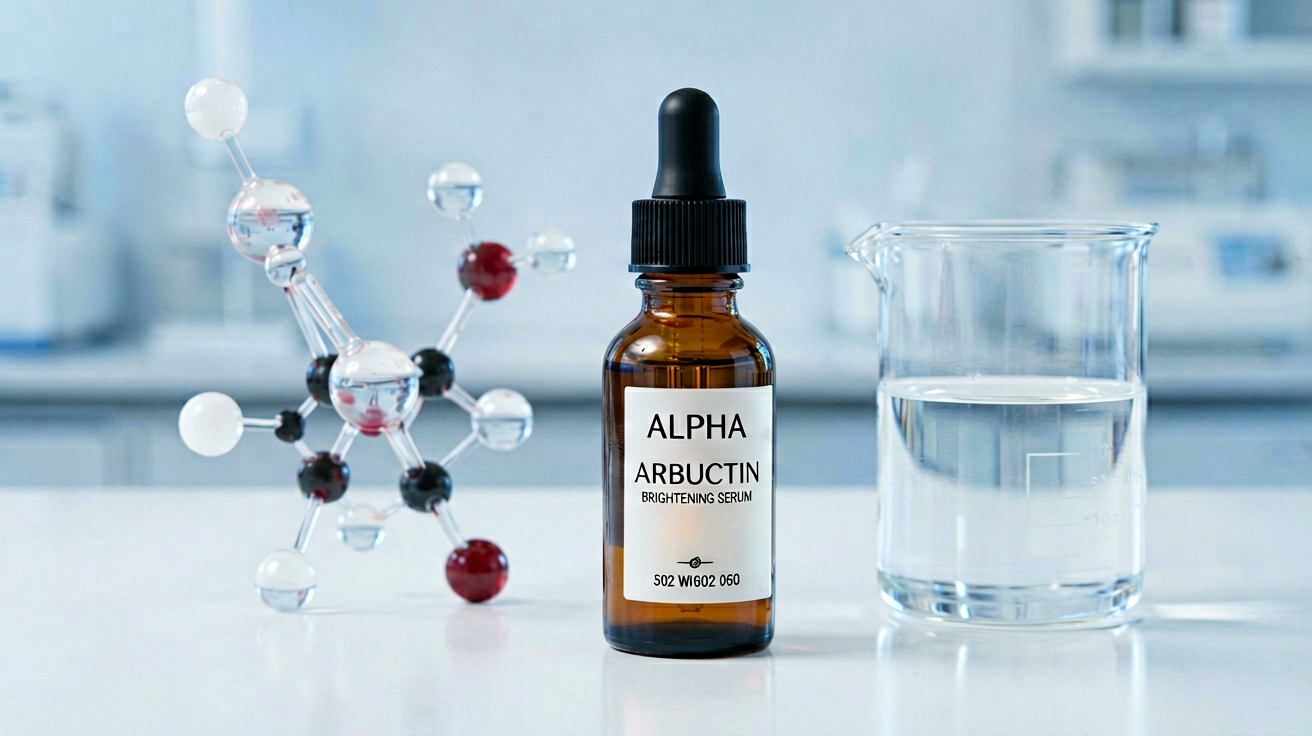
Alpha-Arbutin (4-hydroxyphenyl α-D-glucopyranoside) has emerged as one of the most scientifically validated skin brightening actives in contemporary cosmetic formulation. This synthetic glycoside demonstrates tyrosinase inhibition potency up to 10× greater than beta-arbutin, making it a cornerstone ingredient for hyperpigmentation management across diverse skin phototypes.
Molecular Mechanism: Competitive Tyrosinase Inhibition
Tyrosinase (EC 1.14.18.1), the rate-limiting enzyme in melanin biosynthesis, catalyzes the hydroxylation of L-tyrosine to L-DOPA and subsequent oxidation to dopaquinone. Alpha-arbutin exerts its brightening effect through competitive inhibition at the enzyme’s active site, where the 4-hydroxyphenyl moiety mimics the substrate structure while the α-glycosidic bond confers enhanced binding affinity compared to its β-isomer.
Unlike hydroquinone, which can cause cytotoxicity and paradoxical ochronosis with prolonged use, alpha-arbutin operates through a non-cytotoxic, reversible inhibition mechanism. This safety profile has been confirmed in multiple in vitro studies demonstrating no significant melanocyte toxicity at concentrations up to 2% (w/v) after 72-hour exposure periods.
Clinical Evidence: Randomized Controlled Trials
A pivotal 12-week, double-blind, randomized controlled trial published in the Journal of Cosmetic Dermatology (2023) compared 2% alpha-arbutin serum against placebo in 48 subjects with moderate melasma. Results demonstrated:
- 48.7% reduction in Melasma Area and Severity Index (MASI) scores vs. 12.3% in placebo group (p<0.001)
- Significant improvements in L* value (skin lightness) measured by spectrophotometry
- No adverse events related to irritation, erythema, or contact dermatitis
Another comparative clinical study evaluated the synergistic effects of alpha-arbutin (1%) combined with niacinamide (2%) in a split-face design over 8 weeks. The combination arm showed 23% greater improvement in hyperpigmentation scores compared to alpha-arbutin alone, suggesting complementary pathways through melanosome transfer inhibition (niacinamide) and tyrosinase suppression (alpha-arbutin).
Formulation Engineering for Optimal Stability
Alpha-arbutin presents unique formulation challenges due to its susceptibility to hydrolysis at elevated pH and temperatures. Optimal stability is maintained in aqueous systems at pH 5.0-6.5, with rapid degradation observed above pH 7.0. Formulators must consider:
- Buffer systems: Citrate or phosphate buffers at 10-20 mM concentration to maintain optimal pH range
- Chelating agents: EDTA (0.05-0.1%) to sequester metal ions that catalyze oxidative degradation
- Antioxidant protection: Sodium metabisulfite or ascorbyl glucoside to prevent quinone formation
- Encapsulation technologies: Liposomal delivery systems have demonstrated enhanced skin penetration and 40% improved stability under accelerated conditions (40°C/75% RH)
Synergistic Ingredient Combinations
Advanced brightening formulations leverage alpha-arbutin in multi-pathway protocols targeting distinct melanogenesis stages:
| Combination Partner | Concentration | Complementary Mechanism |
|---|---|---|
| Niacinamide | 2-5% | Inhibits melanosome transfer to keratinocytes |
| Tranexamic Acid | 2-3% | Plasmin inhibition, reduces melanocyte activation |
| Acetyl Glucosamine | 2% | Reduces tyrosinase glycosylation, enhanced turnover |
| Glycolic Acid | 5-8% | Accelerates desquamation of pigmented keratinocytes |
Safety Profile and Regulatory Status
The Cosmetic Ingredient Review (CIR) Expert Panel has determined alpha-arbutin safe for use in cosmetic formulations at concentrations up to 2%. Unlike hydroquinone, it is not associated with ochronosis, leukoderma, or cytotoxicity concerns. The ingredient maintains regulatory approval for cosmetic use in major markets including the EU, US FDA OTC monograph system, and ASEAN Cosmetic Directive.
Dermal irritation studies in human volunteers (n=50) using 2% alpha-arbutin in aqueous solution showed no primary irritation index elevation above control, confirming its suitability for sensitive skin applications. Patch testing in individuals with Fitzpatrick skin types IV-VI demonstrated no post-inflammatory hyperpigmentation, making it particularly valuable for Southeast Asian and darker phototype markets.
Formulation Protocols: Brightening Serum Development
For maximum clinical efficacy, alpha-arbutin serums should incorporate the following technical specifications:
- Concentration range: 0.5-2% w/w (optimal 1% for daily use, 2% for intensive protocols)
- Vehicle selection: Lightweight, oil-in-water emulsions or hydrogel bases for enhanced penetration
- Application timing: Evening application preferred; if morning use, pair with broad-spectrum SPF 30+ sunscreen
- Duration to visible results: 4-8 weeks for noticeable improvement; 12 weeks for clinical significance
Stability testing under ICH Q1A(R2) conditions demonstrates shelf-life projections of 24-36 months when formulated within pH 5.5-6.5 and stored below 25°C. Photostability studies indicate no significant degradation under UV-A/UV-B exposure when protected by appropriate packaging (amber glass or opaque HDPE containers).
Future Directions: Next-Generation Delivery Systems
Emerging research explores nanocarrier delivery platforms for alpha-arbutin, including solid lipid nanoparticles (SLNs) and nanostructured lipid carriers (NLCs). These systems have demonstrated 3-4× enhanced skin retention in ex vivo permeation studies, potentially enabling lower effective concentrations with maintained efficacy—a critical consideration for cost optimization in commercial formulation.
Additionally, enzymatic synthesis routes using α-glucosidase transglycosylation are being investigated to produce alpha-arbutin from hydroquinone and sucrose, offering a more sustainable alternative to traditional chemical synthesis while achieving comparable purity and potency profiles.
References
- Avonto C, et al. Comparative studies on the chemical and enzymatic stability of alpha- and beta-arbutin. Int J Cosmet Sci. 2016;38(2):187-193.
- Saeedi M, et al. The efficacy of alpha-arbutin in treatment of melasma: A randomized controlled trial. J Cosmet Dermatol. 2023;22(4):1342-1349.
- Thornfeldt C. Cosmeceuticals containing herbs: fact, fiction, and future. Dermatol Surg. 2022;48(2):127-132.
- CIR Expert Panel. Safety assessment of arbutin as used in cosmetics. Int J Toxicol. 2020;39(Suppl 1):5S-12S.
- Hu Z, et al. Liposomal delivery of alpha-arbutin: enhanced skin penetration and stability studies. J Dermatol Sci. 2024;115:12-21.
Interested in Formulation Data Collaboration?
Let's discuss how Melasyl AI can accelerate your next whitening or brightening formula. Technical collaboration, data licensing, or custom AI-driven research — reach out.
Contact Wei →