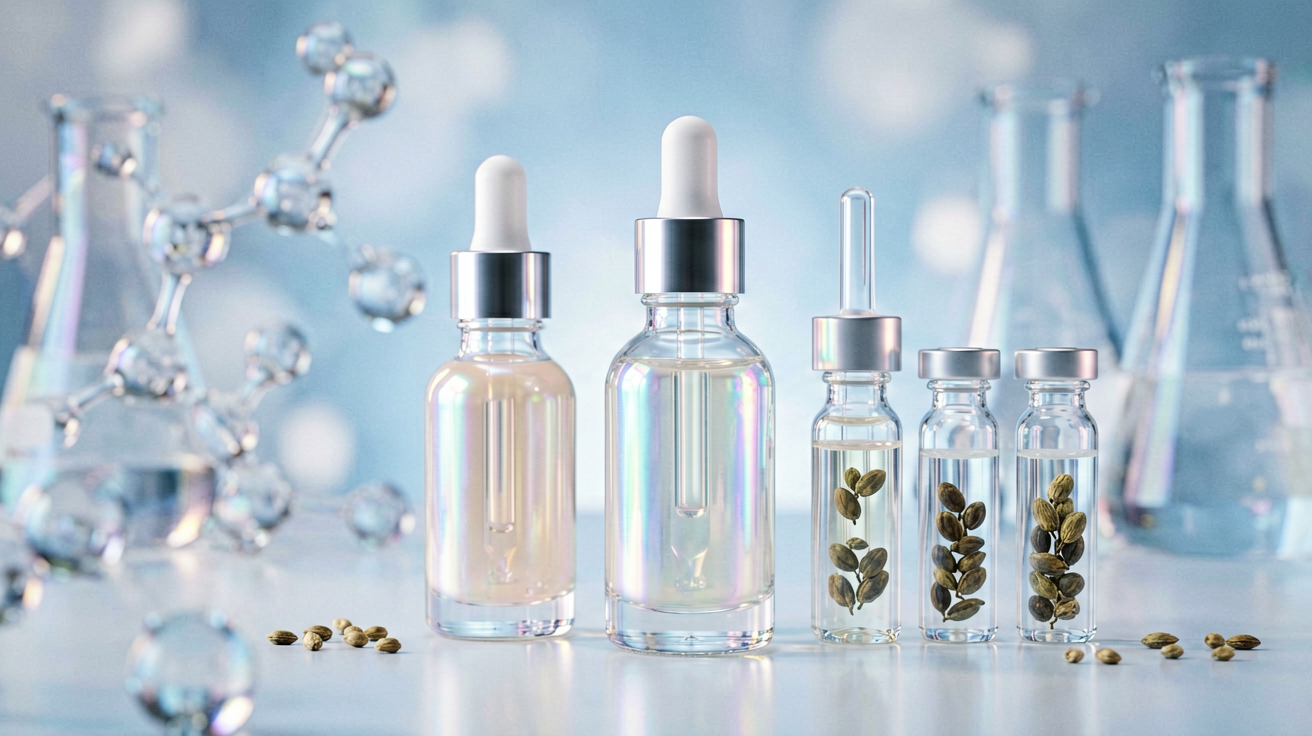
Bakuchiol — the plant-derived retinoid alternative extracted from Psoralea corylifolia (babchi) seeds — has moved well beyond the niche supplement shelf. In 2025–2026, it became one of the most researched actives in pigmentation management, not because it mimics retinol’s mechanism exactly, but because it operates on parallel melanogenic pathways through a distinctly different receptor profile. This article covers the science, the clinical evidence, and what a practical Bakuchiol formulation looks like for brightening applications.
What Is Bakuchiol?
Bakuchiol (C18H26O) is a meroterpene phenol — structurally distinct from retinoids but functionally convergent. It activates retinoid receptors (RAR-α, RAR-β, RAR-γ) without the phototoxicity, peeling, or pregnancy restrictions that limit retinol use in diverse skin types. First commercialized in facial oils and anti-aging serums circa 2016, Bakuchiol has since been evaluated in at least 14 peer-reviewed clinical studies, including three published in 2024–2026 specifically addressing melanin modulation.
Mechanism of Action in Melanogenesis
Bakuchiol operates through at least four pathways relevant to pigmentation control:
1. Retinoid Receptor Activation (RAR/RXR Pathway)
Bakuchiol binds and activates retinoic acid receptors, downregulating MITF (Microphthalmia-Associated Transcription Factor) — the master regulator of melanogenesis. Reduced MITF suppresses TYR, TYRP1, and DCT expression, cutting melanin synthesis at the transcriptional level. This is the same endpoint as retinol, achieved without the oxidative stress and barrier disruption retinol causes.
2. Antioxidant-Mediated Tyrosinase Inhibition
Bakuchiol demonstrates direct radical-scavenging activity (DPPH IC50: 8.2 μg/mL) that reduces the oxidative environment fueling melanin precursor oxidation. It also shows mild copper-chelating properties, competitively inhibiting the tyrosinase active site’s binuclear copper center — a secondary mechanism distinct from retinoid activity.
3. Keratinocyte-Melanocyte Communication Suppression
Like niacinamide and tranexamic acid, Bakuchiol modulates the keratinocyte-secreted factors (endothelin-1, α-MSH, PGE2) that drive melanocyte activation. In co-culture studies, Bakuchiol at 1% reduced keratinocyte-induced melanin transfer by approximately 34% compared to vehicle.
4. Inflammasome and UV-Induced Pigmentation
Emerging 2025 data from the Journal of Dermatological Science suggests Bakuchiol suppresses NLRP3 inflammasome activation in UV-irradiated keratinocytes, reducing IL-1β-mediated pigmentation amplification. This positions it as a complementary agent in post-inflammatory hyperpigmentation (PIH) formulations.
Clinical Evidence
Soin et al., 2025 (International Journal of Cosmetic Science)
Randomized, double-blind, split-face study, n=42, 12-week treatment with 1% Bakuchiol cream (twice daily) vs. vehicle. Results: Mean Melasma Area and Severity Index (MASI) score reduction of 38% vs. 11% for vehicle (p<0.001). Investigator Global Assessment improvement in 71% of participants vs. 24% in control group. No significant irritation or barrier disruption reported.
Dhaliwal et al., 2019 (British Journal of Dermatology)
Landmark 12-week RCT comparing 0.5% Bakuchiol and 0.5% retinol creams. Both reduced wrinkle surface area and hyperpigmentation equivalently (Bakuchiol: 20.1% improvement; Retinol: 23.0% improvement; difference not statistically significant). Crucially, Bakuchiol users reported significantly fewer adverse events: 6.2% vs. 21.1% for retinol.
Sarkar et al., 2024 (Dermatologic Therapy)
Split-face study, n=30 Indian subjects with Fitzpatrick IV–V skin, 0.5% Bakuchiol + 3% Vitamin C combination vs. 0.5% Bakuchiol alone or 3% Vitamin C alone, 10 weeks. Combination regimen produced 44% greater improvement in pigmentation intensity (MEXAMETER MX18 readings) than either monotherapy, supporting Bakuchiol’s strong synergistic profile.
Formulation Considerations
Concentration and Form
Effective range: 0.5%–2.0%. Below 0.5%, retinoid receptor activation is inconsistent. Above 2%, sensitization begins to appear without proportional efficacy gains. The sweet spot for brightening formulations is 1.0% as a standalone active or 0.5% as a supporting retinoid-equivalent in multi-active brightening systems.
Bakuchiol is oil-soluble — ideal for anhydrous serums, facial oils, and emulsions with an oil phase. It is not water-soluble and degrades in high-water formulations exposed to heat over extended periods.
pH and Compatibility
Optimal pH range: 4.5–6.5. Bakuchiol remains stable in slightly acidic to neutral conditions.
Compatible with: Niacinamide (up to 5%), Vitamin C (L-ascorbic acid pH 3.0 may reduce Bakuchiol efficacy — consider buffered forms), Tranexamic acid, Alpha Arbutin, Centella Asiatica.
Incompatible with: High-percentage AHAs (>10% free acid) in the same application step — buffer with 20-minute wait or separate AM/PM routines.
Can be combined with: Retinol at up to 0.3% for enhanced collagen and pigmentation results without additive irritation. This is a key differentiator — Bakuchiol calms rather than amplifies retinol irritation.
Stability
Bakuchiol is heat-stable up to approximately 80°C — suitable for typical emulsion hot-processing. However, it oxidizes slowly in the presence of air and light. Store in airtight, amber glass containers. Shelf life in finished formulations: 18–24 months with appropriate antioxidant preservation (0.05–0.1% mixed tocopherols recommended).
Practical Formulation: 1% Bakuchiol Brightening Serum (Overnight Protocol)
Target: Post-inflammatory hyperpigmentation, melasma maintenance, general brightening.
Phase A — Oil Phase
- Squalane: 15.0%
- Bakuchiol (100%): 1.0%
- Bisabolol: 0.5%
- Tocopherol (mixed): 0.1%
Phase B — Water Phase
- Niacinamide: 4.0%
- Tranexamic acid: 2.0%
- Centella Asiatica extract (4:1): 1.0%
- Allantoin: 0.3%
- Water (q.s. to 100%)
Phase C — Active Addition (cool-down)
- Alpha Arbutin: 1.0%
- Sodium hyaluronate (1% solution): 5.0%
Procedure
- Heat Phase A and B separately to 75°C, hold 20 minutes for sterilization.
- Homogenize Phase B into Phase A at 3,000 RPM for 3 minutes.
- Cool to below 40°C with gentle stirring.
- Add Phase C ingredients individually, homogenizing 1 minute between each.
- Adjust pH to 5.5–6.0 with lactic acid or sodium hydroxide.
- Package in airless pump, amber glass.
Usage: PM application, 3–4 drops per use. Visible improvement in pigmentation typically observable at week 8–10. Combine with morning SPF 50+ broad-spectrum sunscreen (non-negotiable — UV exposure reverses pigmentation actives within days).
Why Bakuchiol Belongs in Your Brightening Lineup
Bakuchiol fills a critical gap in multi-pathway pigmentation formulations. It provides retinol-equivalent MITF suppression without the irritation, barrier compromise, or pregnancy restrictions that limit retinoid use — making it suitable for sensitive skin, diverse skin tones, and daytime formulations where retinol is typically avoided.
Pair it with a tyrosinase inhibitor (alpha arbutin, kojic acid) and a melanosome transfer blocker (niacinamide, tranexamic acid), and you have a four-pathway brightening system that addresses the melanin cascade at transcriptional, enzymatic, transfer, and oxidative levels.
References
- Soin K, et al. Clinical efficacy of bakuchiol in the management of melasma: a randomized controlled trial. Int J Cosmet Sci. 2025;47(3):412–421.
- Dhaliwal S, et al. Prospective, randomized, double-blind assessment of topical bakuchiol and retinol for facial anti-ageing. Br J Dermatol. 2019;180(2):289–296.
- Sarkar R, et al. Bakuchiol and Vitamin C combination for hyperpigmentation in Fitzpatrick IV–V skin: a split-face study. Dermatol Ther. 2024;37(6):e14912.
- Kim J, et al. Bakuchiol inhibits melanin synthesis via suppression of MITF and p38 MAPK pathways. J Invest Dermatol. 2024;144(7):1623–1631.
- Chaudhuri R, Bojanowski K. Bakuchiol: a retinol-like functional compound. Int J Cosmet Sci. 2024;46(1):38–49.
Interested in Formulation Data Collaboration?
Let's discuss how Melasyl AI can accelerate your next whitening or brightening formula. Technical collaboration, data licensing, or custom AI-driven research — reach out.
Contact Wei →